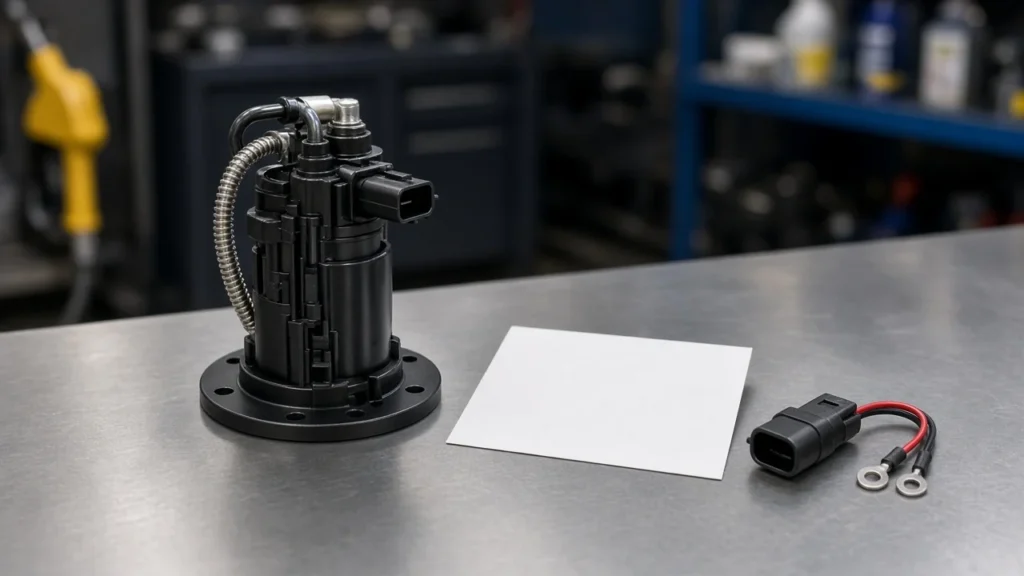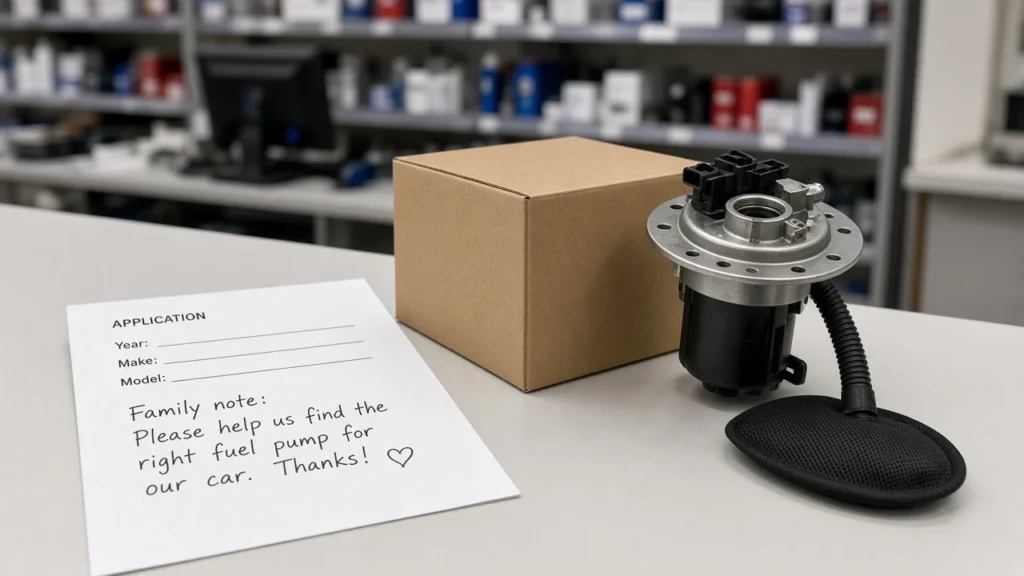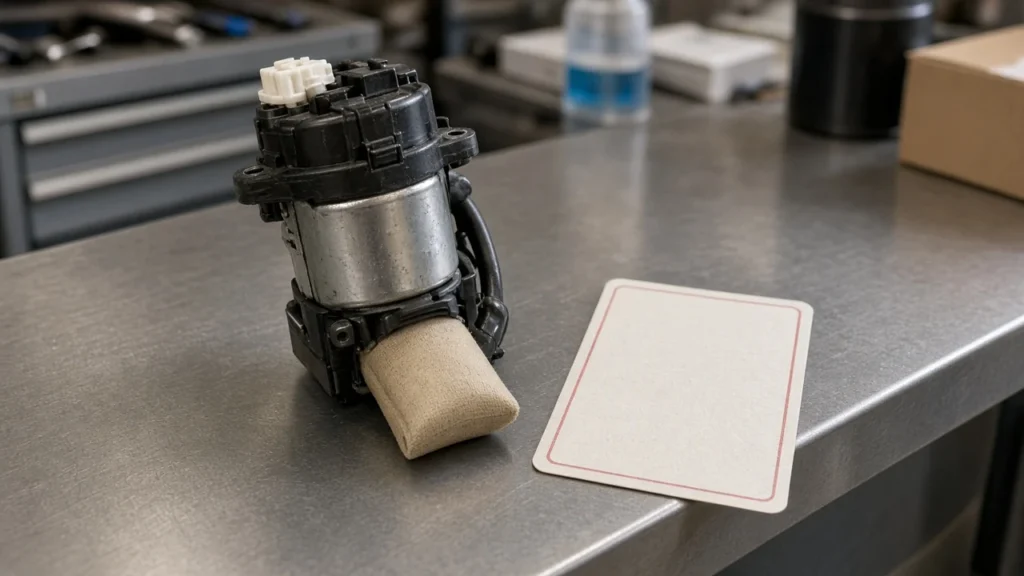
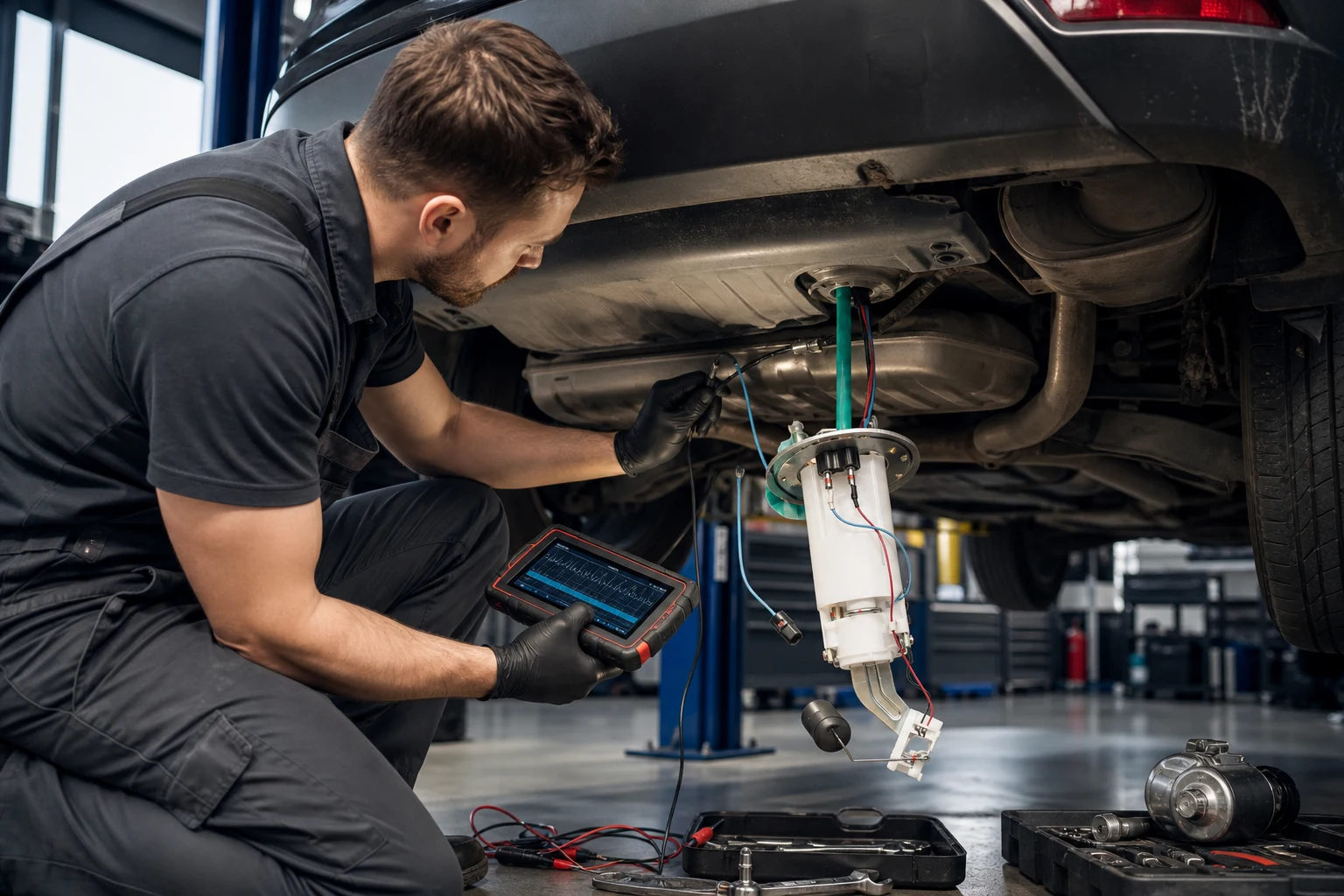
what is the symptoms of a bad fuel pump in plain terms? Hard start, stall under load, a fuel pump whine, and loss of power are the patterns fleets and parts counters hear first. Those symptoms of a bad fuel pump still need a listen test and a rail-pressure reading before anyone stocks or credits a module.
This overview maps the common warning signs, shows how filter, relay, and regulator faults branch the same complaints, then gives an ordered confirmation checklist and the notes buyers should log before RMA. Deeper field, in-tank, and weak-pump guides stay linked rather than rewritten here.
What Bad Fuel Pump Symptoms Usually Mean for Fleet Buyers
Bad fuel pump symptoms usually mean the pump cannot keep rail pressure or volume—hard start, stall, whine, and power loss are the first flags.
On modern EFI platforms the electric pump sits in the tank, submerged so fuel cools and lubricates the motor. When delivery falls short, fuel rail pressure cannot hold what the injectors need under load. That shows up as driveability complaints long before anyone sees a torn impeller on a bench.
For a fleet buyer / parts buyer, the job is not to memorize a longer symptom list. It is to treat bad fuel pump symptoms as a starting hypothesis, then prove or clear delivery with simple ordered checks. A vague “pump feels weak” note is not enough for a clean core credit.
Use this page when a ticket arrives with plain-language wording. Move to the field diagnosis guide for parts distributors when you need shop-floor branching depth.
Hard Start, Stall, Whine, and Loss of Power Patterns
Hard start, stall under load, fuel pump whine, and loss of power are the patterns fleets hear most when delivery falls short.
Hard start or long crank often appears after the vehicle sits. The rail may lose residual pressure, so the first start needs more cranking than the driver expects. Intermittent no-start after a short hot stop fits the same story when heat stresses a worn module.
Stall under load shows up on grades, highway merge, or towing. The engine may idle fine, then stumble when fuel demand rises. Loss of power under acceleration tracks the same delivery shortfall: the rail cannot keep up when injectors open longer.
Whine or buzz from the tank area is the audible clue many drivers notice first. A rising pitch that tracks throttle or grows louder with a low tank is classic, but noise alone is not proof. Pair the sound with pressure data before you condemn the assembly.

When the complaint is mainly low delivery without a dramatic no-start, compare the weak fuel pump symptoms low-pressure delivery review. For tank-level and hot-soak patterns on submerged modules, open in-tank fuel pump symptoms.
How Symptoms Branch: Pump Versus Filter, Relay, or Regulator
The same symptoms of a bad fuel pump can come from a clogged filter, weak relay, wiring drop, or regulator bleed-down until you measure.
A restricted Fuel filter / sock screen starves volume the same way a worn impeller does. Drivers still report hard start and highway sputter. Swap filters on paper before you swap pumps on a hunch.
A failed fuel pump relay, blown fuse, or voltage drop at the connector can silence the prime hum entirely. The ticket reads like a dead pump. Voltage at the pump with key-on often clears that branch in minutes.
A Fuel pressure regulator or check-valve bleed-down can look like a weak module after key-off. Pressure rises on prime, then collapses while the motor itself is still healthy. GarageJournal diagnosis threads make the same point: use a gauge and decide whether bleed-down points at the regulator path before you credit another pump.
| Observed pattern | More likely pump | More likely filter/sock | More likely relay/wiring | More likely regulator path |
|---|---|---|---|---|
| Whine + low pressure under load | Yes | Possible | No | Uncommon |
| No prime hum; no voltage at pump | Uncommon first | No | Yes | No |
| Pressure OK at idle, drops under load after new filter ruled out | Yes | Already cleared | Check voltage under load | Possible |
| KOEO rises then bleeds down fast | Possible check valve | No | No | Yes—inspect first |
| Improves after filter/sock service | No | Yes | No | No |
Important: Do not treat a silent prime as automatic pump failure—confirm relay, fuse, and voltage first (source: EFI relay/control context and shop electrical practice). For relay and harness depth, see fuel pump electrical problems.

Ordered Confirmation Checklist Before You Condemn the Pump
Listen for key-on prime, then measure rail pressure against the service-manual spec before you condemn the module.
Work in a ventilated bay and control ignition sources before you open fuel lines. Markets that follow EPA gasoline standards programs treat vapor control and safe fuel handling as baseline service discipline.
Step 1 — Key-on listen. Turn the key on with the engine off. Listen near the tank for a brief prime hum, typically about one to three seconds on many EFI platforms. No hum points you back to power-path checks before parts.
Step 2 — Voltage sanity. If the pump is silent, check fuse, relay seating/heat damage, and voltage at the pump connector. Near 12 V key-on framing is the usual starting point on 12-volt systems; large drops under load need wiring repair first.
Step 3 — Rail pressure. Install a fuel-pressure gauge at the rail test port. Compare key-on and running readings to the platform service manual—not to a generic internet number. Wikipedia discusses many older port-injection systems in a roughly 40-60 psi conversation band; that band is context only, never a Kangsong SKU rating.
Step 4 — Load the complaint. Watch pressure when the stall or power-loss condition appears. If pressure collapses as the complaint appears while voltage stays healthy, fuel delivery is implicated.
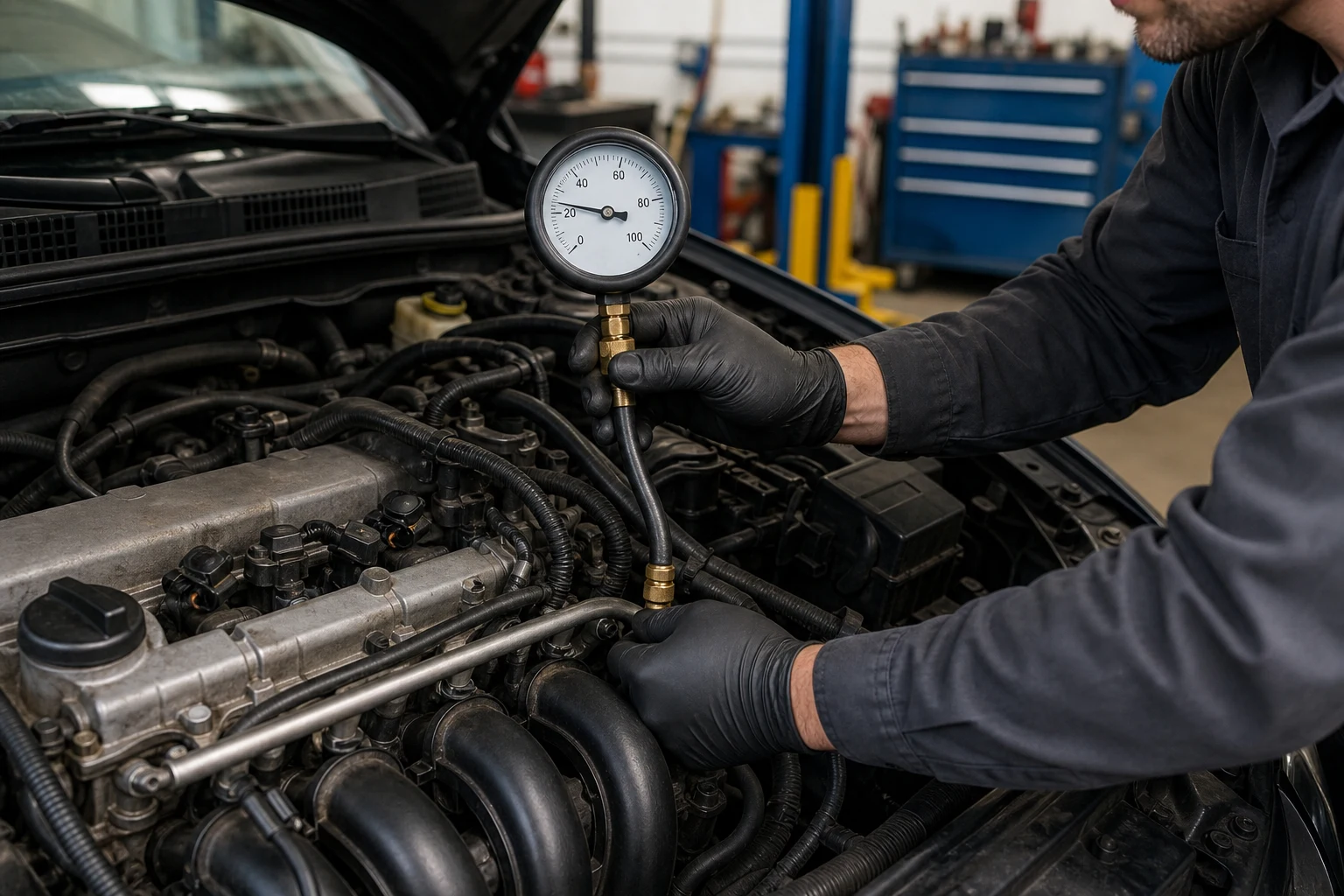
| Observation | What it usually means | Next action |
|---|---|---|
| Brief prime hum; pressure meets manual spec under load | Delivery path can support demand | Look outside the pump for spark/air/sensor causes |
| No prime hum; no/low voltage at pump | Power path fault | Relay, fuse, connector—see electrical guide |
| Prime present; pressure below manual spec under load | Delivery volume/pressure failure | Confirm filter/sock, then module |
| Pressure rises then bleeds down key-off | Regulator/check-valve path | Clear bleed-down before another pump credit |
| Pressure holds while engine dies | Not a delivery collapse | Keep the pump off the blame list for now |
For used or unknown modules already on the shelf, pair this checklist with how to test a used fuel pump.
What Fleet Buyers Should Log Before RMA
Log symptom conditions, listen-test notes, and rail psi on the work order before approving a pump RMA.
Counters that credit cores on “customer says pump is bad” absorb repeat returns. Write the complaint condition (hot soak, low tank, grade load), whether a prime hum was heard, key-on and loaded rail readings with units, and filter/relay findings.
Photograph heat-damaged relays or charred fuse holders when present. Attach those photos to the claim file. If pressure meets spec, do not approve a pump credit just to close the ticket.
Tip: If you are guessing pressure you are guessing parts—write the gauge number on the repair order before the core leaves (Garage Journal test discipline).
A clean log also helps the next tech: they can see whether weak fuel pump symptoms were pressure-proven or only driver-reported.
How This Overview Links to Deeper Symptom Guides
Use this page as the overview, then open field-diagnosis, in-tank, weak-pump, electrical, and used-pump guides for depth.
- Bad fuel pump symptoms field diagnosis guide for parts distributors — shop-floor branching for distributor counters.
- In-tank fuel pump symptoms — submerged-module patterns, low-tank and hot-soak detail.
- Weak fuel pump symptoms low-pressure delivery review — low-pressure evidence focus.
- Fuel pump electrical problems — relay, fuse, and wiring depth.
- How to test a used fuel pump — bench/used-module confirmation.
Keep this hub short on specialty depth so those pages remain the canonical answers for their queries.
Recommended Electric Fuel Pump Assemblies for Confirmed Pump Failure
After pump failure is confirmed, browse Kangsong electric fuel pump assemblies at the products index.
When listen and rail-pressure checks show delivery failure—and filter, relay, and regulator branches are cleared—browse electric fuel pump assemblies for importer and wholesale programs. Match OE references, connector style, and tank depth per SKU.
Example Hyundai/Kia Sonata/Optima assemblies are published for those vehicles only and do not prove fitment on other nameplates.
Why not yet: if rail pressure meets the manual and voltage is healthy, do not open the catalog to “try a pump.” Fix the active branch first. Kangsong does not claim third-party brand equivalence for FASS, Bosch, Facet, or other nameplates.

Confirm wiring health and filter/sock condition on the same work order before you stock assemblies for a recurring complaint pattern.
FAQ
What is the symptoms of a bad fuel pump in plain language?
Hard start, stall under load, fuel pump whine, and loss of power are the common answers. Confirm with a key-on listen test and rail pressure before you treat the module as failed.
Can a clogged fuel filter cause the same symptoms as a bad fuel pump?
Yes. A restricted filter or sock can starve volume and copy hard start or highway sputter. Clear the filter path before you approve a pump RMA.
Does fuel pump whine always mean the pump is bad?
No. Whine is a useful clue, especially with low pressure under load, but noise alone is not proof. Measure rail pressure and verify the power path.
How long should the pump run on key-on?
Many EFI platforms produce a brief prime hum for about one to three seconds when the key is turned on. Treat that as a qualitative listen check, then confirm with a gauge.
What rail pressure reading confirms a weak or bad pump?
A reading below the platform service-manual specification under the complaint condition, with healthy voltage at the pump, supports a delivery failure call. Do not use a generic internet psi as a universal acceptance number.
Should I replace the pump before checking the relay?
No. If there is no prime hum, check the fuel pump fuse, relay, and connector voltage first. Many “bad pump” tickets close with an electrical repair.
What notes should a parts buyer attach before approving credit?
Record symptom conditions, prime-hum result, key-on and loaded rail pressure with units, filter/relay findings, and photos of heat-damaged electrical parts when present.
When is an electric assembly catalog the right next step?
After delivery failure is confirmed and non-pump branches are cleared. Then open the Kangsong electric fuel pump assemblies catalog and match the vehicle-scoped SKU.