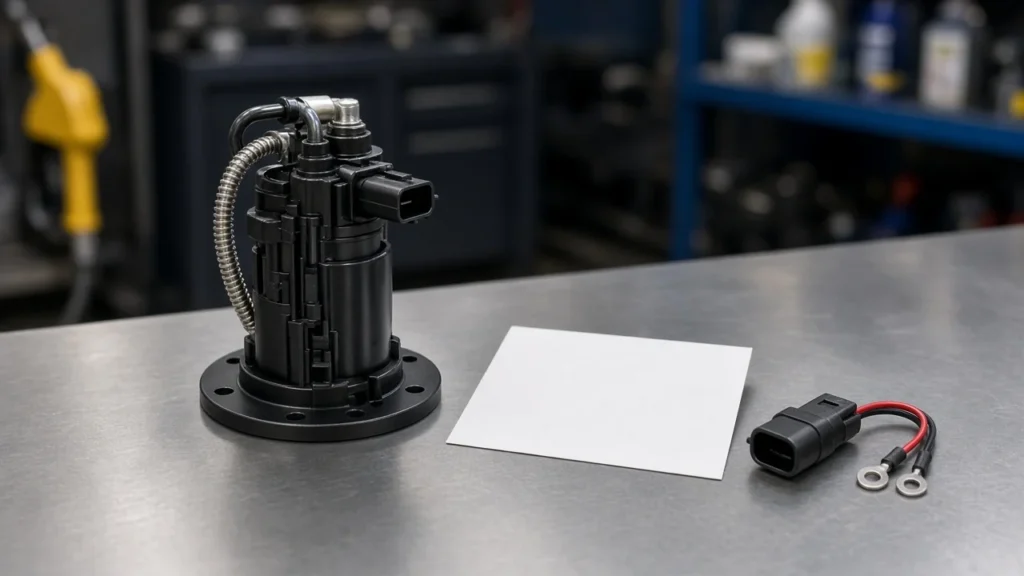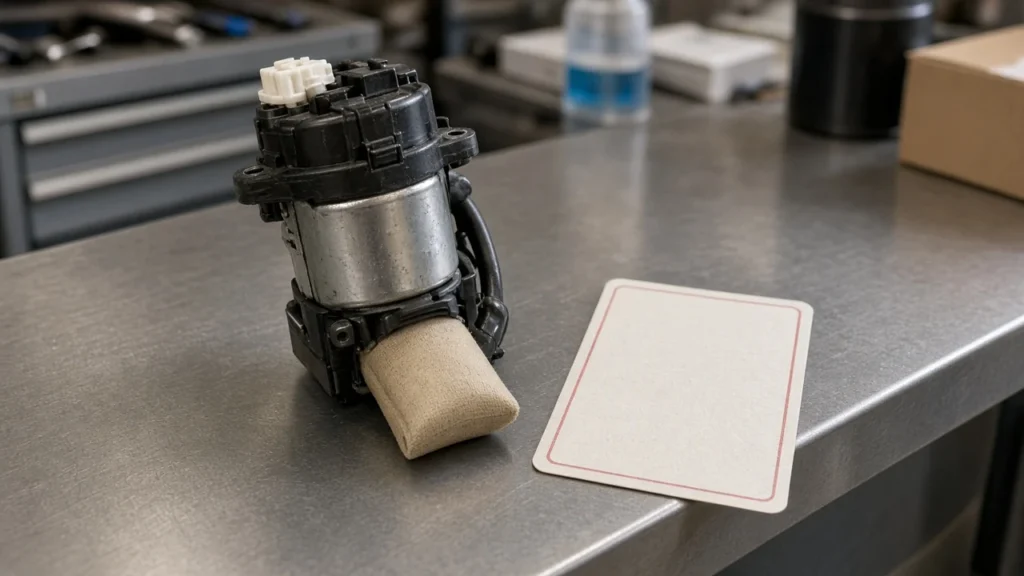

mastercraft fuel pump problems usually show up as sputter or stall under load, hard starting, or intermittent run—often after the unit was run dry below about a quarter tank. Service and parts counters confirm delivery with a Schrader rail-pressure test, clear fuse/relay/kill-switch and hose faults, and document findings before approving a pump RMA.
The sections below cover symptoms, safety, measured pressure, power-path checks, other non-pump mimics, RMA logging, and when Kangsong’s automotive electric assemblies catalog is the right next step.
What Mastercraft Fuel Pump Problems Usually Look Like
Stall under load, hard start, and intermittent run—often after dry-running below about a quarter tank—are the patterns counters hear first when someone asks about a Mastercraft fuel pump.
Owners and techs commonly describe a short run after refill, then a sputter that returns under acceleration or during turns. The complaint may sound like a bad fuel pump even when the root cause is still electrical or install-related. Pair the story with later pressure and power-path checks instead of ordering a module on symptoms alone.
Important: Community diagnosis threads repeatedly tie later pump failure to running the pickup dry below about a quarter tank—treat that history as a risk flag, not proof by itself.
For broader field symptom language across distributors, see the bad fuel pump symptoms field diagnosis guide. For in-tank electric patterns on automotive platforms, compare in-tank fuel pump symptoms.
Safety Checks Before Opening an EFI Fuel System
Ventilate the bay, control ignition sources, and relieve rail pressure before any Schrader hookup or fuel-line opening.
Gasoline vapor and hot surfaces do not mix. Work outdoors or in a well-ventilated shop, keep a fire extinguisher within reach, and disconnect power when you will probe wiring.
Relieve residual rail pressure per the platform procedure before attaching a gauge or cracking fittings. Markets that follow EPA gasoline standards programs treat vapor control and safe fuel handling as baseline service discipline—not optional paperwork.
Avoid spraying starting fluid as a substitute for a pressure reading when you already plan a rail test.
Confirm Delivery with a Schrader Rail Pressure Test
Confirm fuel delivery at the rail with a pressure gauge before you condemn the pump.
Use a rail gauge; community-reported key-on hold often discusses above about 40 psi, with running-pressure talk near about 50-60 psi on healthy systems—always compare those ranges to the platform service manual rather than treating them as a universal Kangsong specification.
Install a fuel-pressure gauge on the Schrader port at the rail. On key-on engine-off (KOEO), watch the brief prime rise, then whether pressure holds for roughly half a minute without collapsing.
Start and run next: note steady pressure and whether it drops when the complaint (stall or sputter) appears. If pressure collapses as the engine stalls while the power path is healthy, fuel delivery is implicated.
Wikipedia’s overview of an electric in-tank fuel pump places many port-injection systems in a roughly 40-60 psi conversation band, which overlaps community Mastercraft discussion—but your service manual remains the acceptance target for that hull or vehicle.

| Observation | What it usually means | Next action |
|---|---|---|
| KOEO rises and holds near community ~40+ psi talk / manual spec | Delivery path can pressurize | Proceed to loaded/running check |
| KOEO rises then bleeds to single digits | Check-valve, regulator, or internal hose leak more than “dead motor” alone | See hose/regulator section before RMA |
| No rise on KOEO | No pump run or open power path | Fuse, relay, kill switch, connector |
| Running pressure collapses at stall | Delivery volume/pressure failure under demand | Confirm voltage at pump, then module |
| Pressure stays up when engine dies | Look outside fuel delivery (spark/ECM/sensor paths) | Keep the pump off the blame list until spark and control paths are cleared |
Log both the KOEO hold and the running reading on the repair order. A single “felt weak” note is not enough for a clean parts decision.
Check Fuse, Relay, and Kill Switch Before Condemning the Pump
Inspect fuse and relay heat damage and kill-switch seating before blaming the pump motor.
A silent prime with a healthy battery often points to the fuel pump fuse, fuel pump relay, or a kill switch that is interrupting pump power. Community threads describe charred fuse housings and overheated relays; shop discussions of automotive relays show contact overload and high pump current as common heat sources.
If the relay socket or housing shows melted plastic, photograph it before you swap parts.
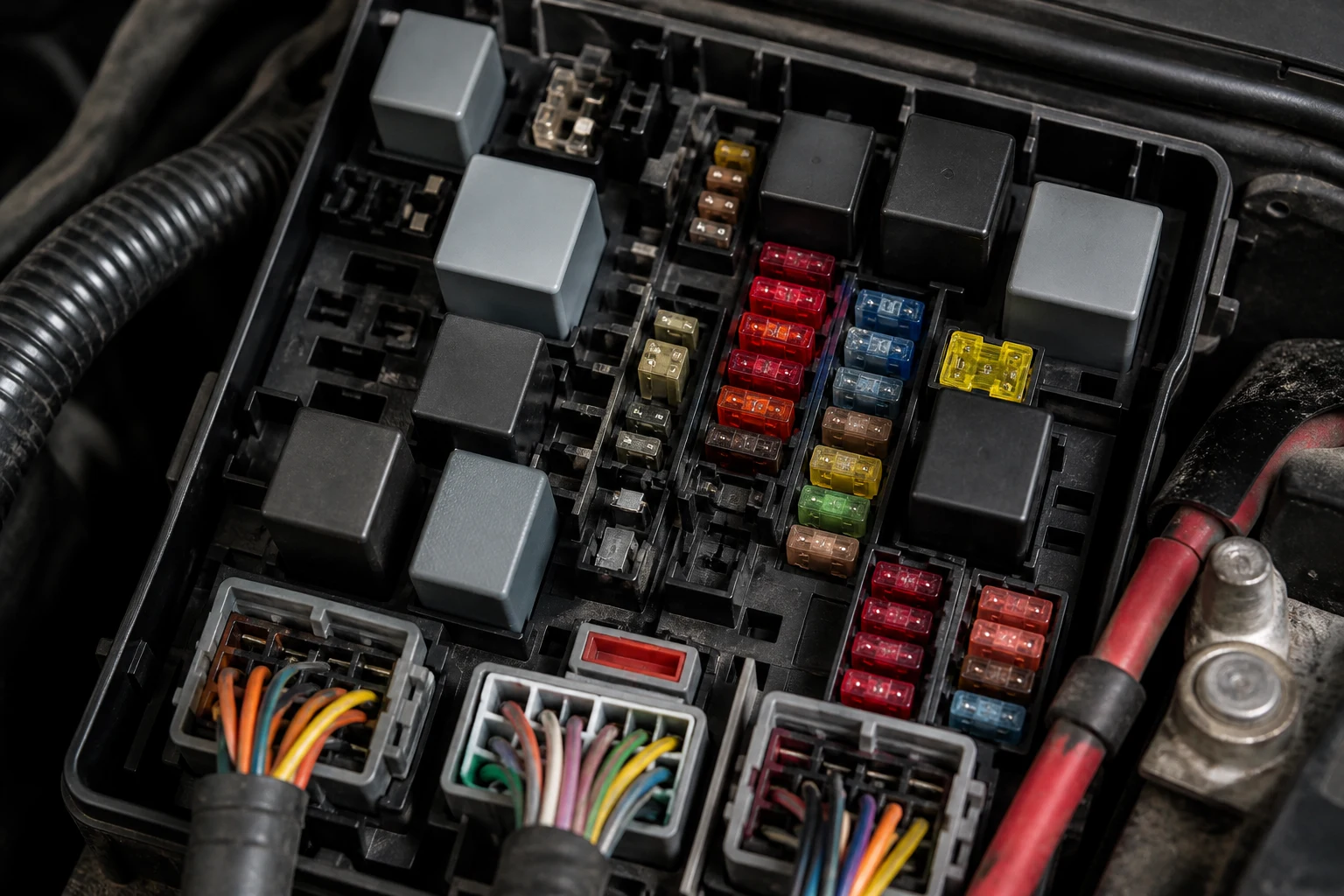
Confirm the kill switch (lanyard/button) is fully seated. Intermittent pump power that tracks switch twist or incomplete depression is a classic false “bad pump” call.
For related electrical diagnosis language on automotive programs, see fuel pump electrical problems.
| Finding | More likely pump | More likely fuse/relay | More likely kill switch | More likely connector/hose |
|---|---|---|---|---|
| No prime hum; no voltage at pump | Uncommon first | Yes | Yes | Possible |
| Charred fuse or hot relay body | Possible high draw | Yes—inspect first | No | No |
| Pressure fluctuates when harness wiggled | Possible | Possible | No | Yes—connector |
| KOEO bleeds down with pump powered | Possible check valve | No | No | Yes—hose/regulator |
| Runs after kill switch fully seated | No | No | Yes | No |
Tip: If jumpering the relay load path runs the pump and builds rail pressure, stop blaming the module until the control side (relay coil drive, kill switch, ECM enable) is cleared — Garage Journal relay heat thread.
Connector, Regulator Bleed-Down, and In-Tank Hose Install Quality
Pump connector faults, regulator or check-valve bleed-down, and poor corrugated in-tank hose installs can look like pump failure.
Wiggle-test the pump connector with a gauge attached; pressure that flickers with harness movement is an electrical contact problem, not a worn impeller story. After a prior pump swap, long crank plus KOEO collapse is a red flag for corrugated in-tank hose fit and clamp quality—community Mastercraft write-ups repeatedly call out diameter mismatch and worm-drive clamps as leak sources.
GarageJournal diagnosis threads make the same point in automotive language: use a gauge and decide whether bleed-down points at the regulator/check-valve path before you credit another pump.
Photograph hose ends, clamps, and the regulator connection when the assembly is out. Counters reviewing RMAs need that evidence when the returned “failed” pump still builds pressure on a bench harness.
Older carbureted vacuum pumps follow a different test path; if the platform is still mechanical, use how to test a vacuum fuel pump instead of forcing an EFI rail procedure.
Document Findings for Parts Counters Before Approving an RMA
Log KOEO hold, running pressure at stall, and electrical or hose findings on the work order before you approve a pump return.

Parts counters move faster when the ticket carries numbers and photos: KOEO psi and hold time, running psi at the moment of sputter/stall, fuse/relay condition, kill-switch status, connector wiggle result, and hose/clamp notes after any prior repair.
Shop communities that discuss pump-versus-regulator bleed-down keep repeating the same discipline—guessing pressure means guessing parts.
Tip: Write the gauge readings on the repair order before the core leaves the building; credits stick when KOEO hold and running pressure travel with the claim. (Garage Journal gauge discipline.)
Refuse a no-evidence swap when the ticket only says “pump bad.” Ask for the pressure pair and the power-path checklist above. That habit protects distributor programs from repeat cores that actually need a relay, kill switch, or hose rework.
Recommended Electric Fuel Pump Assemblies for Automotive EFI Programs
Kangsong lists automotive EFI electric assemblies for distributor programs; it does not publish Mastercraft marine fitment without verified SKU evidence.
When diagnosis confirms an electric in-tank assembly failure on an automotive EFI platform, browse electric fuel pump assemblies for importer and wholesale channels. Match OE references, tank depth, and connector style per SKU.
Example Hyundai/Kia Sonata/Optima assemblies are published for those vehicles only and do not prove fitment on other nameplates—or on boats.
Why not for Mastercraft boat / marine applications: Kangsong’s live catalog evidence supports automotive electric fuel-pump programs. Without a verified Kangsong SKU for a specific Mastercraft marine platform, skip recommending a catalog item as a boat drop-in, and skip implying equivalence to Carter, Airtex, FASS, Bosch, or Mastercraft OEM modules.

Confirm wiring health, filter/sock condition, and hose install quality on the same work order before you stock assemblies for a recurring complaint pattern.
FAQ
What are common Mastercraft fuel pump problems?
Sputter or stall under load, hard start, intermittent run, and failures that appear after the unit was run dry below about a quarter tank are the patterns most often reported. Confirm with rail pressure and power-path checks before replacing the pump.
What rail pressure should I see on key-on?
Community Mastercraft diagnosis often discusses key-on pressure above about 40 psi that holds briefly, with running-pressure talk near about 50-60 psi on healthy systems. Treat those as community-reported ranges and compare them to the platform service manual—not as a universal Kangsong specification.
Can a bad kill switch look like a bad fuel pump?
Yes. A kill switch that is not fully seated can interrupt pump power, producing a silent prime and a no-start that looks like a dead module. Check switch seating and voltage at the pump before you condemn the assembly.
Why do problems show up after running below a quarter tank?
Running the pickup dry during turns or acceleration can overheat and damage an in-tank pump. After a refill, the unit may restart briefly and then stall because the pump was already stressed. Log that history on the ticket and still confirm pressure before RMA.
Should I replace the pump before checking the fuse and relay?
No. Check the fuel pump fuse, relay (including heat damage), and kill switch first when there is no prime hum or no voltage at the pump. Many “bad pump” tickets close with an electrical repair.
Does Kangsong sell Mastercraft marine fuel pumps?
Kangsong publishes automotive electric fuel pump assemblies for distributor programs. It does not publish Mastercraft marine fitment for those SKUs without verified evidence, so treat the catalog as an automotive EFI path rather than a boat OEM replacement list.
What should parts counters record before an RMA?
Record KOEO rail pressure and hold behavior, running pressure at the complaint, fuse/relay/kill-switch findings, connector wiggle results, and hose/clamp notes after any prior repair. Attach photos of heat-damaged electrical parts when present.