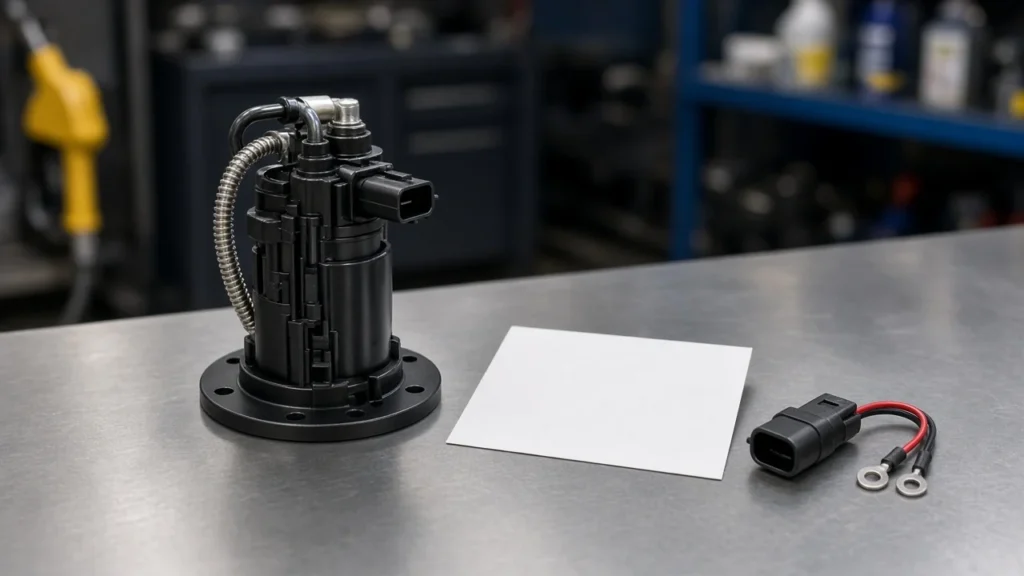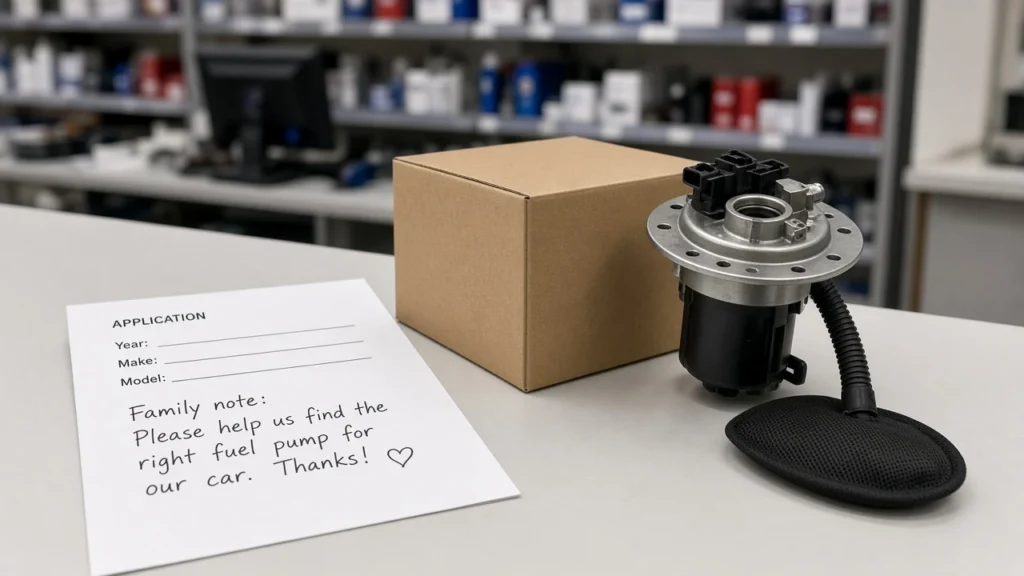
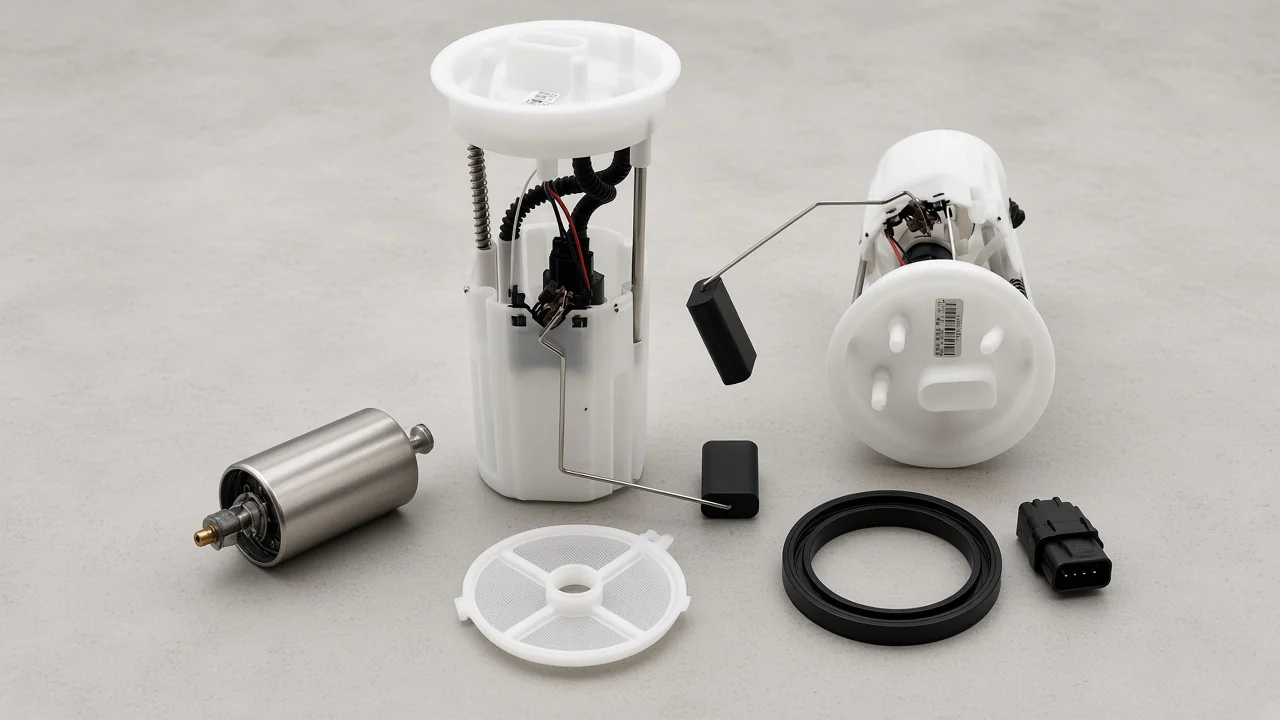
Electric fuel pump parts are the discrete pieces packaged with an in-tank electric fuel pump module—typically the pump motor, inlet strainer (sock), fuel-level sending unit and float, tank seal, and electrical connector, with a pressure regulator or reservoir on some designs. This page maps those parts, flags common wear items, and shows when to order pump-only, a kit, or a full assembly within printed fitment.
What Electric Fuel Pump Parts Actually Are
They are the discrete components packaged in an in-tank electric module, not just the motor alone.
On modern EFI gasoline cars, the electric pump usually lives in the tank as part of a hanger or module.
Buyers often say “pump” when they mean the whole unit. A pump moves fuel; a module packages the pump with support parts such as a screen, optional regulator, and sender.
In counter language, electric fuel pump parts cover both the motor that moves fuel and the support hardware that keeps pressure, filtration, sealing, and fuel-level reading intact. Procurement teams searching for fuel pump module parts are usually trying to name those pieces before they open a purchase order.
A fuel pump assembly is that packaged module. This page stays on the parts list and replaceability choices. Selection trees for choosing an electric fuel pump assembly belong on that sister page; diagram reading belongs on the diagram sister.
Core Parts Map Inside an Electric Fuel Pump Module
Expect pump, strainer, sender, seals/connector, and sometimes a regulator or reservoir.
| Part | What it does | Typical replaceability |
|---|---|---|
| Electric pump / motor | Moves fuel from tank toward the rail | Replaceable alone on some designs; often ordered as a full module |
| Inlet strainer (sock) | Screens debris before the pump inlet | Wear item—renew when the tank is open |
| Fuel-level sending unit + float | Reports tank level to the gauge | Often sold with the module; gauge issues can be module-side |
| Tank seal / lock-ring interface | Seals the module to the tank opening | Plan a correct seal whenever the module is removed |
| Electrical connector / harness | Powers the pump and carries sender signals | Must match pin count and keying |
| Pressure regulator (some modules) | Sets system pressure on applicable returnless layouts | Location varies—module vs rail |
| Reservoir / sub-tank (some modules) | Keeps the intake submerged during cornering or low fuel | Usually replaced with the full assembly |
Manifold-injection in-tank electrics commonly run in the tens of psi—Wikipedia’s general port/TBI band is about 40–60 psi, while AA1Car notes roughly 30–85 psi depending on the application. Treat those as orientation ranges, then confirm the vehicle specification before you buy.
Use the table as a receiving checklist: confirm each line item on the carton or hanger before the old module goes out for core or scrap.
Fuel Pump Strainer (Sock): Wear Item Buyers Overlook
The sock is a pre-pump screen; replace it when the tank is open.
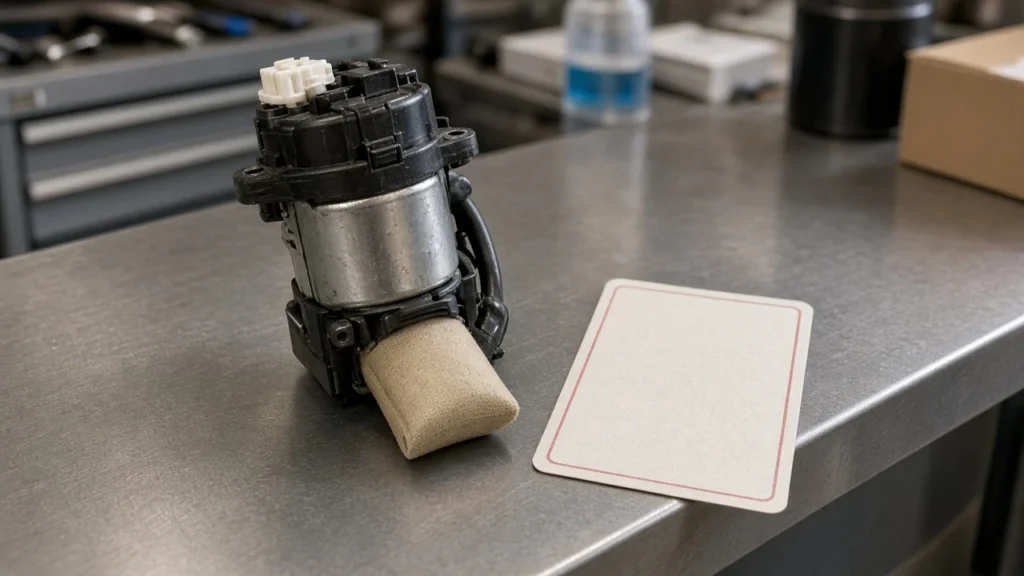
The inlet strainer—also called a fuel pump strainer or sock—sits on the pump intake and catches rust flakes, varnish, and tank debris before they reach the impeller. A clogged sock drops delivery pressure and makes the motor work harder. Independent technical notes also tie contamination and dry-run conditions to shortened pump life.
From the field: Community threads regularly warn against reusing a brittle old sock on a new pump. A new strainer is cheap insurance when the tank is already open and you are investing in a motor or module. — source: r/AskMechanics strainer thread
If a replacement pump arrives without an external sock, check whether filtration is internal to the housing—or whether a matching strainer must be ordered separately. Do not assume the old mesh is still flexible and intact.
Sender, Seal, Connector, and Optional Regulator
These support level reading, sealing, power, and sometimes pressure control.
Fuel-level sending unit. The float arm and sender share the in-tank space with the pump. That is why many modules ship as pump-plus-sender packages. If the gauge was already drifting, a pump-only swap can leave the old complaint in place.
Tank seal and lock ring. Opening the tank is a sealing job as much as a pump job. Haynes-style prep guidance stresses the correct lock-ring tooling and a careful look at contamination once the tank is open. Plan the seal up front so the unit does not go back in on a crushed or reused ring that no longer seats.
Electrical connector and harness. Pin count, keying, and whether accessories ship with the pump matter for drop-in work. Printed kit pages that list connector pin quantity help you reject a look-alike motor that will not plug in.
Pressure regulator. On many returnless systems the regulator lives in the module; on return-style systems it may sit on the rail. Architecture mismatch is a common wrong-order cause—confirm where pressure is controlled before you assume “regulator included” means the same thing on every vehicle.
Causes and failure patterns for whole modules are covered on what causes a fuel pump module to go bad; keep this page on the parts themselves.
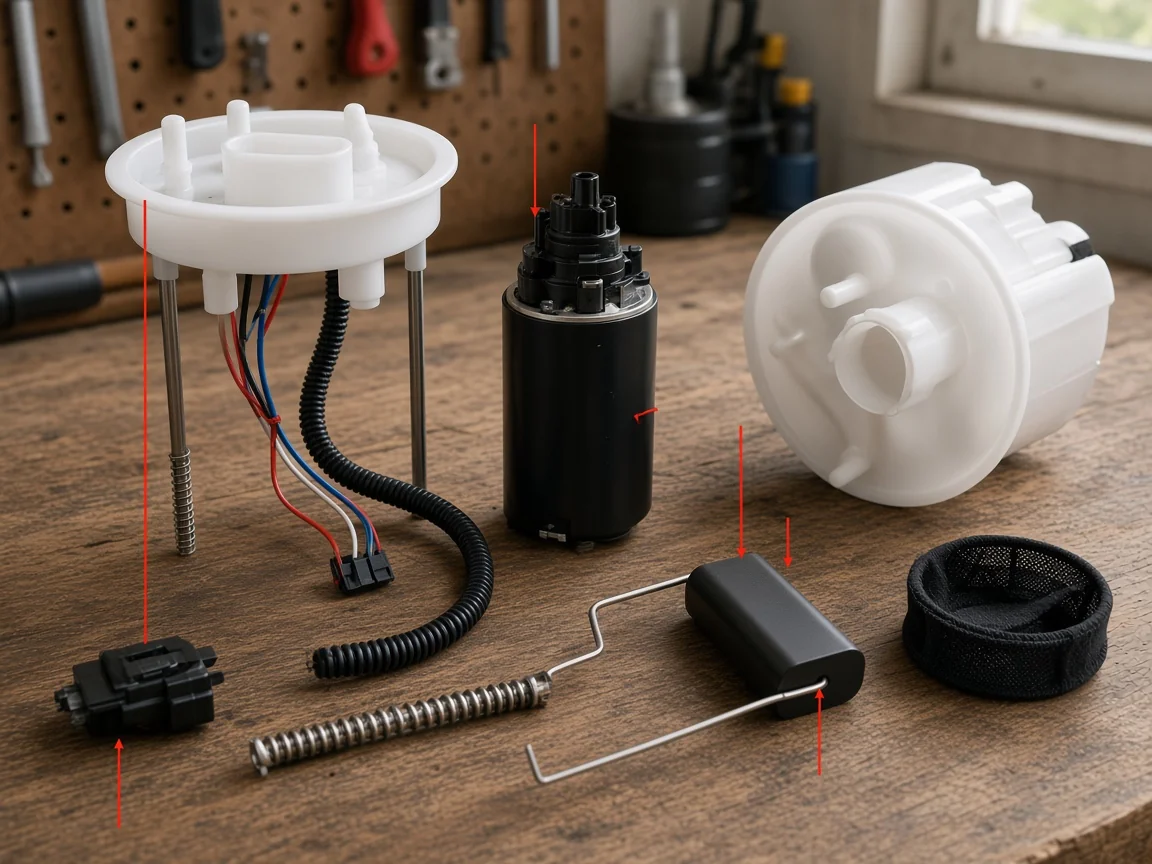
After the support parts are clear, the next decision is packaging: which of those parts you buy together.
Pump-Only vs Kit vs Full Assembly: What to Order
Choose based on hanger condition, available serviceable parts, and labor risk.
| Packaging | Best when | Watch-outs |
|---|---|---|
| Pump-only | Hanger plastics, sender, and internal lines are sound; service literature supports a motor swap | Extra disassembly; brittle hoses and clips; second tank job if hanger fails later |
| Pump + installation kit | Printed kit matches Year/Model/OE and includes the accessories you need | Still not a complete module if the hanger or sender is worn |
| Full fuel pump assembly / module | Tank is open, hanger aged, gauge issues present, or parts are not sold separately | Higher parts cost; still requires OE/VIN match |
Shop and forum language often lands on the full module once the tank is open—“I always replace the module” is a repeated counter-side preference when internal hoses and plastics look brittle. Pump-only can work when stock and labor allow, but budget time for clamps, seals, and a careful tear-down.
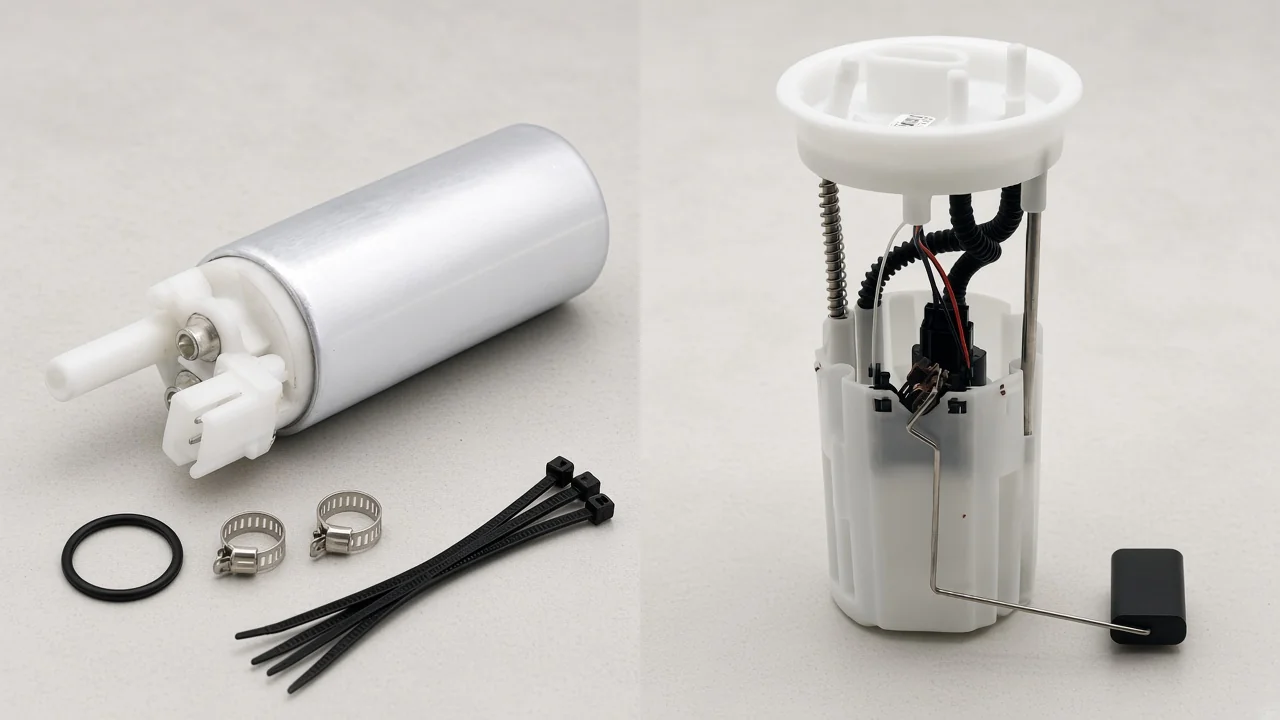
Passenger-car selection nuance lives on the car fuel pump assembly sister; this table only settles packaging for the parts decision.
Checks Before You Order Electric Fuel Pump Parts
Confirm fuel pressure, relay/fuse health, and tank cleanliness before you commit to a parts order.
- Verify fuel pressure against the vehicle specification before condemning the pump.
- Check relay, fuse, and power at the connector so you do not buy a motor for an electrical fault.
- Note return vs returnless architecture and whether a regulator is module-mounted.
- When the tank is open, inspect for debris and varnish that would clog a new sock immediately.
- Match OE / VIN / Year-Model-Engine before treating any catalog photo as “close enough.”
Those checks keep a parts list from turning into a repeat labor ticket.
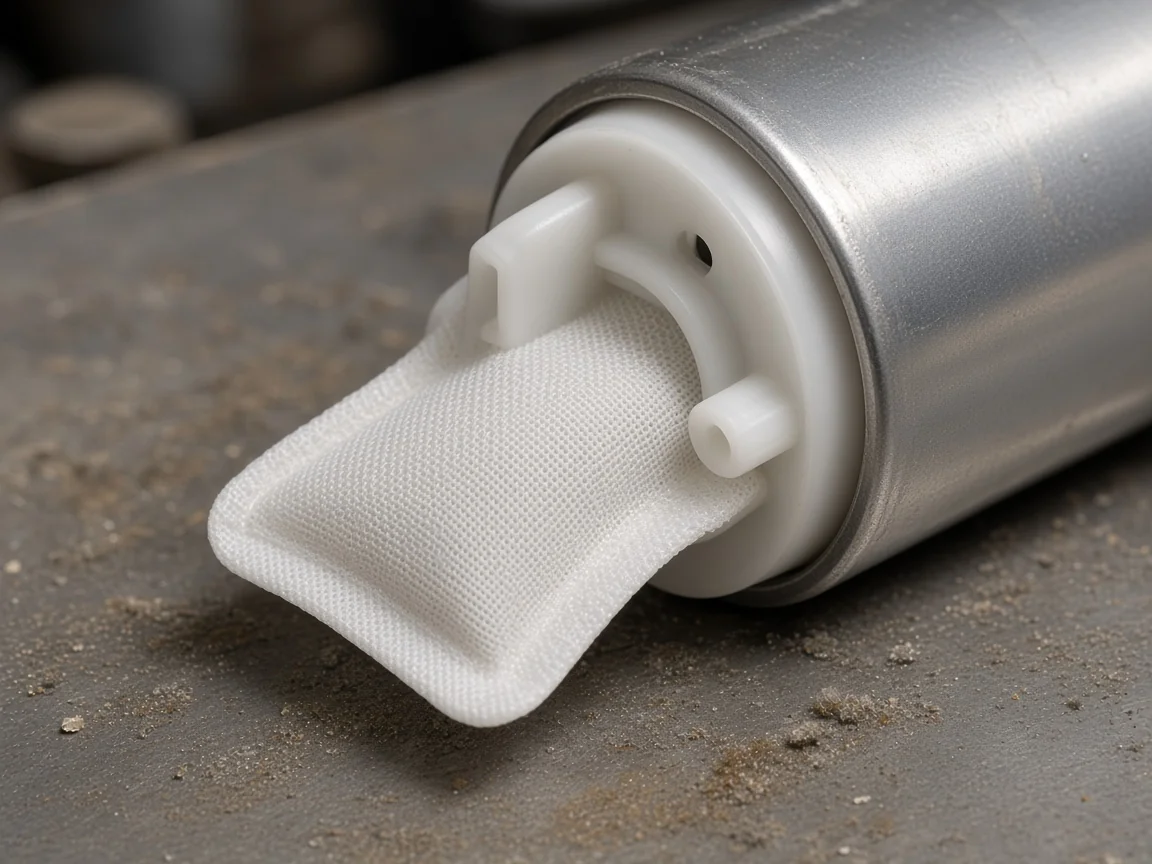
The strainer photo belongs with the wear-item decision: if the sock is clogged or brittle, renew it in the same service window as the motor or module.
Printed-Fitment Assemblies and Kits for These Parts
Use printed Touran assembly or kit windows; otherwise browse products-root.
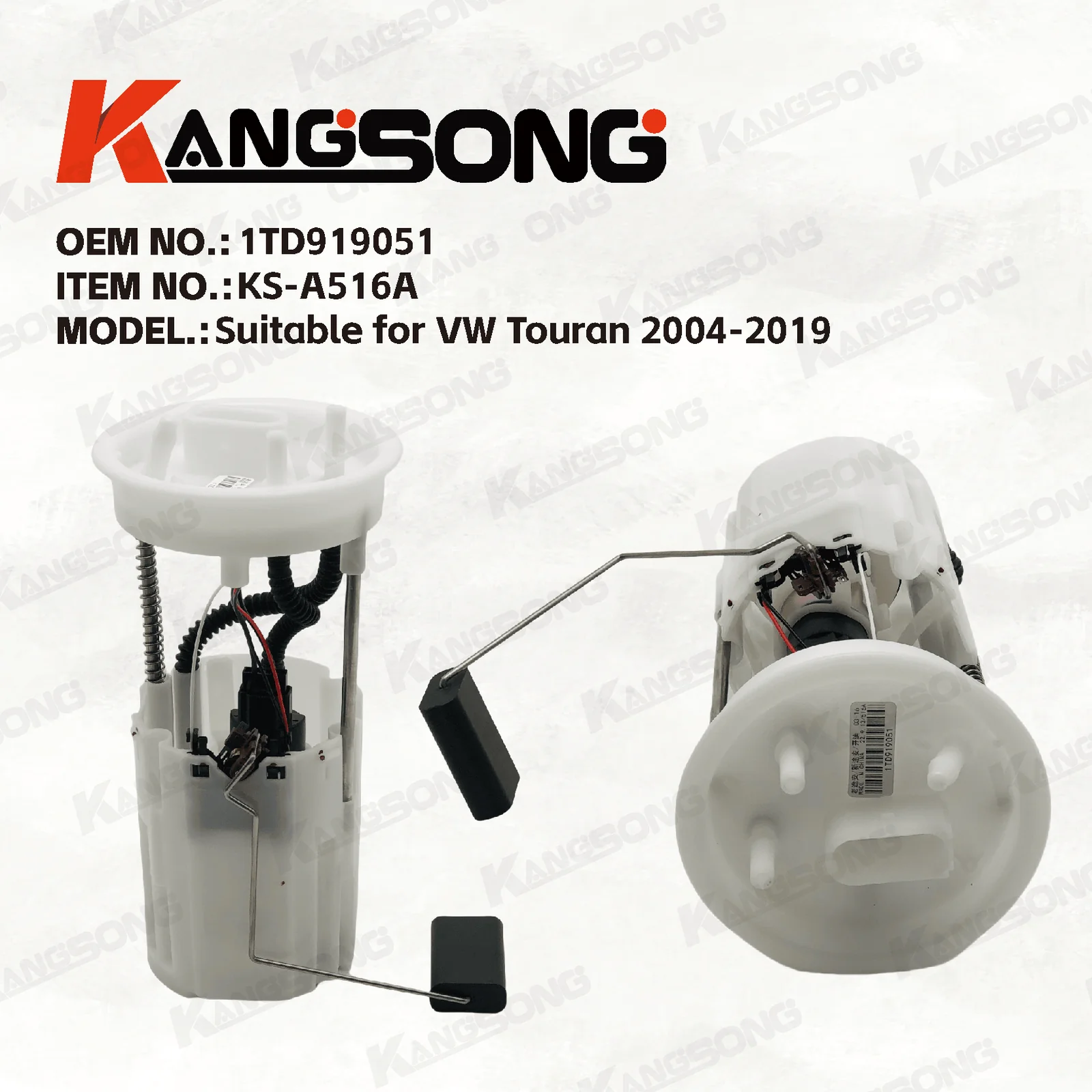
When several wear items are due at once—motor, sock, seal, and an aging sender—a complete assembly is the cleanest parts package. Kangsong publishes a VW Touran 2004–2019 fuel pump assembly (1TD919051) with that Year/Model/OE window printed on the title. Use it only inside that printed scope.
If the job is a pump-plus-accessories swap inside a different printed window, compare an electric gasoline fuel pump with installation kit titled for 1987–1995 C/K trucks (OE cross-refs such as 25168719 / E3902 on that page). That SKU prints accessories included, a two-pin main connector, and a GPH band of 43.3–49.5 for that listing—still not a universal module claim.
For other vehicles, start at the products catalog root and stay inside each PDP’s printed title. Do not stretch one application photo across unrelated platforms.
FAQ
What parts are typically inside an electric fuel pump module?
Most in-tank electric modules package the pump motor, inlet strainer, fuel-level sender with float, tank seal, and connector. Some also include a regulator, reservoir/sub-tank, or related internal filter housing.
Can I replace only the pump motor and keep the hanger?
Sometimes, when the vehicle design and remaining hardware allow it. Labor is higher, internal hoses can be brittle, and many shops prefer a full module once the tank is open.
Should I reuse the old fuel strainer sock?
Prefer a new sock. Old mesh can be clogged or brittle, and reusing it is a common way to stress a new pump.
Why is the fuel level sender part of the assembly?
It shares the in-tank space with the pump. Integrating the sender keeps level sensing aligned with the hanger that carries the motor.
Is the pressure regulator always in the module?
No. Returnless designs often place regulation in the module; other systems regulate at the rail. Confirm architecture before ordering.
Do I need a new tank seal when I pull the module?
Plan on correct sealing hardware and lock-ring practice whenever the module comes out. A poor seal creates vapor and leak risk after an otherwise good pump install.
What pressure should an electric in-tank pump deliver?
Many manifold-injection systems run in the tens of psi (roughly 40–60 psi in general encyclopedia ranges, or about 30–85 psi across AA1Car’s application notes). Confirm the pressure specification for the vehicle on the bench.
When should I order a complete assembly vs a pump kit?
Order a complete assembly when the hanger, sender, or multiple wear items are aging, or when serviceable internals are not sold separately. Use a printed pump kit only inside its titled Year/Model/OE window.
References
- Fuel pump (encyclopedia overview of in-tank electric assemblies)
- AA1Car library note on electric fuel pump pressure and module packaging
- Ryan’s Auto Care: fuel pump versus fuel pump module
- r/MechanicAdvice thread on replacing pump-only versus the module
- r/AskMechanics thread on fuel pump outer filter / strainer reuse
Humanizer audit: PASS
Second self-pass: no facts, OE numbers, or citations added beyond approved research/brief.
Word count target: >1500 reader-facing words.