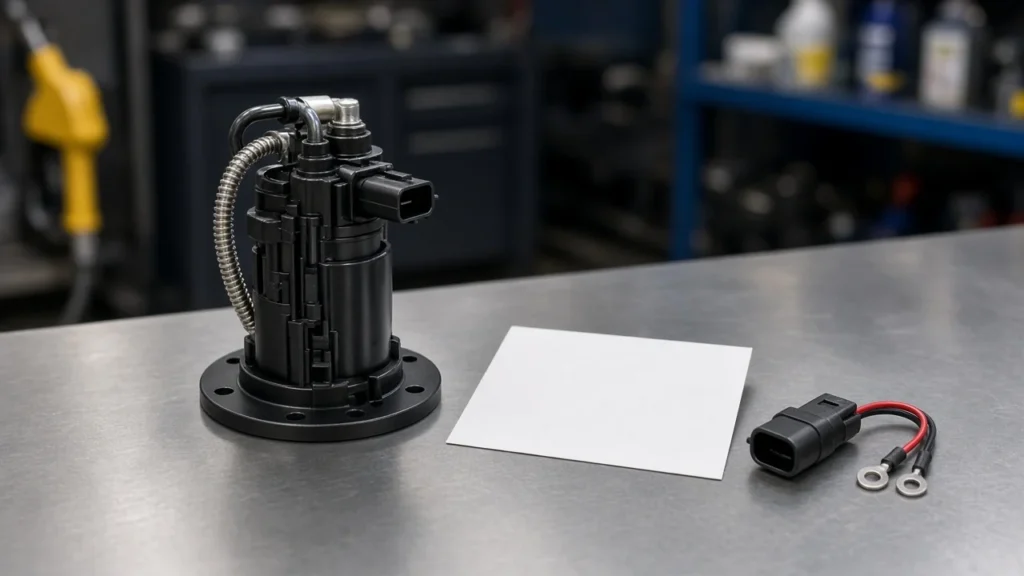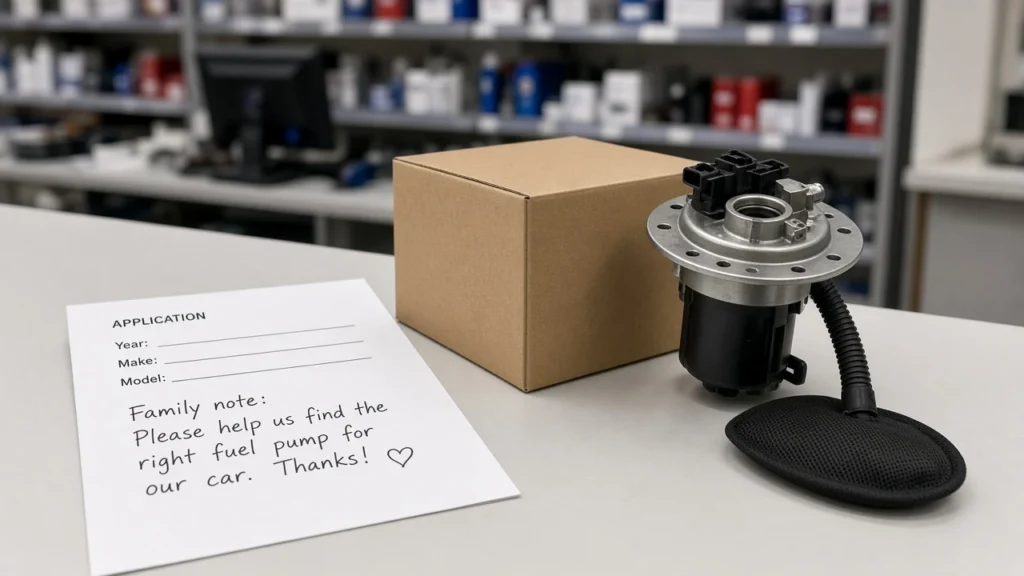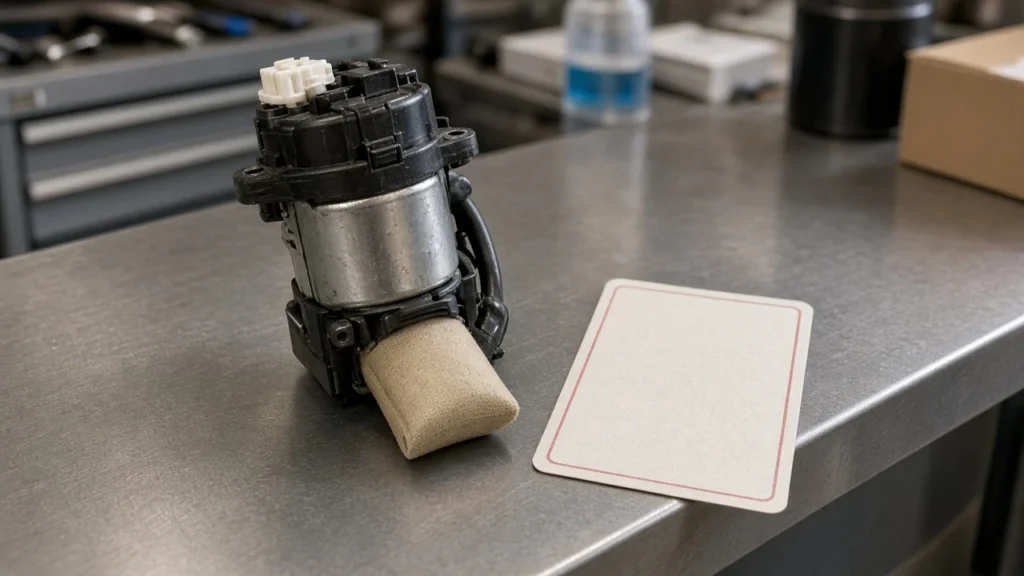
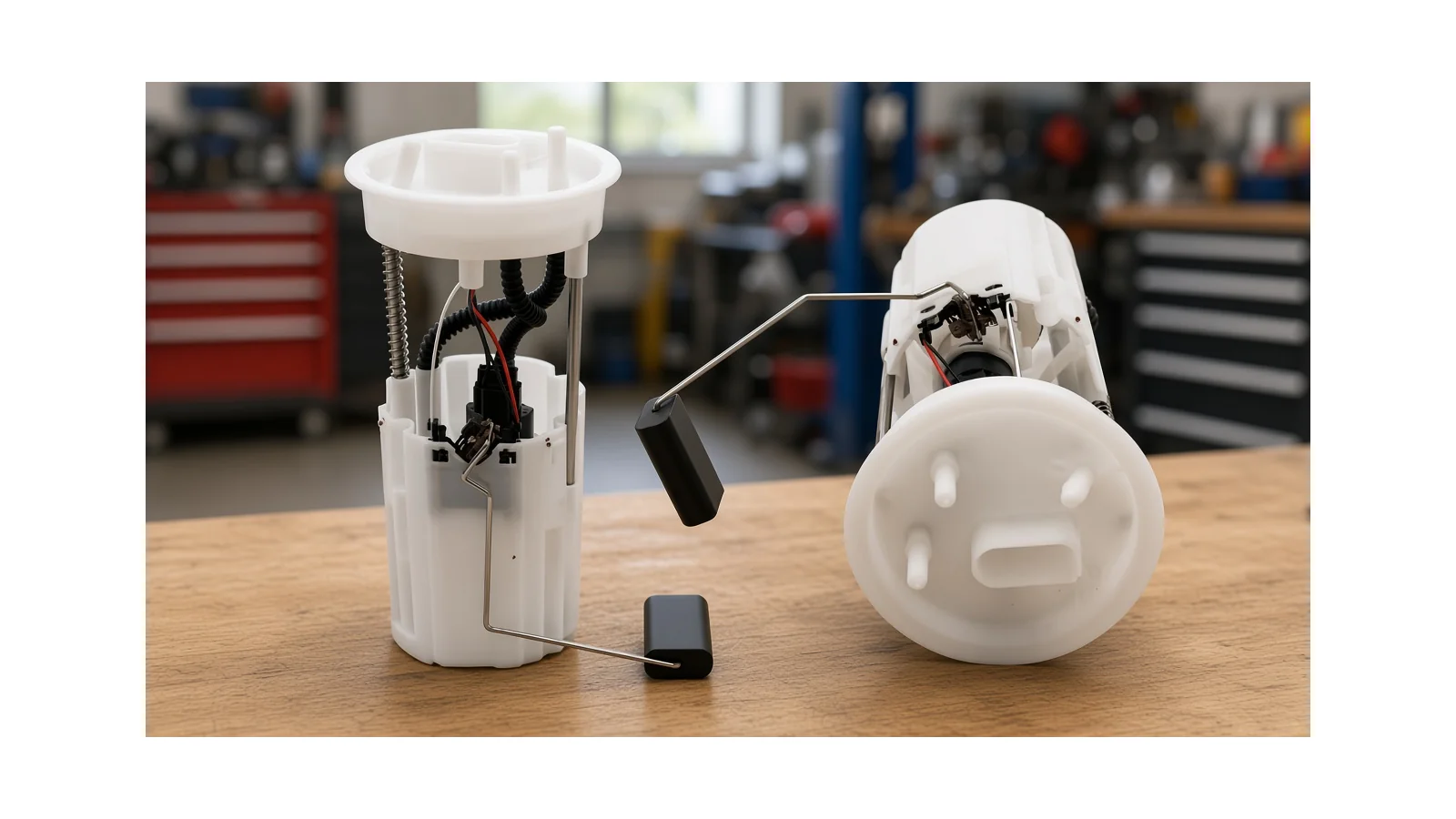
An electric fuel pump assembly is the in-tank service unit that groups the electric pump, strainer, fuel-level sender, and seals so an EFI vehicle can keep injector pressure and volume inside the required band. Buyers get a correct carton when they lock OE or VIN identity, connector and sender geometry, and return versus returnless packaging-not when a brochure LPH number looks bold. Below: what the electric module is, what ships in the box, when to buy the full module versus a pump motor, how architecture checks prevent a second tank drop, what to verify before ordering, and a printed-fitment Kangsong example.
What an Electric Fuel Pump Assembly Actually Is
An electric fuel pump assembly is usually the complete in-tank fuel pump module built around an electric pump rather than a cam-driven mechanical pump. Fuel-injected engines rely on that electric unit to pressurize fuel before it reaches the injectors.
Older carbureted layouts often used a low-pressure mechanical pump on the block instead. Ordering across those architectures sends the wrong family of parts to the bay and the wrong labor quote to the customer.
On most modern EFI cars the assembly sits in the tank. Surrounding fuel cools and lubricates the wet motor, quiets pump buzz, and reduces dry-run vapor problems compared with an external dry mount.
Catalog language therefore favors “assembly” or “module” over a bare motor. Treat the unit as a vehicle-identity part before you treat it as a flow-marketing part.
This page is a selection guide. For a plain-language definition of the module itself, open What Is a Fuel Pump Assembly?.
Passenger-car buying that overlaps this job is covered on Car Fuel Pump Assembly; use it for contrast, not as a second copy of this checklist. Diagram reading, aftermarket in-tank deep-dives, and gasoline electric pump standalones stay on their own sister pages.
Marine search traffic sometimes surfaces OEM electric fuel pump assemblies for boats. Those cartons answer a different buyer job and a different parts ecosystem; they do not replace matching a road-vehicle OE module.
What’s Inside a Typical Electric Fuel Pump Assembly
Expect more than a spinning electric pump. A typical electric assembly packages the pump, an inlet strainer (sock), a float arm with fuel-level sender, the housing or reservoir, and the tank seal called out for that application.
Some returnless modules also integrate a pressure regulator; return-style systems may leave regulation at the rail. Hardware such as a lock ring is application-dependent-do not assume it is in the box.
Skipping the packing list creates two painful outcomes. One: a “complete” looking module arrives without the seal the tank needs, so the job stalls while another part ships.
Two: a pump-only carton is mistaken for a module, and the bay learns mid-job that the sender and sock never left the warehouse.
| Part | Why it matters | Buyer check |
|---|---|---|
| Electric pump | Builds the flow and residual pressure the injectors need | Match vehicle pressure/volume class, not a random high-flow label |
| Strainer / sock | Protects the inlet from tank debris | Prefer a new sock; inspect the tank if the old sock is packed with rust |
| Level sender + float | Drives the fuel gauge | If the gauge already lies, a pump-only order leaves the problem in the tank |
| Seal / gasket | Seals the module to the tank | Plan a new seal whenever the module comes out |
| Connector / harness interface | Power and sender circuits | Pin count and housing shape must match the vehicle plug |
If the old module is still on the bench, photograph the flange top, the connector face, and the float orientation before the tank goes back together. Those photos settle parts-desk arguments faster than memory after a long drop.
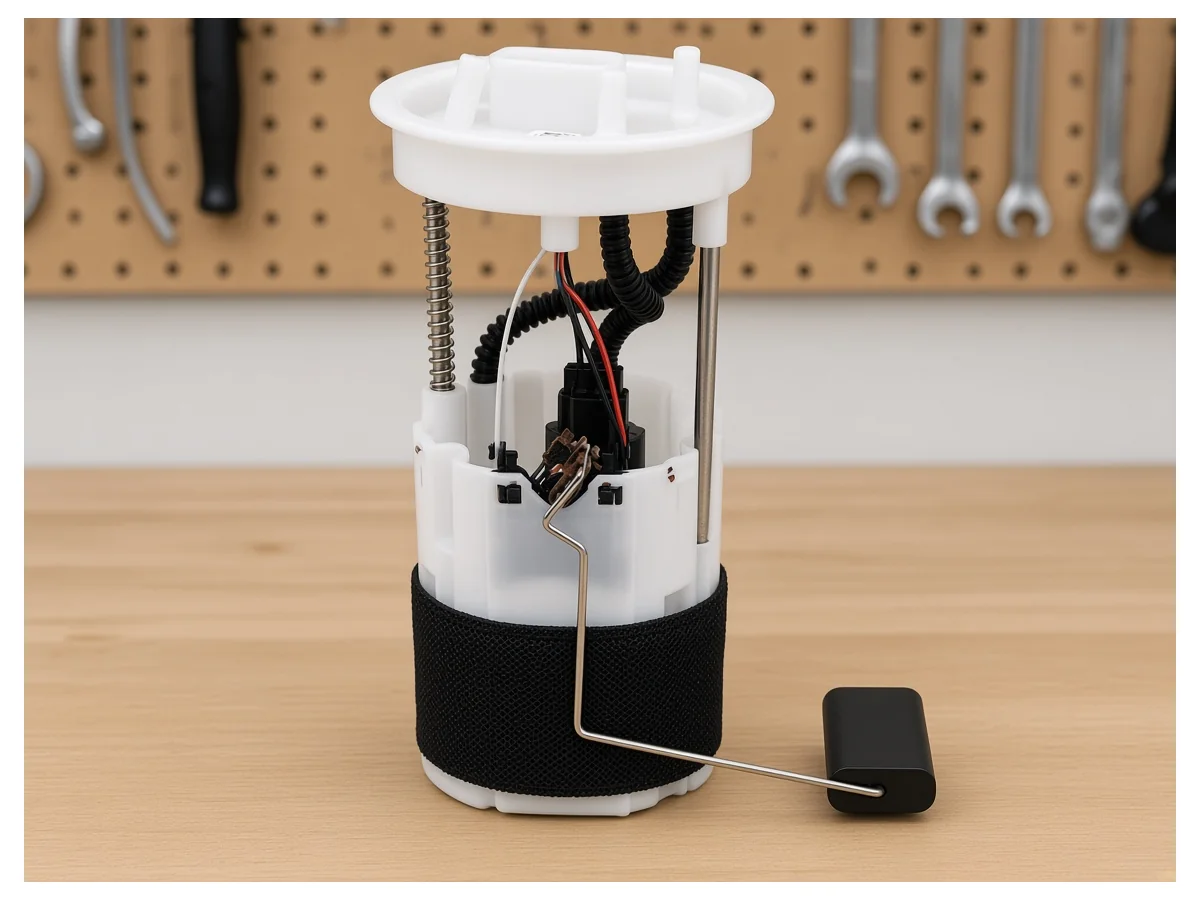
Module vs Pump-Only: Which Replacement Makes Sense
Order a complete electric fuel pump module when the hanger is aged, the sender is already wrong, the strainer is degraded, or labor to open the tank is the expensive part of the job. A full module costs more on the invoice and usually costs less in repeat labor.
Buy pump-only only when the platform supports a motor cartridge swap, the hanger and sender are confirmed reusable, and the shop accepts the risk of opening a sealed tank again.
Disassembling brittle plastic, chasing internal hoses, and resealing clamps is real work. Community threads often end with “I always replace the module” once the tank is already open.
| Situation | Prefer full assembly | Prefer pump-only (when design allows) |
|---|---|---|
| Gauge inaccurate and pump still runs | Yes – sender is usually in the module | Only if a separate sender service exists and mileage is low |
| No-start / low pressure after electrical checks | Yes when the module is the service part | Possible if hanger/sender/seal are sound |
| Contaminated tank or ruined sock | Yes – new sock and clean path | Risky if debris remains |
| Access is a full tank drop | Yes – avoid a second drop | Only with strong evidence the rest of the hanger is healthy |
A few older or specialty platforms still publish a pump cartridge separate from the sender. There, a documented pump-only order can be rational-if the remaining hanger parts are recorded and a motor-only carton is never sold as a “complete assembly.”
For most late-model EFI vehicles, the published service part is the module, and the buying decision should follow that packaging.
How to Match an Electric Fuel Pump Assembly to Your Vehicle
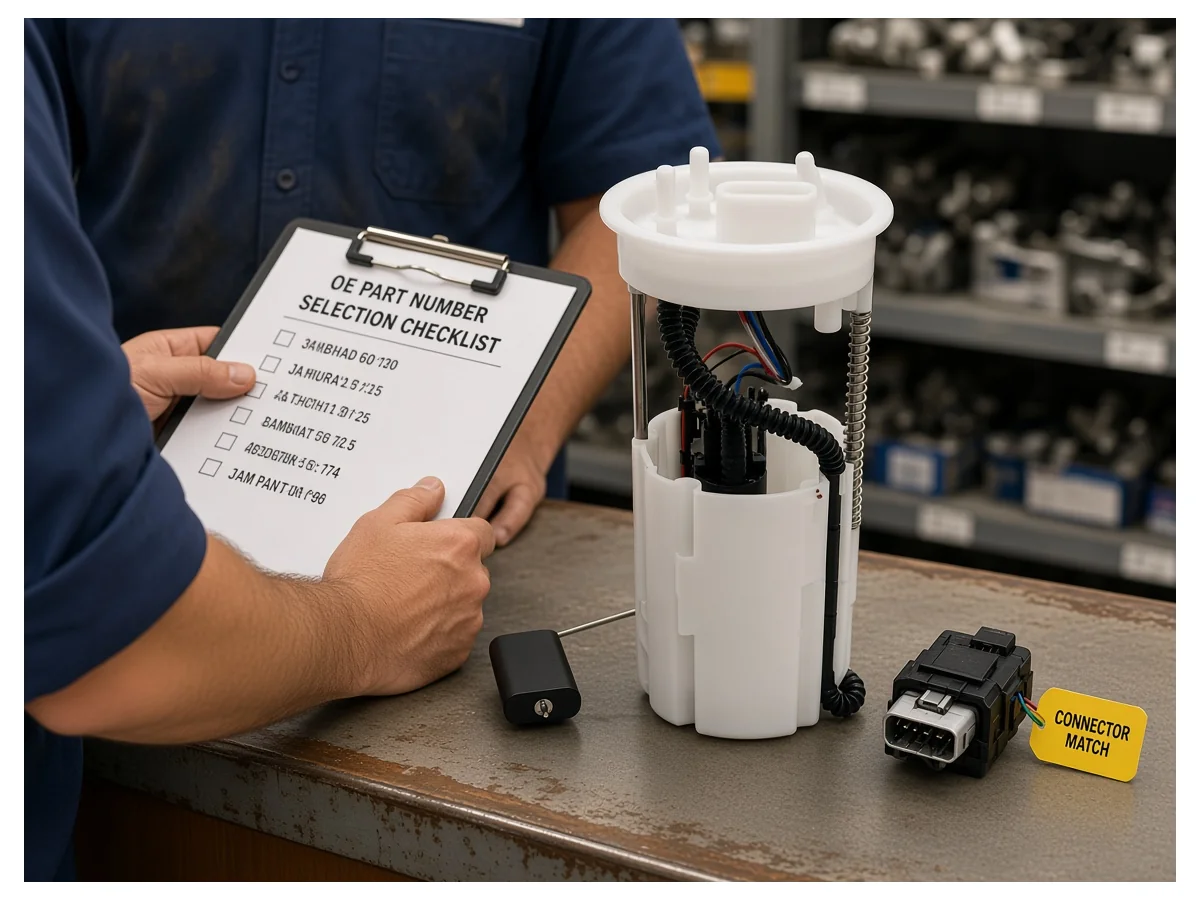
Start with identity. Record year, make, model, engine, and the OE or aftermarket number stamped on the old module.
Production splits mid-year are common enough that VIN or catalog confirmation beats guessing from the model year alone. Then match the electrical connector: pin count, keying, and terminal layout.
A pump that almost plugs in is still a wrong pump. Decide next whether the sender must be new. If the gauge already swings or sticks, buy the sender with the module.
Then confirm pressure and volume capability against the vehicle specification. A replacement motor does not need to copy the original internal pump design, but it must deliver the same operating pressure and volume class.
A stock EFI vehicle rarely needs a performance LPH upgrade marketed for modified engines; those kits answer a different job. Fleet counters can keep a short intake script: print the OE from the old flange or the EPC screen, photograph the connector, and note return versus returnless if known.
Reject “looks close” flange photos as a substitute for OE identity. That habit prevents the costly outcome in this category-a second tank drop after the first module clocks wrong or the float geometry changes between production splits.
For labeled callouts rather than buying logic, use Fuel Pump Assembly Diagram as contrast only. Aftermarket in-tank sourcing nuance lives on Aftermarket In-Tank Fuel Pump.
Standalone gasoline electric pump framing lives on Gasoline Electric Fuel Pump. Those pages do not replace OE-scoped assembly selection.
Return vs Returnless: Architecture Checks Before You Order
Confirm where pressure is regulated before the carton ships. On continuous-return systems, the pump supplies volume while a rail-mounted regulator sends excess fuel back to the tank.
On returnless systems, regulation often sits in the tank with the module, or the control module varies pump duty from a pressure sensor. A module shaped for the wrong architecture creates line, connector, and drivability mismatches even when the flange “almost” fits.
Check line count, regulator location language on the listing, and any fuel-pump control module notes in the service information before checkout.
| Check | Return-style clue | Returnless clue |
|---|---|---|
| Fuel lines at rail | Supply plus return | Supply without a return loop |
| Regulator location | Often at the rail | Often in the tank / module or via duty-cycle control |
| Listing language | May omit in-tank regulator | May list integrated regulator or FPCM control |
| Buyer risk if wrong | Extra unused port or missing return path | Wrong pressure behavior with a “looks close” flange |
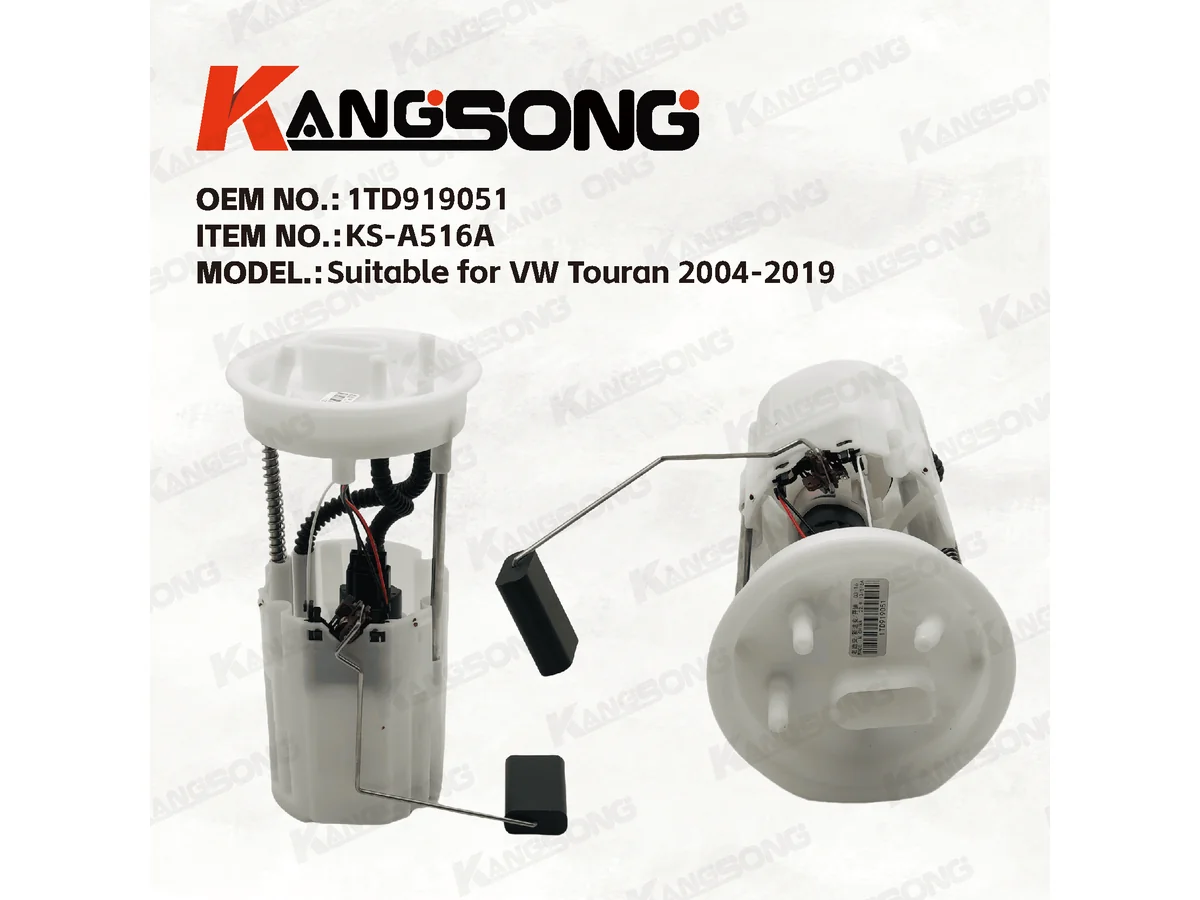
For older port-injection and throttle-body systems, in-tank electric pumps commonly work in a band around 40-60 psi (about 3-4 bar). Broader EFI teaching material often cites roughly 30-85 psi depending on the application.
Use those numbers only as orientation. They do not replace the pressure specification for the vehicle on the hoist. Direct-injection engines still rely on an in-tank supply pump, yet the engine-mounted high-pressure pump is a separate part with a separate buying path.
Checks to Run Before You Buy the Assembly
Verify the complaint before you condemn the assembly. A fuel-pressure reading is the most direct check; a failed relay or fuse is a much cheaper fix than a module.
If pressure is normal while the engine still runs lean, look at injectors, regulation, or vacuum leaks before swapping the tank unit.
Important: Pressure-test the system and check the fuel-pump relay and fuse before you order a replacement assembly. When the tank is open, inspect for rust, varnish, or sediment, and never reuse an old strainer sock-debris left in the tank or sock can kill a new pump quickly. (Source: Haynes fuel-pump assembly guidance; AA1Car electric-pump notes)
Access varies by vehicle. Some platforms open through a rear-seat or trunk panel; others require a tank drop.
The lock ring that holds the module often needs the correct spanner-forcing it risks the tank neck and the new seal. Plan tools and residual-pressure relief before the carton is on the counter.
If the vehicle is still running intermittently, note whether the gauge lies, whether the pump primes on key-on, and whether low-fuel driving has been habitual. Those notes do not replace a pressure reading, but they help the parts desk decide between module, pump-only, and further electrical diagnosis.
Choose a Printed-Fitment Electric Fuel Pump Assembly on Kangsong
When the selection checklist points to a complete in-tank assembly, open a product page whose printed Year/Model/OE title matches the vehicle-do not stretch a nearby SKU into universal fit.
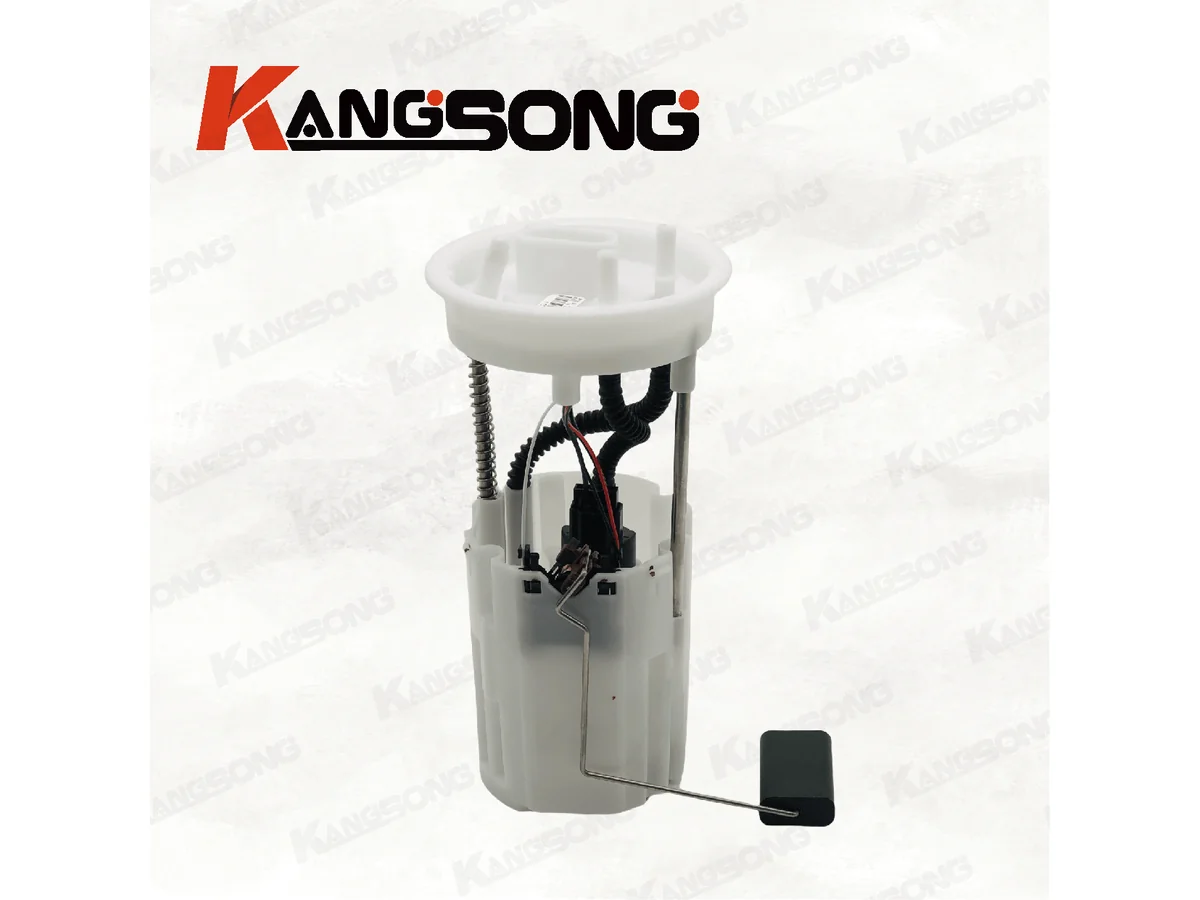
For a concrete assembly example, see the VW Touran 2004-2019 fuel pump assembly (OE 1TD919051). The listing prints applicability for VW Touran 2004-2019 with OE number 1TD919051 (KS-A516A).
Stay inside that printed window.
If the job is a printed 1987-1995 C/K pickup pump-with-installation kit requirement rather than a drop-in Touran-style module, review the electric gasoline fuel pump with installation kit (25168719 / E3902) only within its printed C/K title.
Do not treat that installation kit as a universal assembly substitute. When the vehicle sits outside those printed titles, browse the products catalog root and keep fitment language tied to whatever the chosen PDP prints.
No third-party brand equivalence is implied by either example.
FAQ
What is an electric fuel pump assembly?
It is typically the in-tank module that combines the electric pump with a strainer, fuel-level sender/float, and seals. Shops often call the same unit a fuel pump module. For a fuller definition page, see What Is a Fuel Pump Assembly?.
Is an electric fuel pump the same as the assembly or module?
No. The electric fuel pump is the motor that moves fuel. The assembly or module is the full in-tank package that usually includes the pump plus strainer, sender, and related hardware.
Can I replace only the pump motor and keep the old hanger?
Sometimes, when the vehicle design supports a cartridge swap and the hanger, sender, and seals are confirmed healthy. Once the tank is open on a high-mileage vehicle, many shops prefer the full module to avoid a second drop.
What pressure should an electric fuel pump assembly deliver?
Manifold-injection in-tank systems commonly work in the tens of psi. Educational bands around 40-60 psi or roughly 30-85 psi by application appear in technical references. Always confirm the pressure specification for the vehicle on the hoist.
Should I pressure-test before buying an assembly?
Yes. Confirm low pressure or no delivery with a gauge, and check the fuel-pump relay and fuse first. Replacing a module for a cheap electrical fault wastes the tank job.
Do I always need to drop the tank to replace the assembly?
No. Access may be through a rear-seat or trunk panel on some vehicles; others require a full tank drop. Check the service information before quoting labor.
How does return vs returnless affect the part I order?
Return-style systems often regulate at the rail with a return line. Returnless systems often regulate in the module or by pump duty cycle. Ordering across that boundary can create line and pressure mismatches even when the flange looks similar.
Where can I browse if my vehicle is not a Touran with OE 1TD919051?
Use the products catalog root and stay inside the Year/Model/OE text printed on the PDP you select. Do not assume cross-application fit from a neighboring SKU.
Why do some searches show Volvo Penta electric fuel pump assemblies?
Those results usually point at marine OEM MPI pump modules, which are a different buyer job from road-vehicle in-tank assemblies. This guide does not claim marine OE fitment or drawings for that category.
References
- Fuel pump (Wikipedia) – in-tank electric packaging and typical port-injection pressure band.
- Electric Fuel Pumps: How They Work, Why They Fail (AA1Car) – module vs pump-only, pressure/volume match, returnless notes.
- Fuel Pump And Assembly: What You Should Know Before Replacement (Haynes) – assembly contents, pressure-test, relay/fuse, access, tank inspection.
- Is there a difference between a fuel pump and a fuel pump module? (Ryan’s Auto Care) – pump vs module naming and replacement practice.
- Replacing fuel pump only vs. fuel pump module (r/MechanicAdvice) – user-language labor risk for pump-only swaps.
- Whole fuel pump or just the internal motor? (r/JeepDIY) – community preference for full assembly when the tank is open.