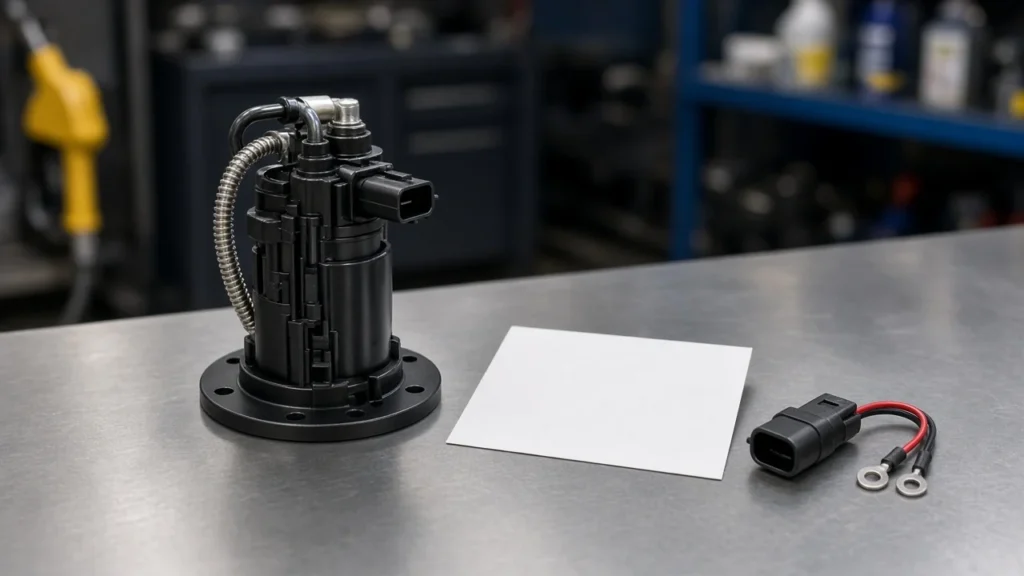
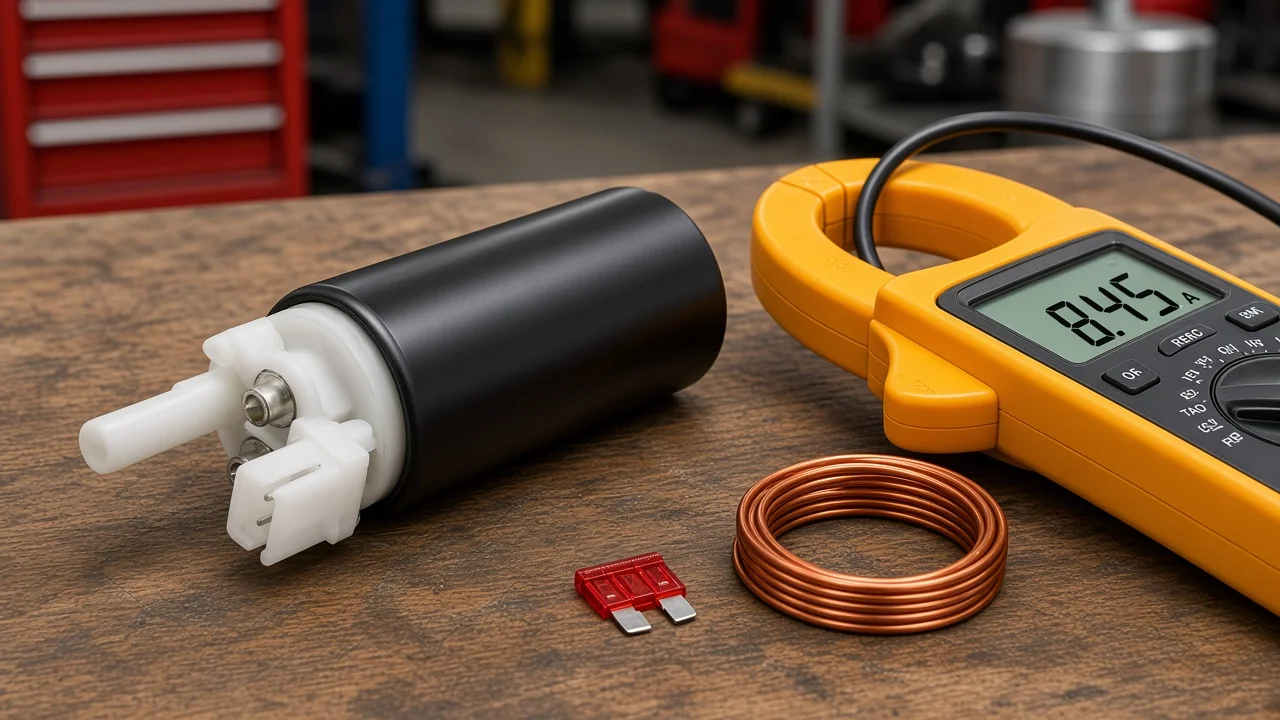
Electric fuel pump amp draw is the continuous—and sometimes peak-start—current the pump motor pulls on a twelve-volt class circuit, and that number is what you use to size the fuse and the wire after you verify it.
How many amps does an electric fuel pump draw? Training and trade sources cluster common gasoline systems into a few-amp band on low-pressure setups and higher bands on port or central-port injection, while high-demand builds can climb further.
This page turns fuel pump current draw into a fuse-and-wire selection job, then points you to a verification path before you browse kits. Relay contact worksheets, low-voltage cause maps, and full wiring novels stay on their sister pages.
Typical Electric Fuel Pump Amp Draw by System Type
Class bands exist for common gasoline systems; they are starting points, not a single universal amp rating for every pump.
When a counter asks how many amps does an electric fuel pump draw, answer with system class first. A NATEF-style training worksheet groups typical running currents by injection family and fuel pressure (psi) band: throttle-body injection around 2 to 5 amps at roughly 9 to 13 psi, port injection around 4 to 8 amps at roughly 35 to 45 psi, and central port injection around 8 to 12 amps at roughly 55 to 64 psi.
Independent tech charts often place everyday electric fuel pumps in a 4 to 12 A maximum discussion band. Port-fuel heuristics commonly add about 1 amp for every 10 psi of fuel pressure—so a port system near 45 psi often lands around 4 to 6 amps—while some technicians cite closer to 1.5 amps per 10 psi on the waveform captures they teach from.
These pump amp draw bands are orientation only until your datasheet or meter reading locks continuous current.
| System class | Typical running current | Pressure context |
|---|---|---|
| TBI / low-pressure injection | About 2–5 A | About 9–13 psi |
| Port fuel injection | About 4–8 A (often ~4–6 A near 45 psi) | About 35–45 psi |
| Central port injection | About 8–12 A | About 55–64 psi |
| High-demand / performance builds | Can exceed the chart bands; community EFI notes cite pumps drawing well into the teens or ~25 A per pump in extreme setups | Pump and duty specific |
Pulse-width-modulated pump modules and high-volume aftermarket pumps break simple psi-to-amp shortcuts. PWM pump control changes how average current appears on a meter, so treat the table as orientation, then lock a datasheet or meter reading before you buy copper or blades.
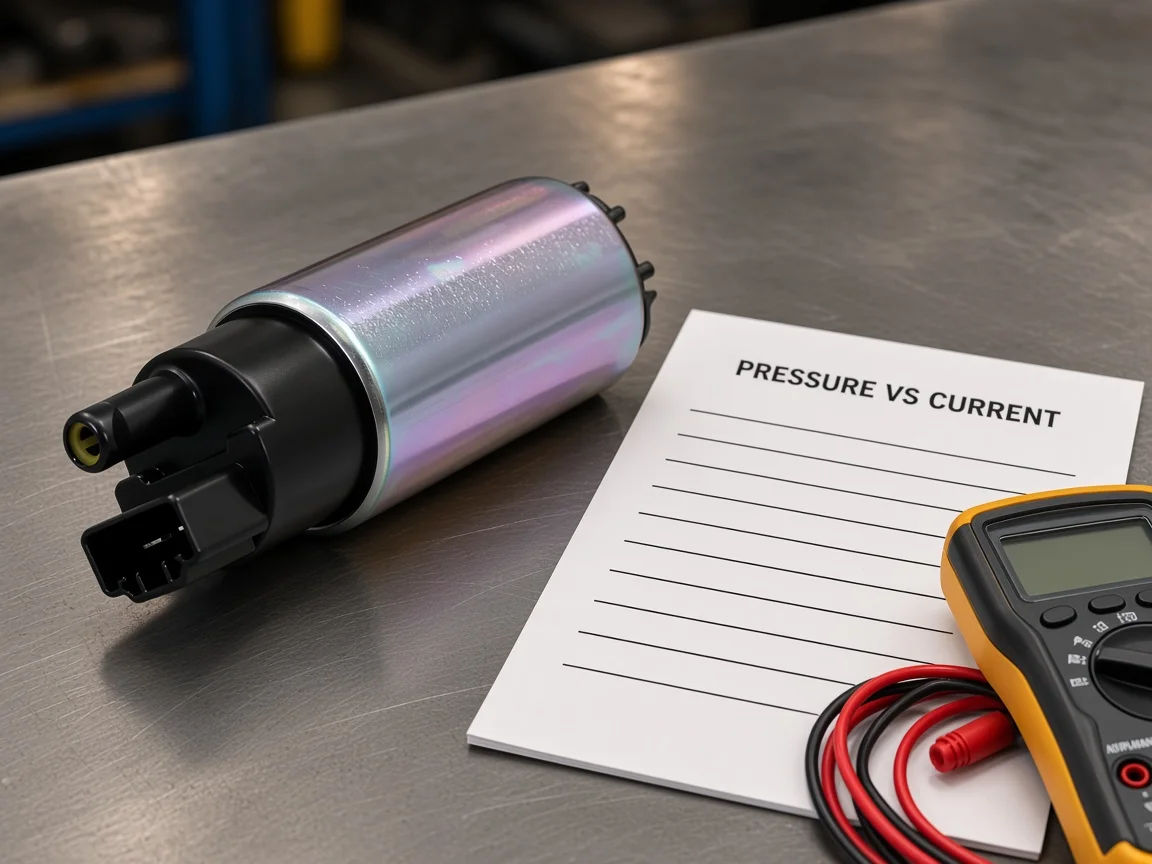
Measure or Read the Datasheet Before You Size Parts
Meter or datasheet continuous current beats any universal “normal amp” myth.
Size the fuse and the conductor from the pump’s continuous running current, with awareness of brief inrush when the motor starts. Insert an ammeter in series at the fuse cavity, or use a low-amp clamp on the pump feed, while the pump is actually commanded on. Allow the reading to settle for tens of seconds so you are not buying parts from a one-frame spike.
If the pump maker prints a continuous current, use that figure and still confirm on the vehicle when the harness, regulator, and filter are in the loop. Live Kangsong electric pump kit pages for representative SKUs publish DC 12V working voltage plus flow and pressure bands, but they do not print an amp rating—so do not invent one from the catalog photo.
Important: If paperwork is missing and you cannot measure yet, do not guess a fuse “one size larger to be safe.” Hold the electrical parts decision until continuous current is known, or pull the OE service spec for that platform. — source: HPA fuse sizing discussion
Size the Fuel Pump Fuse from Amp Draw
The fuse sits above continuous—and peak—draw with margin; it is not a tuning knob for a shorted harness.
Community EFI wiring practice often sizes fuses near 150 percent of peak current draw so normal running and brief inrush do not nuisance-open the circuit. The fuse still has to protect the wire ampacity. Upsizing a blade to stop repeated opens without finding the fault removes that protection while the short or dragging motor remains.
Keep fuse amp and relay contact amp as separate fields. The fuse protects the conductor; the relay switches the feed.
Deep fuse-blow application language belongs on the fuel pump fuses guide. Contact-rating worksheets belong on what size relay for fuel pump.
| Draw situation | Fuse selection move | What not to do |
|---|---|---|
| Known continuous amps + modest inrush | Choose the next standard blade that clears peak with ~150% community margin and still protects the wire | Install a much larger fuse “just in case” |
| Fuse opens immediately on key-on | Suspect short to ground or seized motor before buying another pack | Keep raising amp rating |
| Fuse opens after long run time | Re-check rising amp draw and restrictions | Blame “weak fuses” alone |
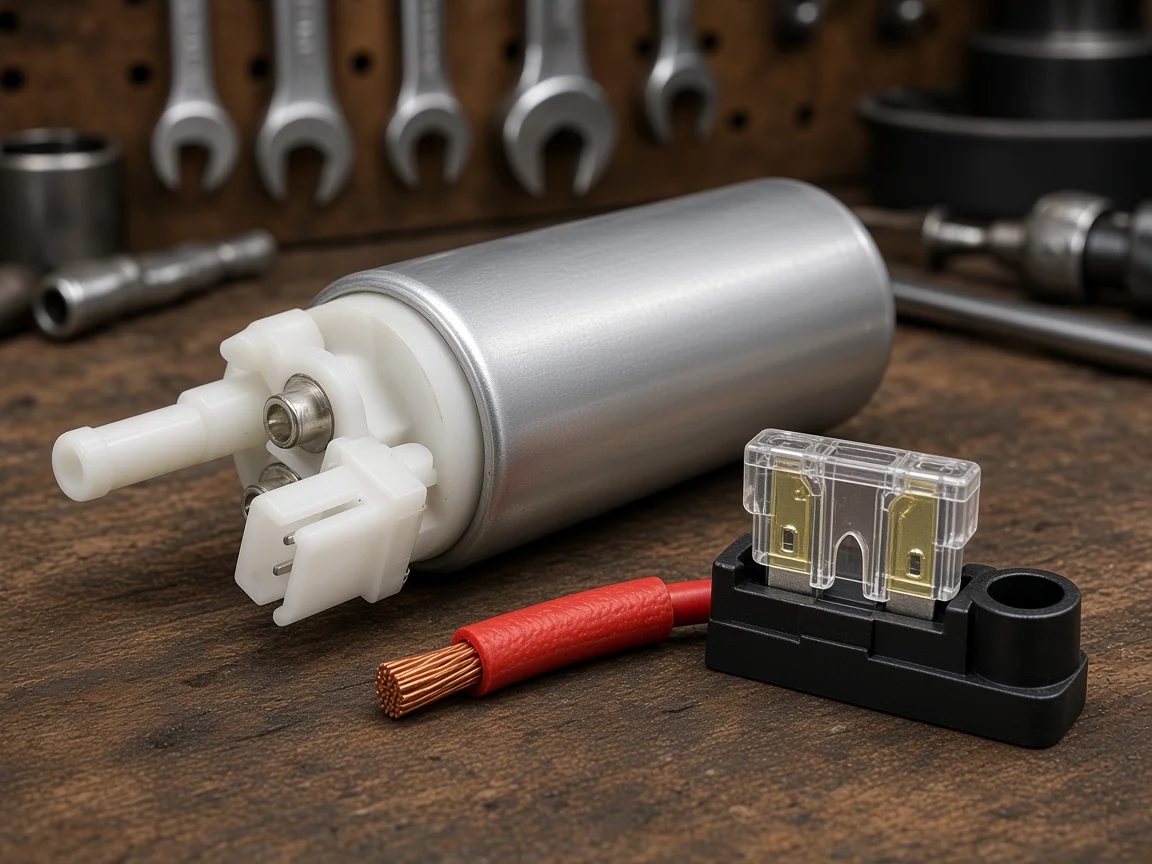
Choose Wire Gauge for Continuous Current and Run Length
Match conductor ampacity to continuous current, then upsize for long runs and under-hood heat so voltage stays usable at the pump.
AWG wire-gauge tables show why thicker copper carries more current with less resistance: for enclosed copper examples, wire gauge (AWG) 14 sits in a mid-teens to mid-twenties amp class depending on insulation temperature rating, 12 AWG steps into the twenties, and 10 AWG into the thirties. Chassis practice also cares about length. Hot Rod wiring guidance stresses heavier gauge on long battery-to-pump runs because small resistance shows up as voltage drop on a twelve-volt system.
Installers on older vehicle forums often default to 14 AWG when paperwork omits amp draw and the measured load stays moderate, and they step toward 12 AWG or 10 AWG when continuous current or run length climbs. Match the ground conductor to the feed. A relay shortens the high-current path so the heavy wire does not have to snake through every switch in the dash.
| Continuous pump current (typical) | Short run (under ~1–2 m) | Longer tank/bed run or hot bay |
|---|---|---|
| Roughly 3–7 A | 14 AWG commonly adequate with proper fuse | Prefer 14 AWG minimum; consider 12 AWG |
| Roughly 7–15 A | 12 AWG common starting point | 12 AWG or 10 AWG |
| High-demand teens to ~25 A class | 10 AWG territory after you confirm draw | 10 AWG or heavier; verify drop |
Exact chassis layouts still need a voltage-drop check under load. When the pump voltage is soft, use what causes low voltage to a fuel pump instead of only upsizing copper by habit.
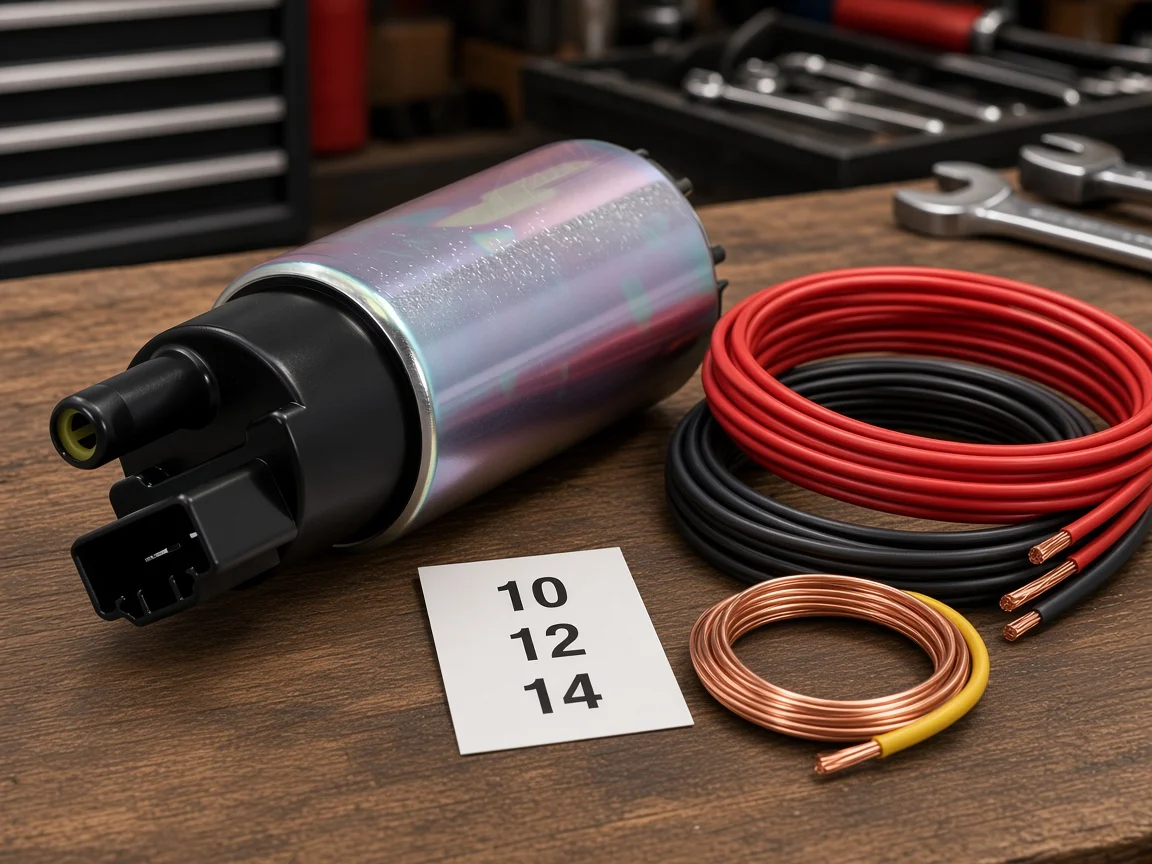
When Amp Draw Looks Too High, Too Low, or Keeps Climbing
Abnormal current is a diagnostic flag: high with poor delivery often means restriction or a worn pump, while low current with low pressure often means resistance or a soft supply.
Trade diagnostics pair current with pressure.
If pressure is low and amperage sits above spec, look for a clogged filter, pinched line, or a pump that is mechanically dragging. If pressure is low and amperage sits below spec, chase high resistance on the power or ground side, or a weak pump.
Voltage-drop guidance commonly treats more than about 0.5 V on either side of the circuit as a wiring or connector problem while the pump is energized.
From the field: Technicians describe pumps that look almost normal at first key-on, then climb from the high single digits past 14 amps toward 17–18 amps over many minutes until a 15 amp fuse opens and the circuit voltage sags. A rising amp trace after a warm-up window is a worn or sediment-dragged motor story, not a reason to fit a larger fuse and walk away. — source: r/TechniciansAdvice amp-draw thread
Clamp-meter waveforms and PWM controllers change how “average” current looks on a scope. Soft-link the low-voltage sister when the real complaint is volts at the connector, and keep this page focused on whether the amp number you measured is still valid for fuse and wire selection.
Relay and Wiring Boundaries Soft-Linked on Purpose
Relay contact class, coil voltage, and pin-by-pin harness work are adjacent jobs—use the live sisters instead of retelling them here.
A relay lets the high-current battery feed stay short and fused while a small trigger energizes the coil. Aftermarket practice often shows a common 40-amp ISO-style example on pump feeds, and professional forums remind builders that fuel pumps are among the high-current loads that need their own fused relay path. That is enough context for amp-draw selection.
For contact amp and form-factor worksheets, open what size relay for fuel pump. For twelve-volt coil matching, open the twelve-volt fuel pump relay guide or the whole-circuit electric fuel pump relay guide. For harness diagrams, open how to wire a twelve-volt fuel pump.
Verify Current, Then Browse Electric Fuel Pump Kits
Browse the live catalog after continuous current is known; do not invent amp ratings from kit photography.
Kangsong’s public products-root catalog lists electric fuel pump kits for scoped applications. Representative live kit pages show DC 12V operation plus published flow and pressure bands, but they do not print current draw. Your RFQ or shop note should carry the measured continuous amps—or the OEM/pump datasheet figure—before anyone sizes fuse and wire for that install.
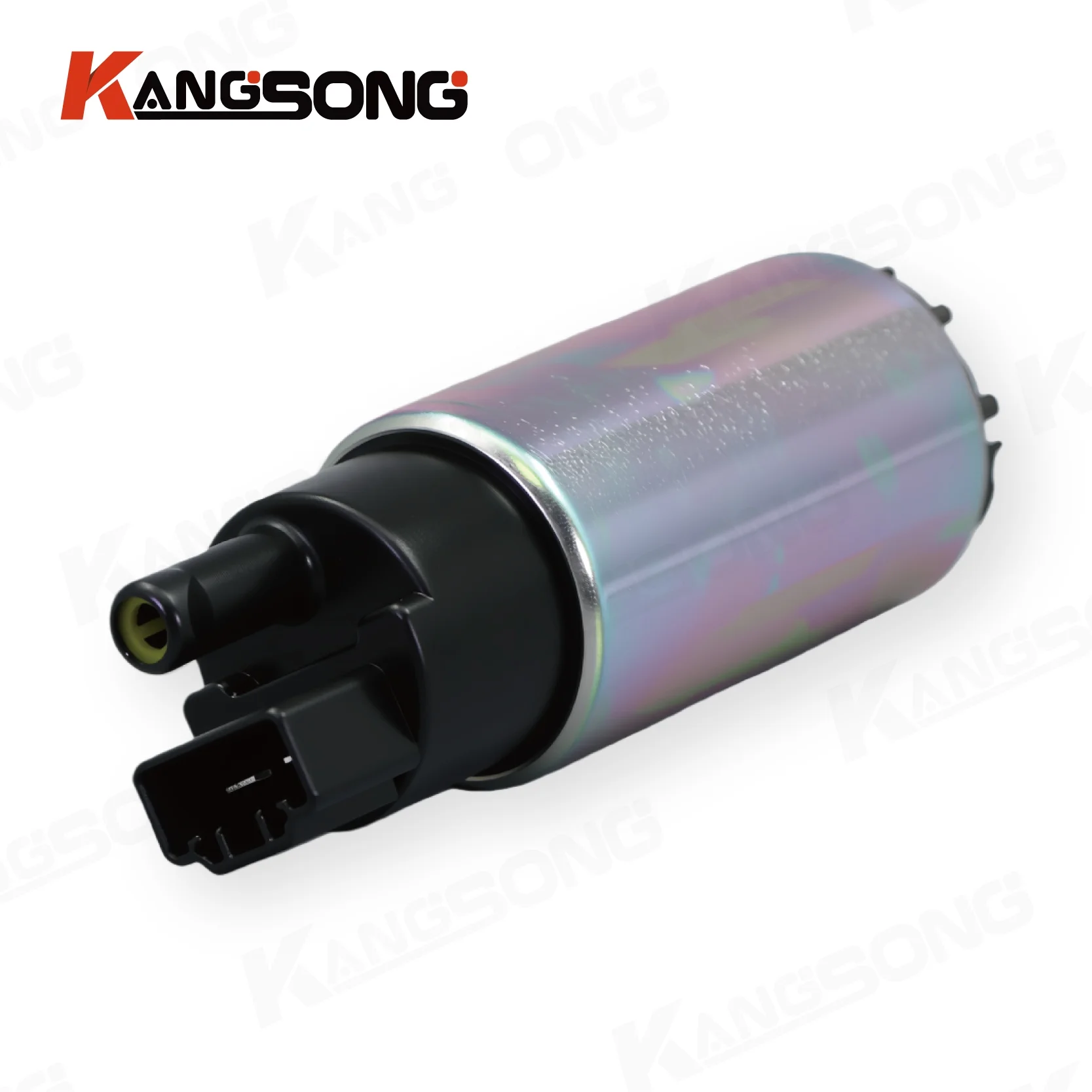
Next step: browse electric fuel pump kits, attach the verified amp figure to the inquiry, and soft-link the relay or low-voltage sisters if those checks are still open. Never treat a Sonata/Optima assembly page or an unpublished amp guess as a substitute for measurement.
FAQ
How many amps does an electric fuel pump draw?
It depends on pump design, fuel pressure, and load. Training bands often show about 2–5 A on TBI, 4–8 A on port injection, and 8–12 A on central port injection, while everyday charts discuss roughly 4–12 A max for many electric pumps—always verify your unit.
What is a normal fuel pump amperage?
“Normal” means within the OE or pump datasheet window for that system, not a single internet number. Use the class table above only until a meter or datasheet locks fuel pump current draw for the vehicle in front of you.
How do I check amp draw on a fuel pump?
Use a series ammeter at the fuse cavity or a low-amp clamp on the pump feed with the pump commanded on. Let the reading settle; compare it to the service spec or datasheet, and note whether a PWM module is in the circuit.
What gauge wire should I use for my electric fuel pump?
Start from continuous current and run length. Moderate loads on short runs often use 14 AWG; higher continuous current or long tank runs commonly move to 12 AWG or 10 AWG, with the ground matched to the feed and a fuse that protects that wire.
How should I size a fuel pump fuse from amp draw?
Community practice often places the fuse near 150 percent of peak draw while still protecting the conductor. Do not upsize the blade to hide a short, a chafe, or a motor that climbs in current as it heats.
Does higher fuel pressure always mean higher amp draw?
On many port-fuel systems, current tends to rise with pressure—about 1 amp per 10 psi is a common heuristic, with some techs citing about 1.5 amps per 10 psi. High-volume and PWM-controlled pumps can break that shortcut, so measure.
Why is my fuel pump amp draw rising over time?
A climbing amp reading after minutes of run time often points to a dragging or sediment-loaded pump motor, and it can open a correctly sized fuse while sagging shared circuit voltage. Confirm with a time-based amp check before replacing unrelated sensors.
Can I use Kangsong pump pages for amp ratings?
Live representative kit pages publish DC 12V and flow/pressure bands but not amp draw. Verify continuous current from measurement or an OEM/pump datasheet, then browse the product catalog.
References
- James D. Halderman — Fuel Pump Current Draw Test (NATEF worksheet PDF)
- Rick Muscoplat — How many amps a car uses while running
- Wikipedia — AWG wire gauge
- High Performance Academy forum — Sizing relays
- r/TechniciansAdvice — GM TBI Idle Surge fuel pump amp draw…
Humanizer self-audit (Draft Agent KS-DRF-AMPDR-C): problem-led open; focus bold once; no Claim-ID bleed; sibling fences lateral; second pass varied paragraph rhythm and removed meta-process language; no invented 2551/2552 amp figures. Humanizer audit: PASS.