A fuel pump harness connector pigtail repair kit is the short leaded plug package counters use to restore power—and often fuel-gauge circuits—when the original connector is melted, corroded, or fatigued. This article covers what belongs in the kit, which failure cues point to the plug instead of a “dead pump,” which specs to capture before you quote, and when a documented assembly route is the next step. It is selection and triage for parts counters—not a full wiring-diagram handbook.
What a Fuel Pump Harness Connector Pigtail Repair Kit Includes
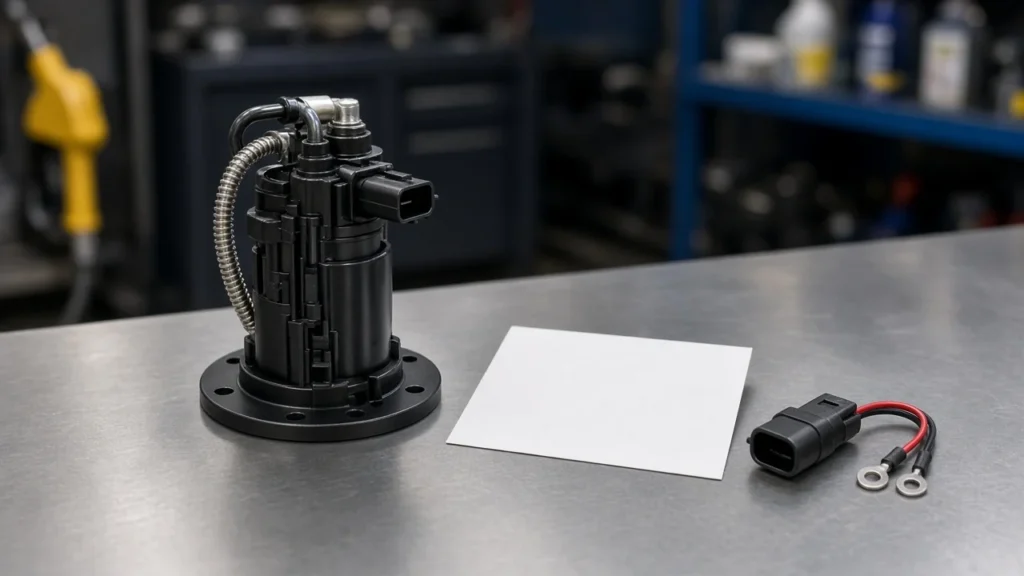
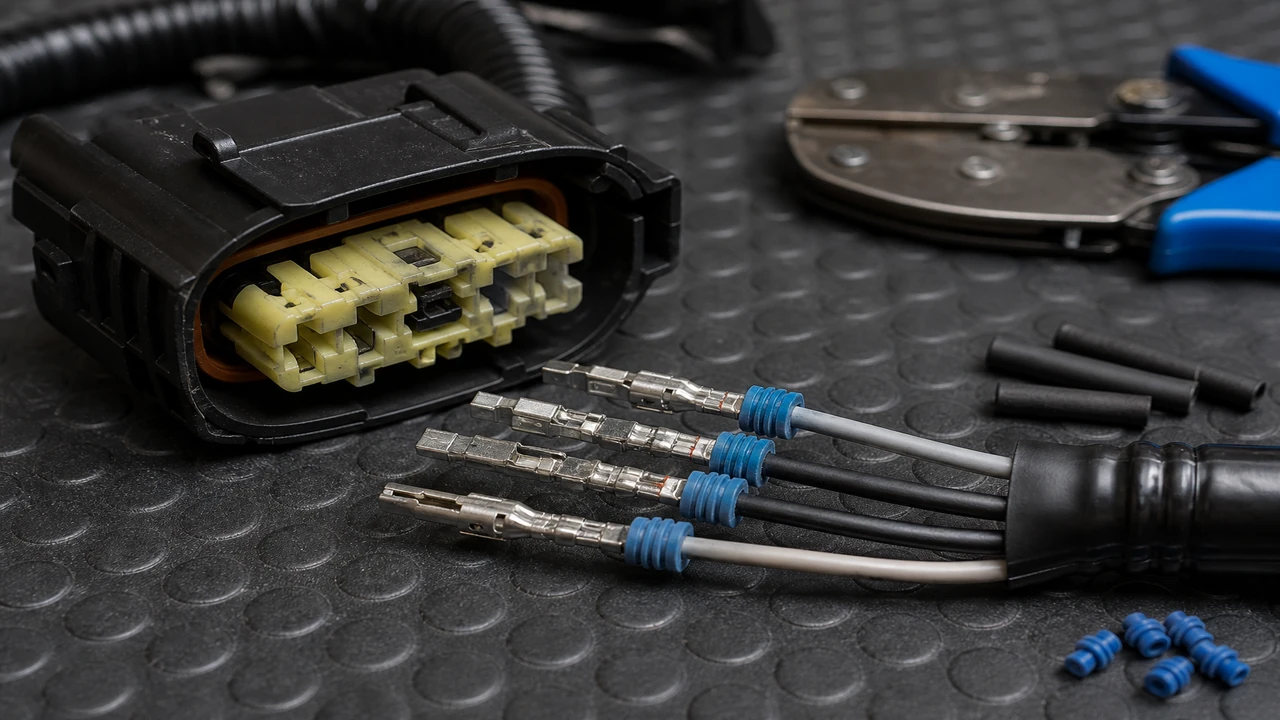
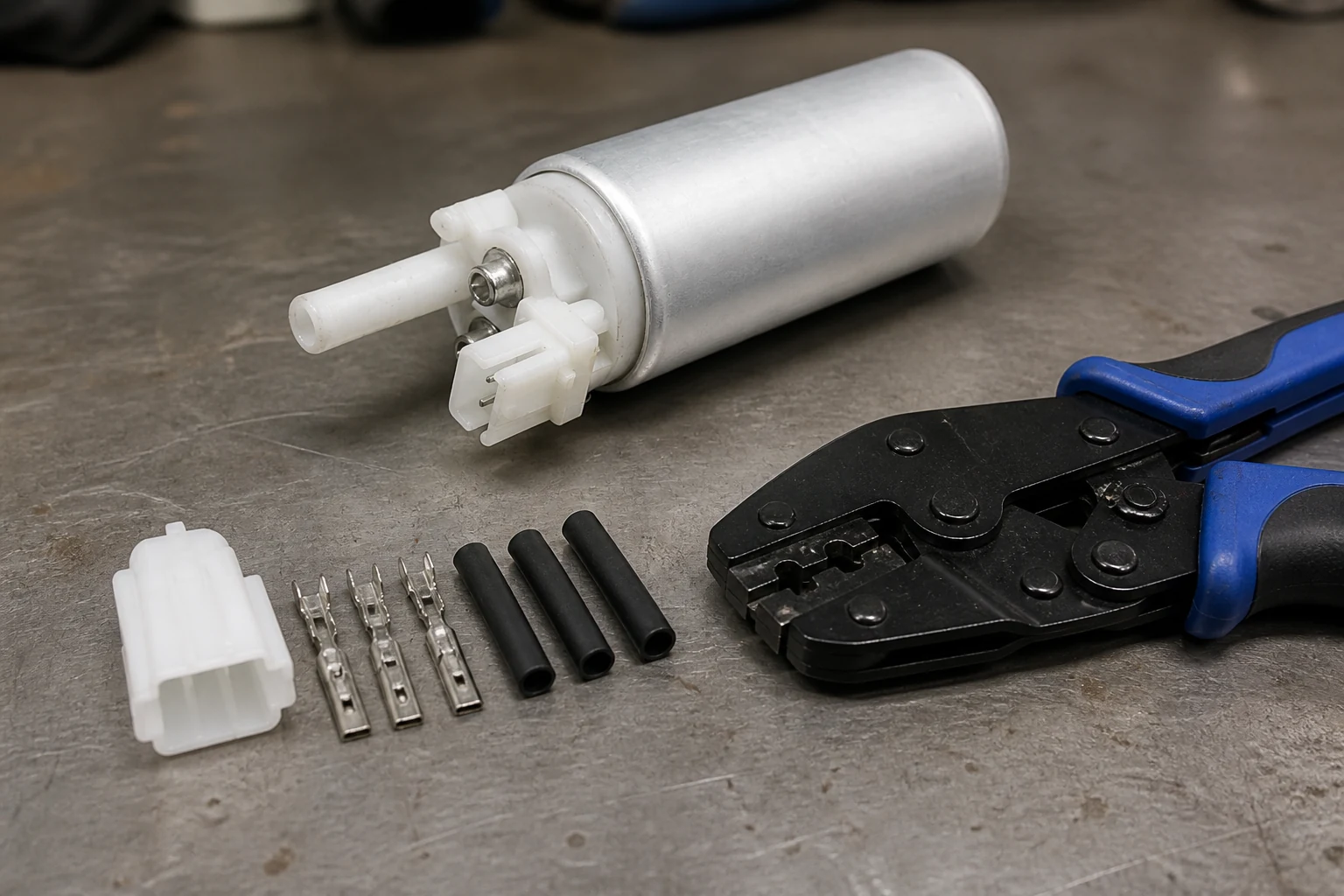
Counters stock a fuel pump pigtail as a short connector-and-lead package—often with butt splices and adhesive heat-shrink—so the vehicle harness can be restored at the fuel pump or module interface.
It is not a complete chassis harness and not a substitute for platform wiring diagrams. Catalog listings show the same “fuel pump harness connector” idea sold as a body-only piece, a bare pigtail, or a complete kit with splices and shrink tubing. Module suppliers also treat a new pigtail as part of protecting a replacement pump connection, not as optional tape.
| Kit level | Typical contents | Counter use |
|---|---|---|
| Connector body / terminals only | Housing and terminals | Only when leads behind the plug are undamaged |
| Bare pigtail | Connector + short leads | When you will supply your own sealed splices |
| Complete pigtail kit | Leads + butt splices + adhesive heat shrink (+ instructions) | Default when heat damage reached the original crimp area |
Ask which level is in the box before you promise a “plug-and-play” fix. A body-only SKU will not solve melted wire insulation two inches behind the old connector face.
Melt, Corrosion, and Intermittent Power Patterns
Heat-damaged fuel pump connectors usually announce themselves with intermittent delivery, hard starts, stalling, or a burned smell—often while a fuse still looks intact.
Loose terminal tension, dirty contact faces, and corrosion raise resistance at the pin. Current through that resistance turns into heat at the plastic housing.
A worn or restricted pump can also pull more current than design load. If that draw stays under the fuse rating, the fuse may survive while the connector cooks. Shops that only swap the pump then see the same melt pattern return on the new unit.
| Field cue | What it often means | First counter question |
|---|---|---|
| Charred, warped, or browned plastic at the pump plug | High resistance or overdraw at the connector | Was the vehicle-side connector replaced or only the pump? |
| Green/white crust on terminals | Corrosion raising contact resistance | Is the replacement sealed against moisture and vapor? |
| Intermittent no-start that “clears” after unplug/replug | Marginal contact wiped temporarily | Do you have heat discoloration or loose pin tension? |
| Pump replaced twice; same burned pin location | Recurring high current or reused damaged harness | Was tank debris / overdraw checked with the connector? |
From the field: Community threads describe multiple fuel pumps dying with a burned corner pin on the connector—evidence that heat at the interface can outlast a single pump SKU. Treat repeated pin burns as a harness-and-load problem, not only a random bad pump. (Source: Mechanics Stack Exchange API record — burned fuel pump connector pins.)
Important: A fuse that still tests good does not prove the connector is healthy. Sustained current below the fuse rating can still melt terminals and housings. (Source: Mechanics Stack Exchange API — burned fuel pump connector pins; NHTSA recall docs in References.)
Spec Checklist: Terminal Count, Wire Gauge, and Kit Level
Select the kit by terminal count, circuit roles, wire gauge split, and whether splices are included—not by a photo that “looks close.”
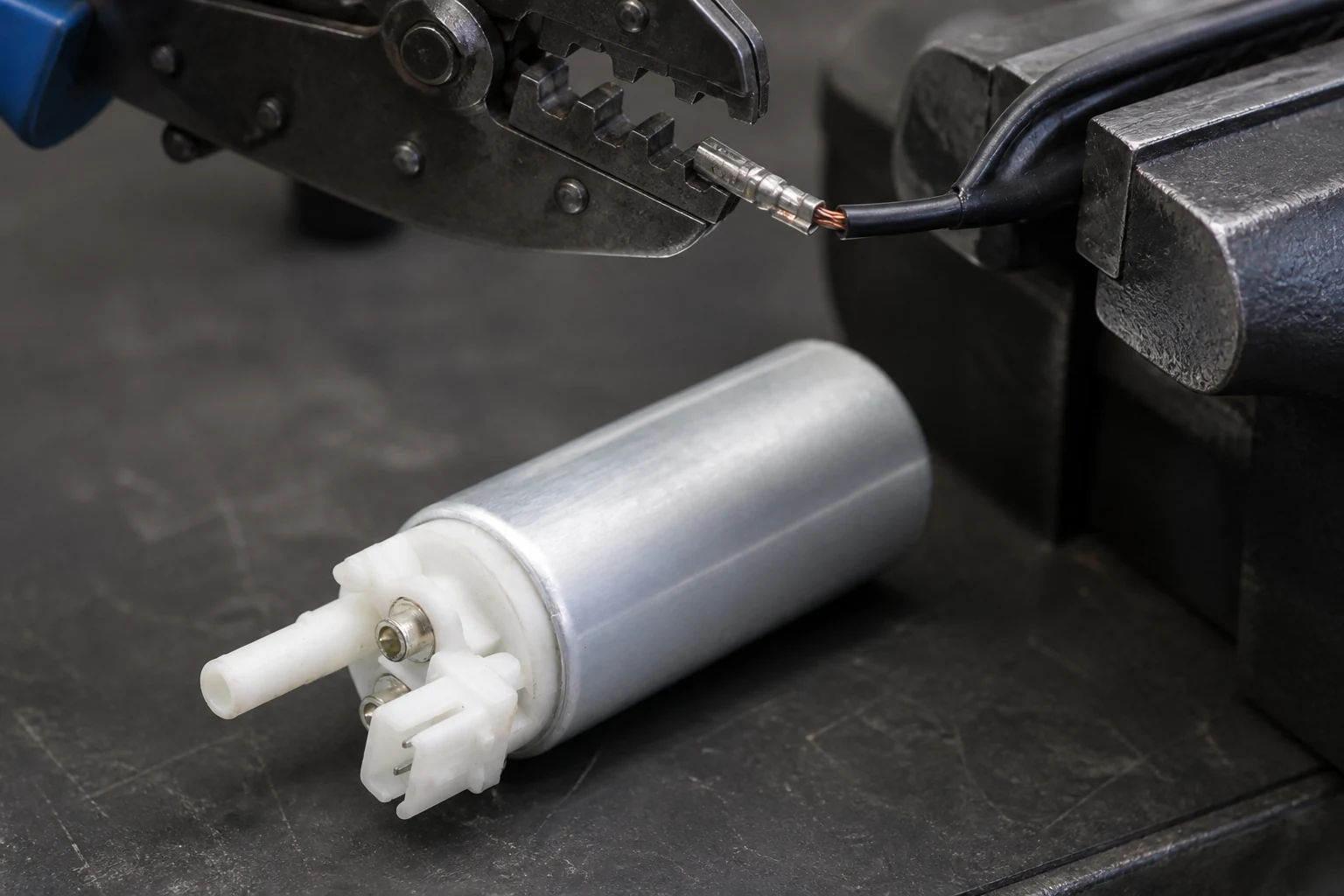
Capture Wire gauge (AWG) separately for pump power versus sender leads, confirm Connector keying so the housing cannot be forced onto the wrong flange, and record Pinout by cavity role rather than insulation color. Prefer Adhesive-lined heat shrink / sealed splice media on heat-damaged repairs.
Contact resistance at dirty pins turns normal current into housing heat. Escalate to a Fuel pump assembly / module only after connector and supply checks.
Common architectures run from two terminals on simple pump-only plugs, to three or four on combined pump-and-sender housings, to five or six when dual senders or extra tank signals share the connector. A two-pin body that partially seats on a four-pin flange can spin the pump while the fuel gauge stays dead—and the return will be blamed on the “new pump.”
Capture these attributes on the counter ticket:
- Terminal count (Pin / cavity count) matching the module flange, not only the pins the shop “cares about today.”
- Circuit map for pump power, pump ground, sender signal, and any sender reference/ground.
- Wire gauge split — pump power/ground leads are commonly heavier (often in the 12–14 AWG class) than sender leads (~18 AWG). Uniform thin “signal” wire on the pump feed is a red flag.
- Kit level — body only, bare pigtail, or complete kit with adhesive-lined splices.
- Sealing intent — tank-area connectors live with fuel vapor and road moisture; weather-sealed splices matter.
- Heat-affected length — if the old insulation is browned behind the plug, the splice point must land past that damage.
If the buyer needs GM color-code reference for a module replacement rather than kit attribute matching, point them to the existing GM fuel pump wire colors harness reference instead of stretching this page into a pinout atlas.
When Connector Repair Is Enough—and When the Assembly Is Next
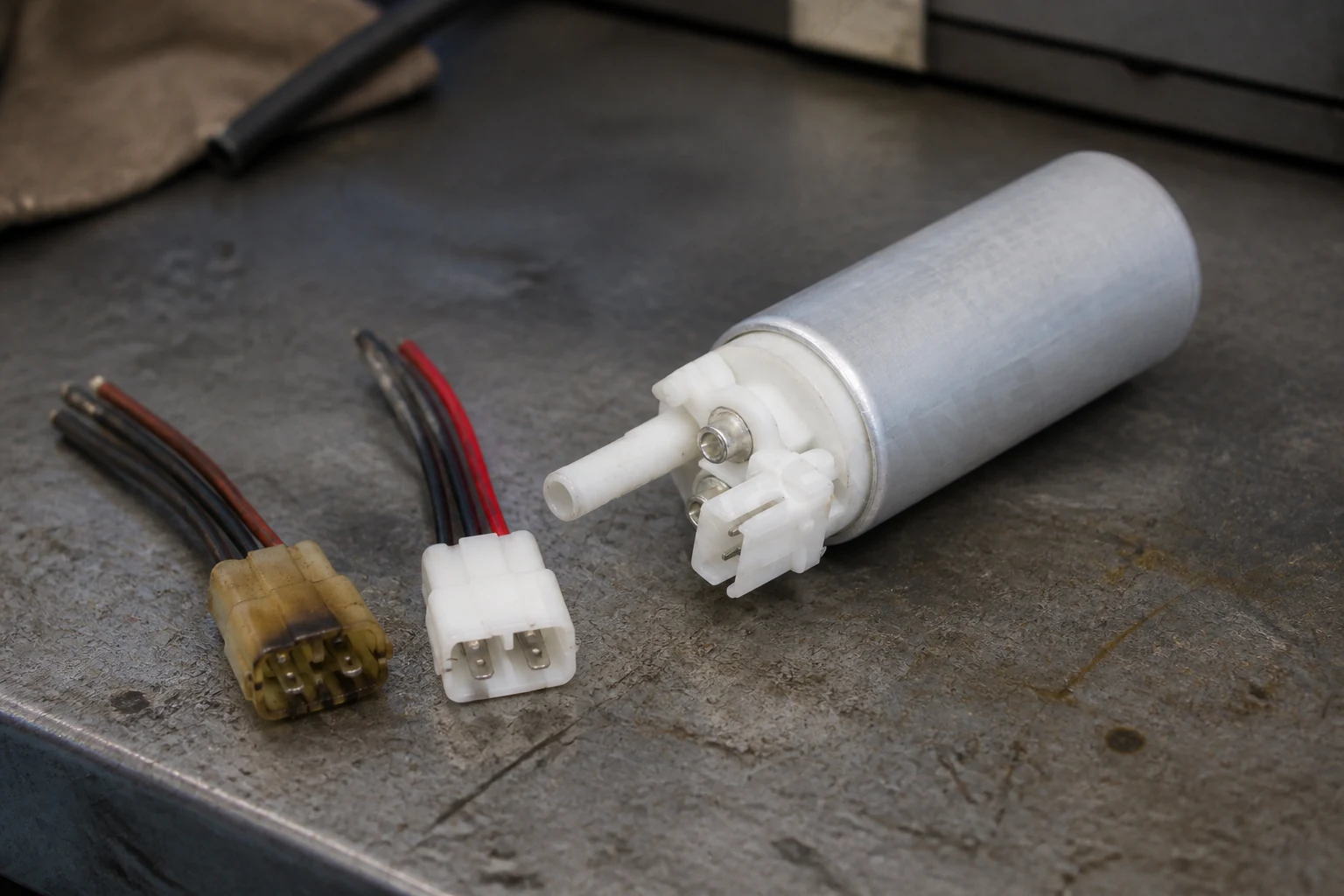
Repair or replace the damaged vehicle-side connector whenever heat or corrosion is visible—even if a new pump is already on order. Escalate to a fuel pump assembly or module when the pump itself failed, the flange side is melted, or loaded electrical checks still fail after a correct pigtail install.
Safety-recall documentation shows how improper connector pin work can raise resistance, generate heat, and deform flange plastic and sealing surfaces—sometimes requiring both a repair harness and a pump replacement on the affected platforms. Separate GM documentation describes terminal overheat that melts flange material near the terminal and calls for module plus jumper-harness replacement on the named vehicles. Those campaigns are not universal kits, but they prove why “pump only” or “connector only” guesses fail when both sides are heat-damaged.
Decision cues for the counter:
- Connector-first: Visible melt/corrosion on the vehicle harness plug; pump still spins and builds pressure once solid voltage arrives under load.
- Both sides: Flange plastic deformed around terminals; prior pump failed with burned pins; odor of fuel near the connector area after heat events.
- Assembly-next: Pump locked, noisy, contaminated, or still fails pressure after a correct sealed pigtail and verified supply/ground.
- Lookalikes: Silent prime with a blown fuse, or relay socket heat, belong on separate paths—see fuel pump fuse blown symptoms, fuel pump relay failure signs and bad fuel pump symptoms for distributors.
Do not sell a new assembly as a silent substitute for an unrepaired melted harness. The new unit will inherit the same resistance heat.
Counter Interview Questions Before You Quote the Kit
Before you release a pigtail SKU or an assembly quote, lock heat evidence, pin count, and whether voltage was checked under load.
Open-circuit meters can lie. Community cases show 12 V present at the connector with the pump unplugged, then voltage collapsing as soon as the pump load is connected—classic high-resistance wiring upstream of a “good looking” reading.
Ask:
- Is there discoloration, melt, or corrosion on the vehicle-side connector, the pump flange, or both?
- What is the exact terminal count on the module, and does the gauge circuit share that plug?
- Was voltage measured with the pump connected and commanded on—or only with the plug hanging open?
- Has a pump already been replaced into this harness without a pigtail repair?
- Are you requesting a body-only connector, a bare pigtail, or a complete splice kit?
- If the pump still fails after a sealed repair, which platform and OE references define the next assembly?
Write those answers on the ticket. They prevent the common loop of “new pump, same no-start” that burns trust faster than it burns plastic.
When a Documented Assembly Example Is the Next Step
When connector repair is complete and pump or module demand is confirmed for a listed platform, move to documented assembly pages—not another guess at a universal plug.
For a concrete Path① example, use Kangsong’s fuel pump assembly compatible with Hyundai Sonata / Kia Optima. That page supports the platforms and references shown there. It does not prove that every pigtail kit on the market mates to that assembly, and it does not authorize FASS, AirDog, Facet, or Bosch equivalence claims.

From there, browse the products hub for family navigation, read about for company context, or contact with the platform evidence already captured on the work order.
FAQ
What is a fuel pump harness connector pigtail repair kit?
It is a short connector-and-lead package—often with splices and heat shrink—used to restore the electrical interface between the vehicle harness and the fuel pump or module after the original plug fails.
Can a bad fuel pump melt the connector?
Yes. A pump that draws excess current can overheat terminals and melt the housing, especially when contact resistance is already high. The fuse may still be intact if the draw stays under its rating.
How do I choose the right pigtail kit at the counter?
Match terminal count and circuit roles to the module flange, confirm pump vs sender wire gauge, and confirm whether the box includes sealed splices or is body-only.
Should the pigtail be replaced when installing a new pump?
If the vehicle-side connector shows heat, corrosion, or loose pins, replace or repair it with the pump. Plugging a new pump into a damaged harness is a common repeat-failure path.
Why does open-circuit voltage look normal until the pump is plugged in?
Open-circuit voltage can look normal across a high-resistance fault. Under pump load, voltage collapses. Prefer loaded checks before condemning the pump alone.
Connector-only vs complete kit—what should we stock?
Stock complete kits with adhesive-lined splices for heat-damaged repairs. Keep body-only pieces for undamaged lead repairs where the housing alone failed.
When is a full assembly the next quote—not another connector?
When the pump motor, flange, or module has failed—or when sealed connector repair and verified supply still leave pressure or delivery short—quote a documented assembly for the platform.
Is this the same as a GM wire-color harness guide?
No. Color-code reference for module replacements is a different reader task; use the GM harness color article when the buyer already knows they need wire identity maps rather than kit attribute selection.
References
- NHTSA-hosted recall documentation: in-tank pump connector resistance and heat damage — improper connector pin crimps can raise resistance and melt or deform flange plastic and sealing surfaces; remedy language includes a repair harness.
- NHTSA-hosted recall documentation: fuel pump module terminal overheat — electrical terminal overheat can melt flange material near the terminal; correction replaces the fuel module and tank jumper harness on the named vehicles.
- Mechanics Stack Exchange API record: burned fuel pump connector pins on repeated pump failures — community report of burned corner pins accompanying successive fuel pump failures.