Diesel high pressure fuel pump failure symptoms on a work truck usually show up as hard starting, power loss under load, surging, stalling, rail-pressure fault codes, or metal in the fuel filter — but the same clues can come from a weak lift pump, clogged filter, stuck fuel control actuator, or injector return problem. This article maps those symptoms to the evidence a diesel service counter should collect before quoting a high-pressure pump. It stays on field diagnosis and counter checklists; it is not a CP4 sourcing guide (see the separate CP4 failures and high-pressure diesel pump sourcing article) and not a gasoline bad fuel pump symptoms encyclopedia.
Map Diesel HPFP Failure Symptoms Before You Quote a Pump
Diesel HPFP complaints cluster into drivability symptoms, scan evidence, and physical fuel-system signs — and a good counter triages all three before opening a pump catalog.
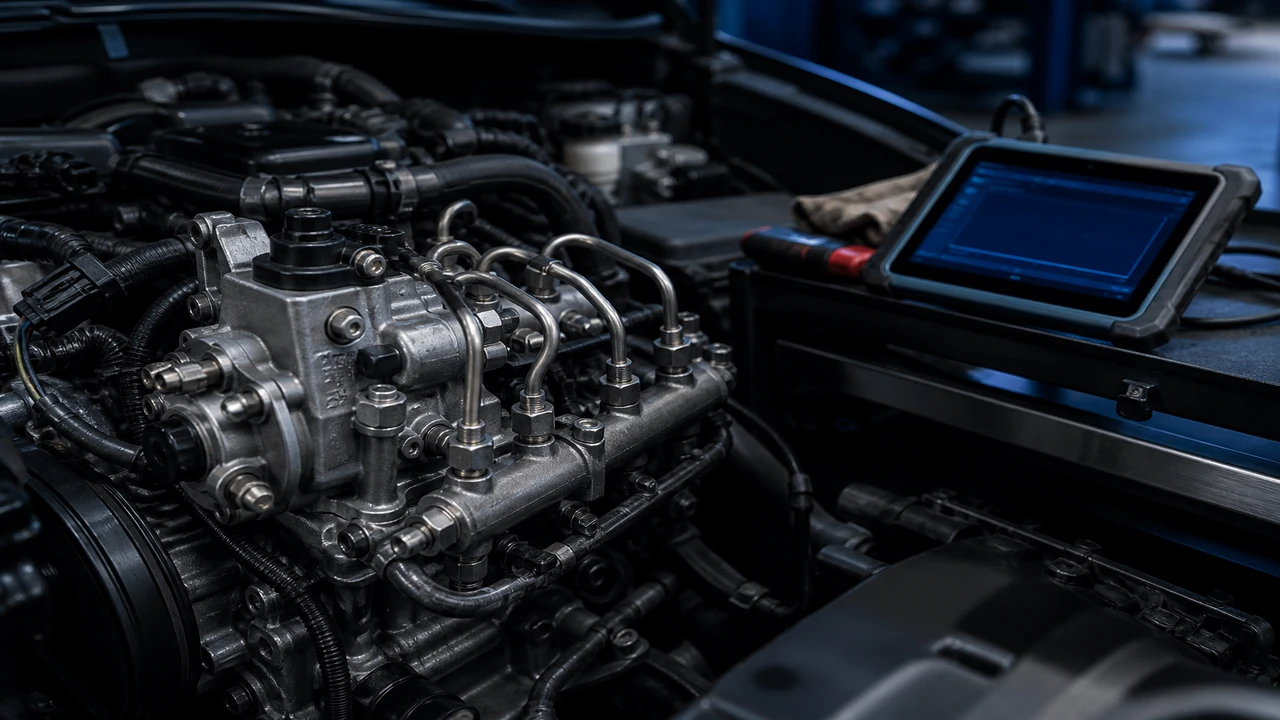
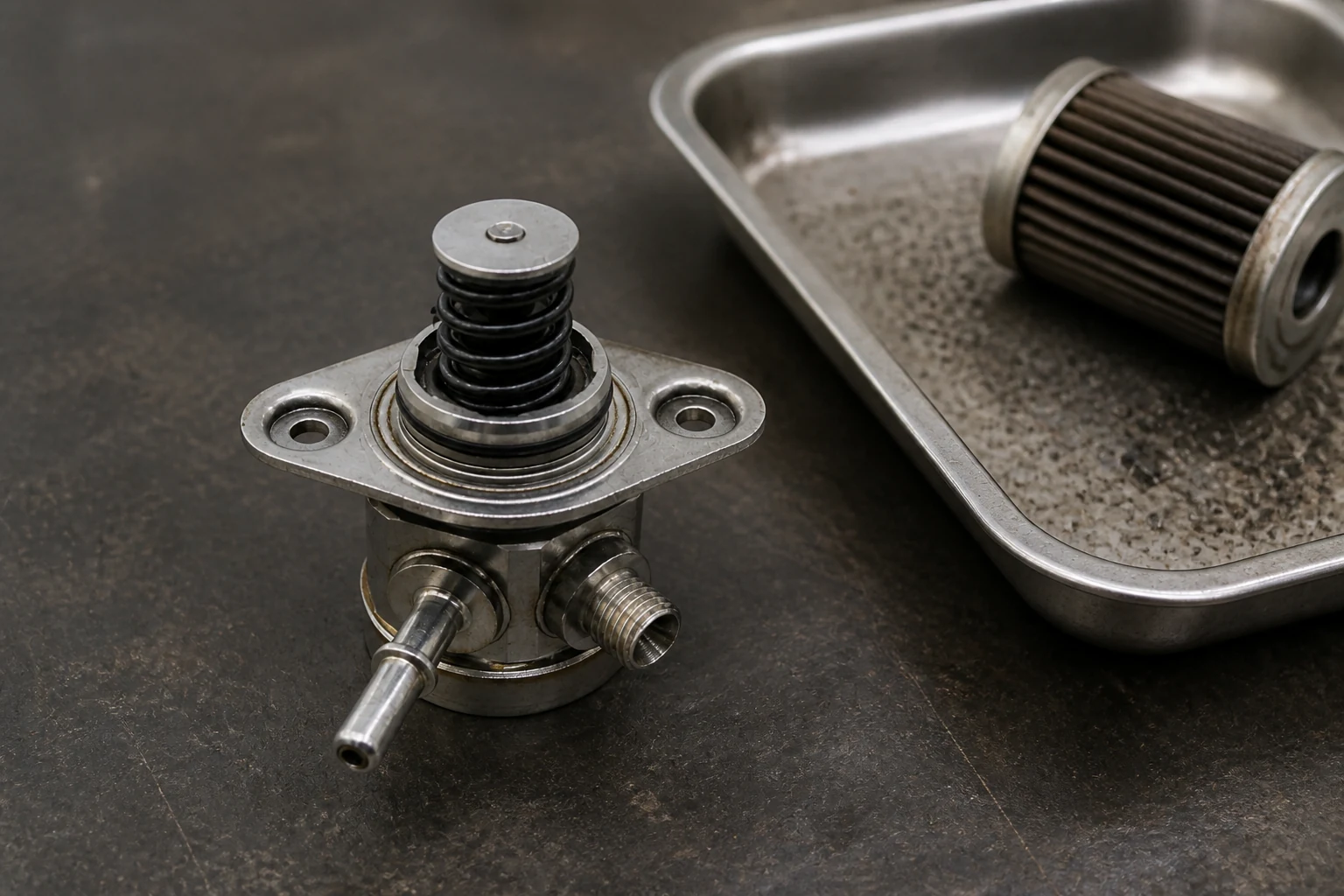
The high-pressure fuel pump (HPFP), sometimes called the diesel injection pump on common-rail trucks, raises low-pressure supply fuel to the rail pressure injectors need. When internal wear begins, drivers and fleet desks often report hard starts, hesitation, power loss while towing, unexpected stalling, or a crank-no-start after the truck sat. Scan tools commonly show fuel-rail-pressure faults such as P0087 (pressure too low) or, on some platforms, related high-side pressure codes.
Those symptoms are possible HPFP warnings. They are not automatic proof the pump failed. Technical articles on common-rail platforms stress that filters, lift-pump supply, metering valves, injectors, sensors, and wiring can produce the same driver story.
U.S. highway diesel has been ultra-low sulfur diesel (ULSD) since 2006, with sulfur capped at 15 ppm per EPA fuel guidance. That context matters for how shops maintain filtration and water separation — but it does not, by itself, tell you which component failed on today’s ticket.
| Symptom or signal | What the driver/shop usually reports | First evidence to capture |
|---|---|---|
| Hard start / extended crank | “Turns over longer before it fires” | Rail pressure during crank; lift supply; filter age |
| Power loss under load | “Fine empty, dies towing” | Commanded vs actual rail pressure under load |
| Surge / hesitation | “Hunts on acceleration” | Freeze-frame codes; fuel pressure stability |
| Stalling / shutdown | “Quit on the highway” | Codes at stall; whether restart is immediate |
| Rail-pressure codes | P0087 or platform equivalents | All active and pending fuel codes, not one alone |
| Metal in filter bowl | “Glitter when we changed the filter” | Fuel filter inspection photos; stop-run status; contamination scope |
Keep diesel HPFP tickets on a separate board from gasoline in-tank electric pump returns. Mixing those complaint types creates false “quality spikes” and wrong SKU quotes.
Read Hard Start, Extended Crank, and No-Start Clues
Hard starting and extended cranking often mean the common rail is slow to reach the pressure the ECM expects — not necessarily that the HPFP is completely destroyed.
A diesel engine needs adequate rail pressure before reliable combustion. A worn or failing HPFP may take longer to build that pressure, especially when cold or after the truck sat. The same pattern appears when the lift pump cannot fill the HPFP inlet, when air enters the low side, or when filters are restricted.
For counter staff, start questions should be concrete:
- Does the engine crank normally but fail to fire, or fail to crank at all?
- Does ether or repeated key cycles change the outcome?
- Was the fuel filter changed recently — and was the bowl inspected?
- Does rail pressure build during crank on a scan tool, per the platform service information?
A shop that only says “won’t start” without crank-time rail data forces you to guess between supply, air, and HPFP wear. Ask for the scan capture or a photo of the live data screen.
Crank-no-start after long storage also invites contamination and gelled-fuel questions in cold markets. Document fuel condition and filter service date before you treat the ticket as a pump quote.
Capture Power Loss, Stalling, and Rail-Pressure Divergence
Power loss under load and unexpected stalling are classic diesel high pressure fuel pump failure symptoms — when actual rail pressure cannot keep up with ECM command.
Fleet units often run fine at idle or light throttle, then fall flat climbing a grade or pulling a trailer.
Scan data may show actual rail pressure trailing commanded pressure under load. Fault codes may include P0087 or platform-specific high-side pressure faults.
Those codes identify a fuel-system pressure problem; they do not, by themselves, name the HPFP as the failed part.
From the field: On a CumminsForum thread, an owner described full-throttle driving with very low rail pressure and almost no power after major fuel-system work, later tracing part of the fault to an FCA connector mismatch. The lesson for counters is familiar: low rail under load is real, but the root cause may still be electrical, metering, or supply — not the pump casting you are about to quote. (Source: CumminsForum — Fuel rail pressure problems, no power.)
When a shop calls with “no power,” capture:
- Whether the truck enters limp mode or sets a check-engine light
- Freeze-frame rail pressure at the event if available
- Whether power returns after a key cycle or stays gone until cool-down
- Tow/load condition when the fault appeared
Stalling on the highway with immediate restart can still be fuel pressure related. Treat intermittent stalls as a data-collection job, not a single-part guess.
Note Surge, Hesitation, and Pump-Area Noise
Surging, stuttering, and hesitation during acceleration often track inconsistent rail pressure as the ECM tries to hold command with a weakening pump or a sticking metering valve.
Drivers describe this as the truck “surging,” “missing,” or “bogging” when the throttle moves. Rough idle that smooths when RPM rises can also appear when pressure regulation is unstable.
Some technical write-ups add a secondary physical clue: a rhythmic knocking or ticking localized near the HPFP, associated with internal cam and roller wear on certain pump designs. That sound can support internal wear suspicion — still not a stand-alone diagnosis.
Noise alone should never close an HPFP sale. Pair it with scan evidence and a filter inspection path.
Treat Metal in the Fuel Filter as a Stop-Engine Signal
Metal debris in the filter bowl — fine glitter on the media or settled in the sample — is the highest-severity physical field sign on many common-rail programs.
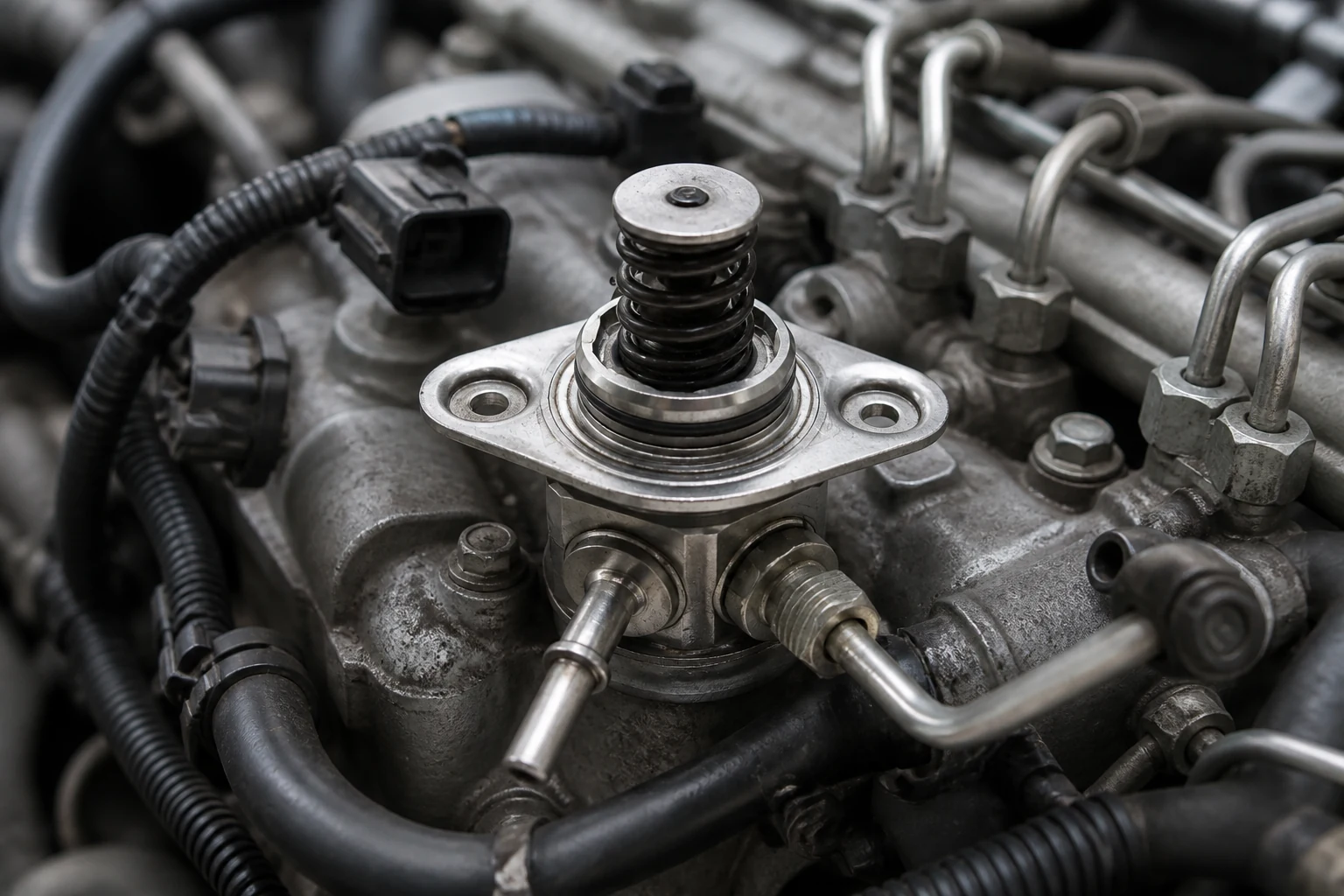
Metal flakes or fine “glitter” in the fuel filter bowl are treated on many common-rail platforms as evidence that something inside the high-pressure pump — or another high-pressure component — has begun shedding debris.
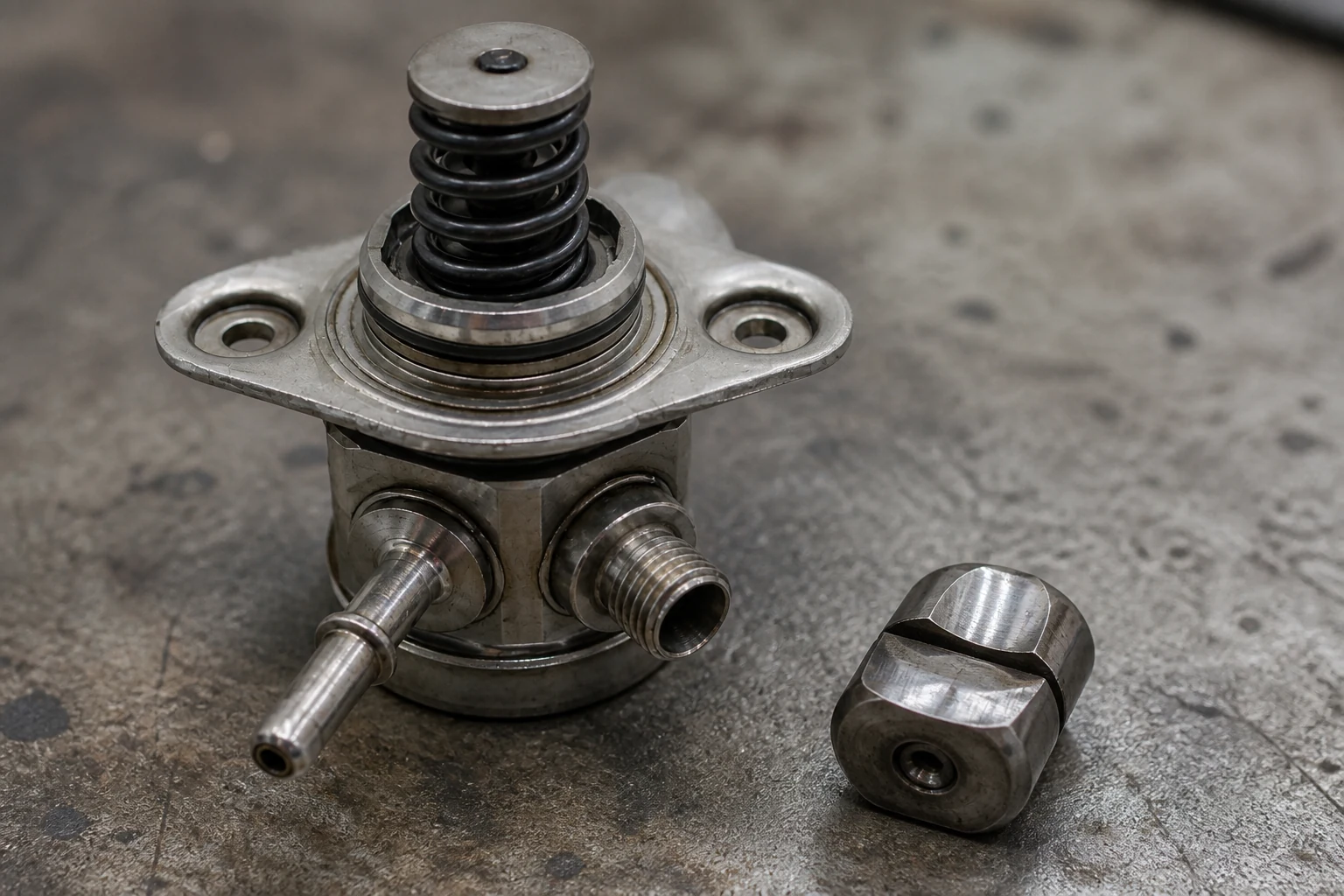
This is the highest-severity field sign in the symptom list. Technical sources describe metal particles traveling through rails, lines, and injectors once the pump starts disintegrating. Continuing to run the engine can spread contamination beyond the pump itself.
Counter protocol when a shop reports metal:
- Tell them to stop cranking and stop driving if they have not already.
- Ask for a photo of the filter bowl, filter media, and any metallic residue on a clean surface.
- Record whether the contamination was found during routine service or after a breakdown.
- Do not quote pump-only pricing until the scope of contamination is understood.
Important: If metal is visible in the diesel fuel filter, assume the high-pressure circuit may already be contaminated. A pump-only swap without addressing rails, injectors, lines, and tank scope is how counters inherit expensive comebacks. (Source: BD Diesel CP4 symptom guidance and diesel shop field reports on filter-bowl metal inspection.) Escalate to full-system evaluation language before promising a single SKU fix.
This article documents symptoms and evidence. Sourcing paths for CP4 and other high-pressure programs belong in the dedicated CP4 failures and sourcing options guide — not here.
Separate HPFP Symptoms From Lift Pump, FCA, and Filter Lookalikes
The fastest way to misquote an HPFP is to treat every P0087 as “bad pump” while the low side or metering valve is still unproven.
Lift pump and supply faults can starve the HPFP inlet. Owners may see both lift-pressure codes (such as P1011 on some Cummins applications) and low-rail codes together. In one CumminsForum case, a new aftermarket lift pump did not clear P0087; commanded rail pressure at wide-open throttle still fell short of spec while the fuel control actuator showed heavy duty cycle — pointing the diagnosis beyond “just replace the CP3.” (Source: CumminsForum — P1011 & P0087 need help.)
Fuel control actuator (FCA) / fuel control valve (FCV) issues can mimic pump failure.
Community technicians note that disconnecting the FCA at idle should drive rail pressure high on some platforms — a isolation step used to see whether the valve is stuck or commanding incorrectly.
Sticky FCA / FCV units, leaking pressure relief valves, and excessive injector return flow appear in the same troubleshooting threads as failed CP3 pumps. (Source: CumminsForum — Intermittent rail pressure issue.)
Filters and air ingestion belong on every ticket. Clogged primary or secondary filters, neglected water separators, and tank vent restrictions can produce low-rail codes without internal pump wear.
| Lookalike fault | Clue that points away from HPFP alone | Counter ask |
|---|---|---|
| Weak lift pump | Low supply pressure; lift codes with rail codes | Lift pressure log to HPFP inlet |
| Stuck FCA / PRV | Rail pressure spikes or hangs at odd values; FCA test changes behavior | Was FCA disconnected or commanded on scan? |
| Injector return excess | Rail drops hot; return flow test discussed in shop notes | Injector return measurement noted? |
| Restricted filter | Recent no-start after sitting; dark bowl debris without metal glitter | Filter change date and restriction evidence |
| Wiring / connector | New pump or FCA with mismatched connector; odd idle until throttle | Connector photos; pin fit |
Gasoline weak-delivery symptom guides such as the live weak fuel pump symptoms page cover a different architecture. Send gasoline tickets there; keep diesel rail-pressure evidence on this page.
Build a Diesel HPFP Counter Evidence Checklist
Before you quote an HPFP or accept a warranty return, turn the phone symptom into a short evidence packet.
| Field | Why it matters |
|---|---|
| VIN / exact engine / model year | HPFP families differ within the same badge |
| Mileage and duty cycle | Towing, idle hours, and fuel source history |
| All active and pending fuel codes | P0087 alone is incomplete |
| Commanded vs actual rail pressure snapshots | Idle, crank, and load if available |
| Lift/supply pressure to HPFP inlet | Separates starvation from pump wear |
| Fuel filter and water separator service date | Rules out restriction before pump condemnation |
| Metal in filter bowl (yes/no + photo) | Changes scope from pump-only to system event |
| Recent parts replaced on fuel system | Avoid double-selling what was already changed |
| Shop tests already performed | FCA disconnect, PRV leak check, return flow |
If the packet is incomplete, quote time to diagnose — or request data — before you lock lead time on a high-pressure pump line. Importers quoting overseas should mirror the same fields in RFQ email to cut misidentified SKUs.
When the evidence still points to HPFP replacement after supply and metering checks, buyers may need program-level sourcing context. Route that conversation to the CP4 failures and high-pressure diesel pump sourcing options article rather than duplicating sourcing tables here.
Browse the wider fuel-system product family when the platform is confirmed and the ticket is no longer a symptom-only call.
Recommend an OE-Scoped Gasoline Assembly for Fit Documentation
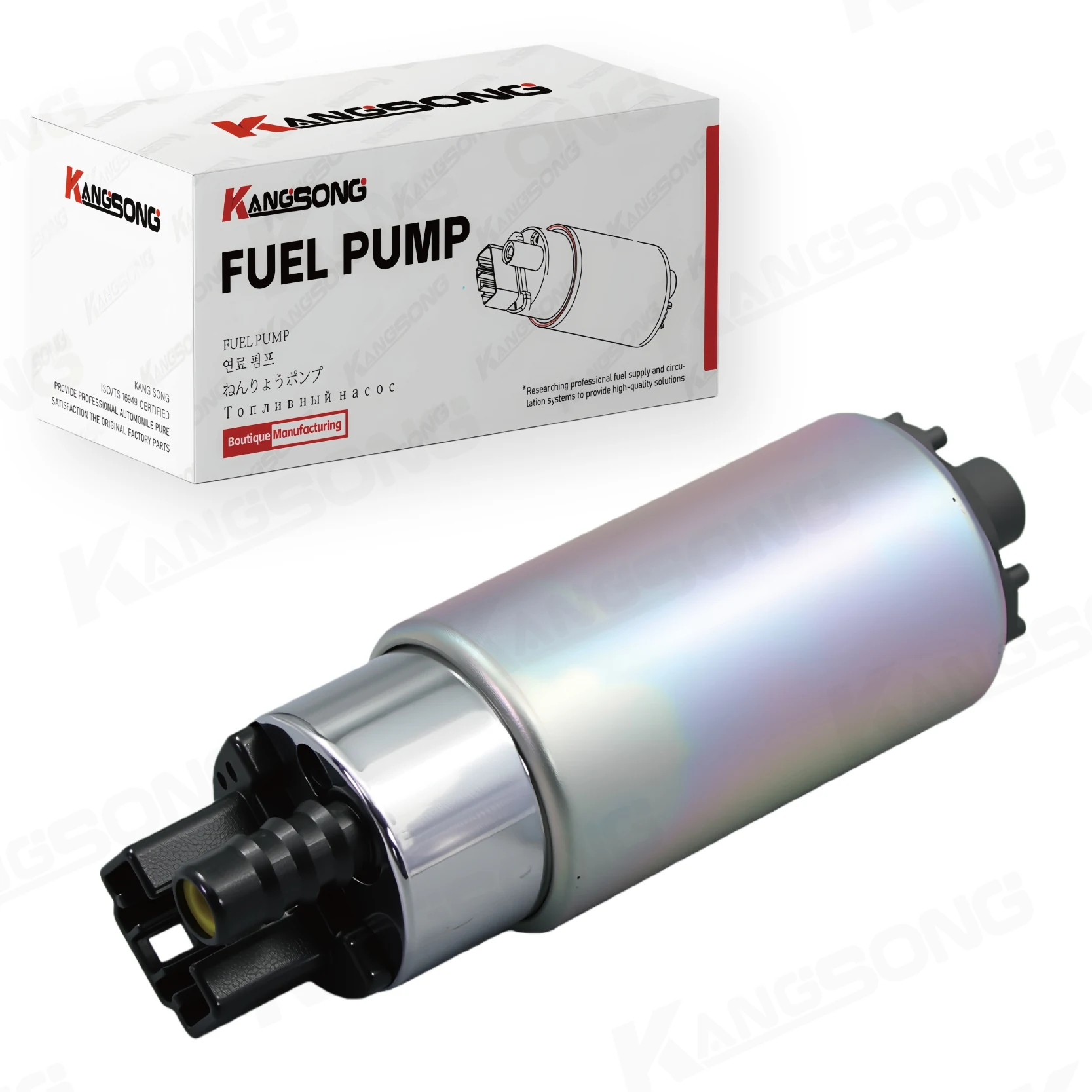
Kangsong publishes a fuel pump assembly for Hyundai Sonata and Kia Optima with stated OE references such as 31110-D5500, 31110-C2500, and 31111-C110 on the product page. That listing is a gasoline in-tank assembly — not a diesel HPFP, not a CP3/CP4 substitute, and not proof of fitment on a Cummins or Power Stroke program.
It still illustrates what counters should demand on any fuel-system quote: application-bound OE numbers, model-year scope, and clear product documentation instead of “diesel pump” language on the phone.
When a buyer’s diagnosis is complete and the need is diesel high-pressure sourcing, use contact with the evidence checklist above. For company background, see about Kangsong.
FAQ
What are the most common diesel high pressure fuel pump failure symptoms?
Shops usually report hard starting or extended cranking, power loss under load, surging or hesitation, stalling, fuel-rail-pressure fault codes, and — most critically — metal particles in the fuel filter bowl. Each symptom still requires lift-side, filter, and metering-valve checks before you blame the HPFP alone.
Does a P0087 code mean the high-pressure pump is bad?
No. P0087 means fuel rail or system pressure read low compared with command.
Clogged filters, weak lift supply, air ingestion, a stuck fuel control actuator, injector return issues, sensor faults, and HPFP wear can all appear in the same code family.
Capture commanded versus actual rail pressure and lift supply data before quoting a pump.
Can a diesel HPFP fail without warning?
Sometimes. Drivers may see gradual hard starts or load-related power loss first, but some trucks move quickly to a no-start or shutdown. That is why filter inspection and contamination checks matter even when the symptom list looks mild.
What does metal in the diesel fuel filter mean?
On many common-rail systems, visible metal flakes or glitter in the filter bowl indicate internal high-pressure component damage has started. Treat it as a stop-engine event and assume contamination may have reached rails and injectors until a qualified diesel shop scopes the system.
How do I tell HPFP failure from a bad lift pump?
Document supply pressure to the HPFP inlet and note whether lift-related codes appear alongside low-rail codes. Forum cases show new lift pumps that did not clear P0087 when rail pressure still fell short under load — proof that the low side and high side must be tested together.
Is noise from the fuel pump area a reliable symptom?
A rhythmic knock or tick near the HPFP can support internal wear suspicion on some designs, but noise alone is not proof. Pair any sound complaint with scan data and filter inspection.
What should a parts counter ask before quoting a diesel HPFP?
At minimum: VIN or exact engine, all fuel-related codes, commanded versus actual rail pressure snapshots, lift supply pressure, filter and separator service history, metal-in-filter status with photos, and a list of parts already replaced. Incomplete packets should get a diagnose-first response, not an automatic pump SKU.
References
- U.S. Environmental Protection Agency — What fuel? (ULSD sulfur cap and U.S. highway diesel context).
- CumminsForum — Fuel rail pressure problems — no power.
- CumminsForum — P1011 & P0087 need help.
- CumminsForum — Intermittent rail pressure issue.