A car runs without fuel pump fuse when fuel is already in the rail, the lid names the wrong device, a mechanical pump is still feeding the engine, or another wire is still powering the pump. At a United States service counter, a short stumble and a steady idle are different jobs. Pulling fuses on a running engine is a shop observation with stall and fire risk, and it is a poor trick to hand a customer.
The four readings below are the whole page. A continuity test lives on the sister note for how to test a fuel pump fuse. What the fuse is for, and why one opens, lives on fuel pump fuses.
Symptom lists for a dead pump live on fuel pump fuse blown symptoms.
Why the engine can keep running with that fuse out
Four different fuel paths can keep the engine alive after that fuse is out. None of them, by itself, means the electric pump has failed.
Counters hear this after a filter job, a compression-test prep, or a customer who pulled a fuse and then got a start anyway. The engine may cough and die. It may idle badly and then catch again on the next key cycle.
Or it may drive as if nothing was removed. Those three outcomes point at different hardware.
| What the counter heard | Reading that fits | Pump order? |
|---|---|---|
| Stumble, then a stall | Residual rail pressure from fuel already in the line | No |
| Idle never changes | Wrong lid, or a second feed still live | No |
| Carburettor engine with a cam-driven pump | Mechanical fuel pump, no electric fuse in the drive | No |
| Direct-injection engine, supply fuse out, idle still smooth | High-pressure fuel pump on the engine, or the wrong fuse | No |
A fuel-pump fuse is only one interrupt in that path. Treat the idle as a clue about which interrupt you actually opened.
Residual rail pressure is fuel already in the line
Leftover pressure in the rail can feed the injectors until it falls off. The outlet check valve is what holds that residual rail pressure after the electric pump stops.
On a multiport engine the pump pushes fuel up to the rail, and the check valve keeps some of it from draining straight back when the motor stops. Injectors can still open against that leftover pressure. Once the pressure falls below what the spray needs, the engine stumbles and stalls.
A later key cycle can fire again for a moment if a little fuel is still in the plumbing. That pattern showed up on a third-generation Maxima thread: the car died with the fuse out, then restarted and ran rough because the lines were not empty.
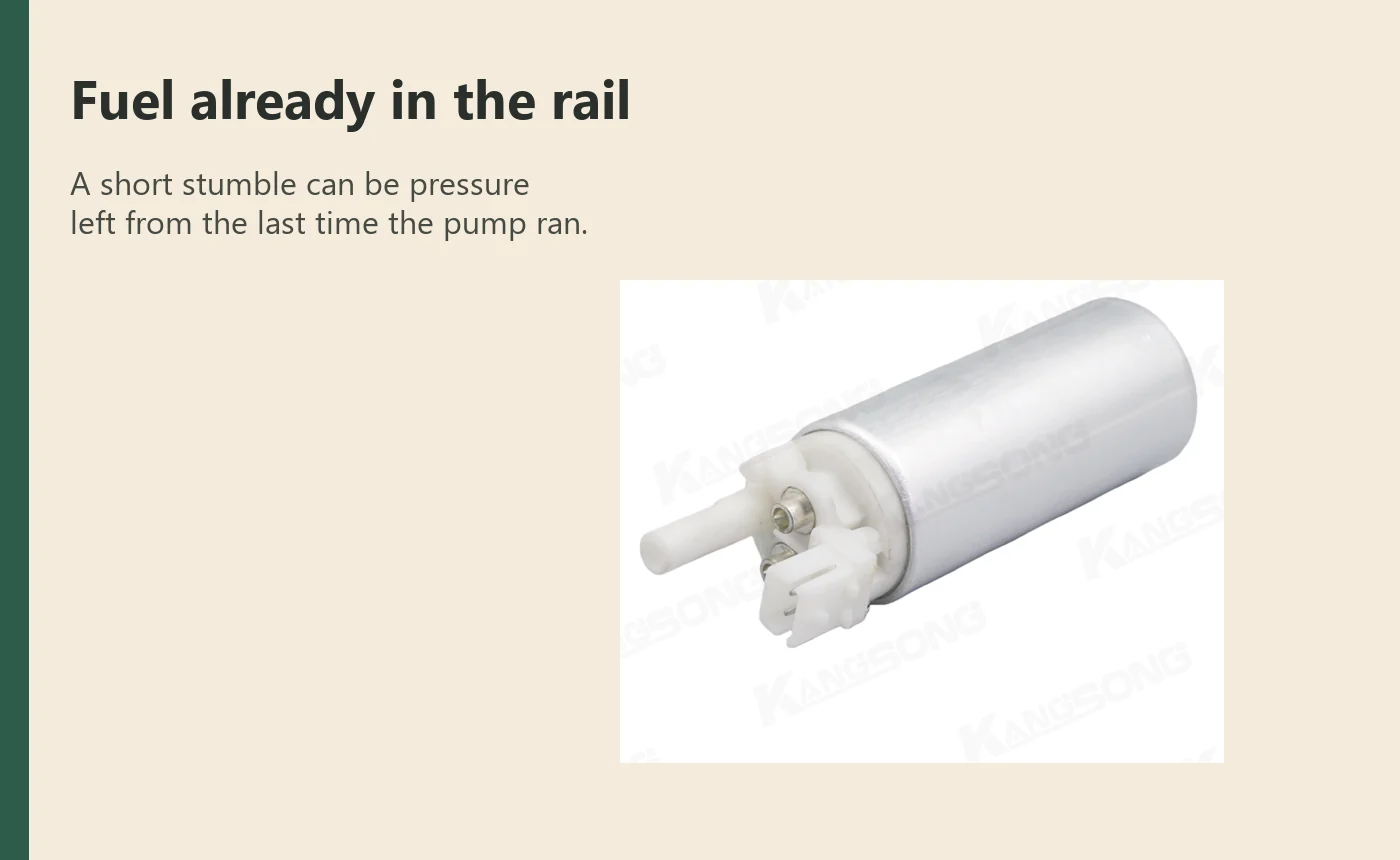
From the field: Maxima owners who pulled the fuel-pump fuse still saw the engine take fuel from the line, and one of them said fuel in the eye was its own lesson — residual pressure on a running Maxima.
Opening a fitting because the engine finally stalled does not prove the rail is empty. A stuck regulator or a check valve can leave pressure in a corner of the line. Shop practice is to treat every opened fuel joint as a fire and spray hazard, with the engine cool, a catch plan, and no audience leaning over the bay.
A short run fits residual fuel. A smooth idle that never changes does not. That second pattern is the next section.
A fuel-pump label can mark the wrong device
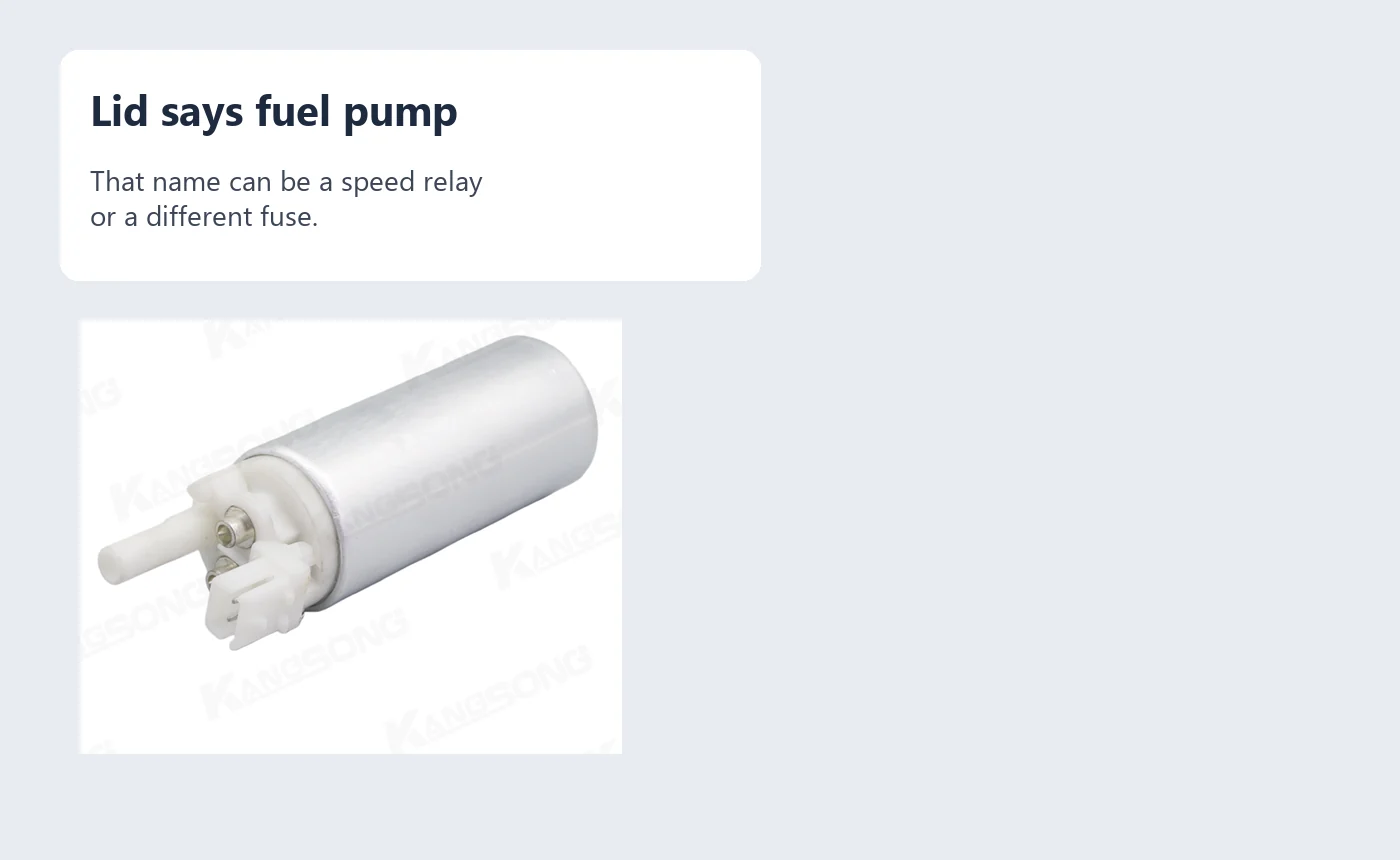
A lid that says fuel pump can be a speed relay or the wrong fuse. If the engine note does not change, the label is the first thing to doubt.
FD RX-7 owners learned this the hard way. One driver pulled the front-box fuel pump relay, forgot it on the bench, and the car drove normally. Members pointed at the resistor path: that relay switches the pump from a reduced feed to a full feed under load.
Idle does not need the high-speed relay. Another FD owner, changing a filter, pulled the part marked fuel pump relay and watched the engine idle on. The fuse that actually opens the pump circuit sat in a different panel, and the fuel pump fuse location was not the box in front of the air filter.
A fuel pump relay and a fuel-pump fuse are not interchangeable names. On that Mazda the relay in the front box is the speed device. The circuit-opening relay and the fuse live elsewhere.
A Silverado owner hit a cousin of the same problem: the diagram in the manual showed a relay the truck did not have, and the engine stalled only after the fuel-system control module fuse came out.
C4 Corvette posts add a quieter version. One car carried two fuses labeled for the pump. Pulling one of them leaves the other path intact.
Another owner was sure the yellow fuse matched the lid, and the engine kept running anyway. Certainty about the printing is not certainty about the circuit.
If the idle is normal, stop talking about a failed pump. Find which device actually feeds it. The test steps for continuity belong on the sister page, not here.
A mechanical pump never used that fuse
A cam-driven pump, or a mechanical high-pressure pump downstream of the in-tank pump, does not depend on that fuse.
Older carburettor engines often use a mechanical fuel pump. A rocker rides an eccentric on the camshaft and moves a diaphragm. There is no electric motor in that drive, so there is no fuse whose removal can starve it.
Some of those pumps grew a second chamber. On the early combination units that chamber was a vacuum source for wiper blades. Treating that chamber as a fuel supply mixes two jobs that shared a housing.
Direct injection splits the work a different way. The in-tank electric pump is a supply pump. It feeds an engine-mounted high-pressure fuel pump, which is mechanical.
Pulling a fuse on the supply side can still leave the high-pressure pump able to move whatever fuel is already at its inlet. That is a layout fact. Running the high-pressure pump that way asks it to pull fuel it was built to receive already under pressure.
Tractor boards show the same split in plainer hardware. A Branson owner forgot the electric lift-pump fuse and the engine still ran. Replies split three ways: fuel already in the system, the wrong fuse, or gravity when the tank sits above the injection pump.
A small gear pump inside the injection pump can move a little fuel. A low tank shows how little that gear pump can move on its own. The passenger-car lesson is the same shape.
A mechanical feed can outlast an electric fuse without meaning the electric pump is healthy.
A second power feed can keep the pump alive
An oil-pressure switch or another feed can leave the pump powered after one fuse is out. The steady idle is then an electrical fact, not leftover fuel.
On many vehicles an oil-pressure switch sits in the fuel-pump relay circuit so that lost oil pressure removes pump voltage. The point of that wiring is crash and rupture safety: if the engine is not making oil pressure, the pump should not keep pushing fuel at a broken line.
The same idea shows up as an inertia switch in the trunk, under a seat, or in a side panel. A hard hit opens the pump circuit until someone resets the switch. Neither device belongs in a customer workaround, and this page will not draw one.
C4 owners argued in public about where the fuse sits relative to that oil-pressure path. One reply said the pump gets a secondary voltage from the oil-pressure sender, so the pump can run with the fuse blown if oil pressure is up. A later reply, on an ’89, said the fuse is downstream of both the relay and the oil-pressure switch, so the pump should die with the fuse out.
Both reports can be true of different years. A counter that treats every GM truck as if it had that second feed will order the wrong part on the trucks where the fuse is the last device in the line.
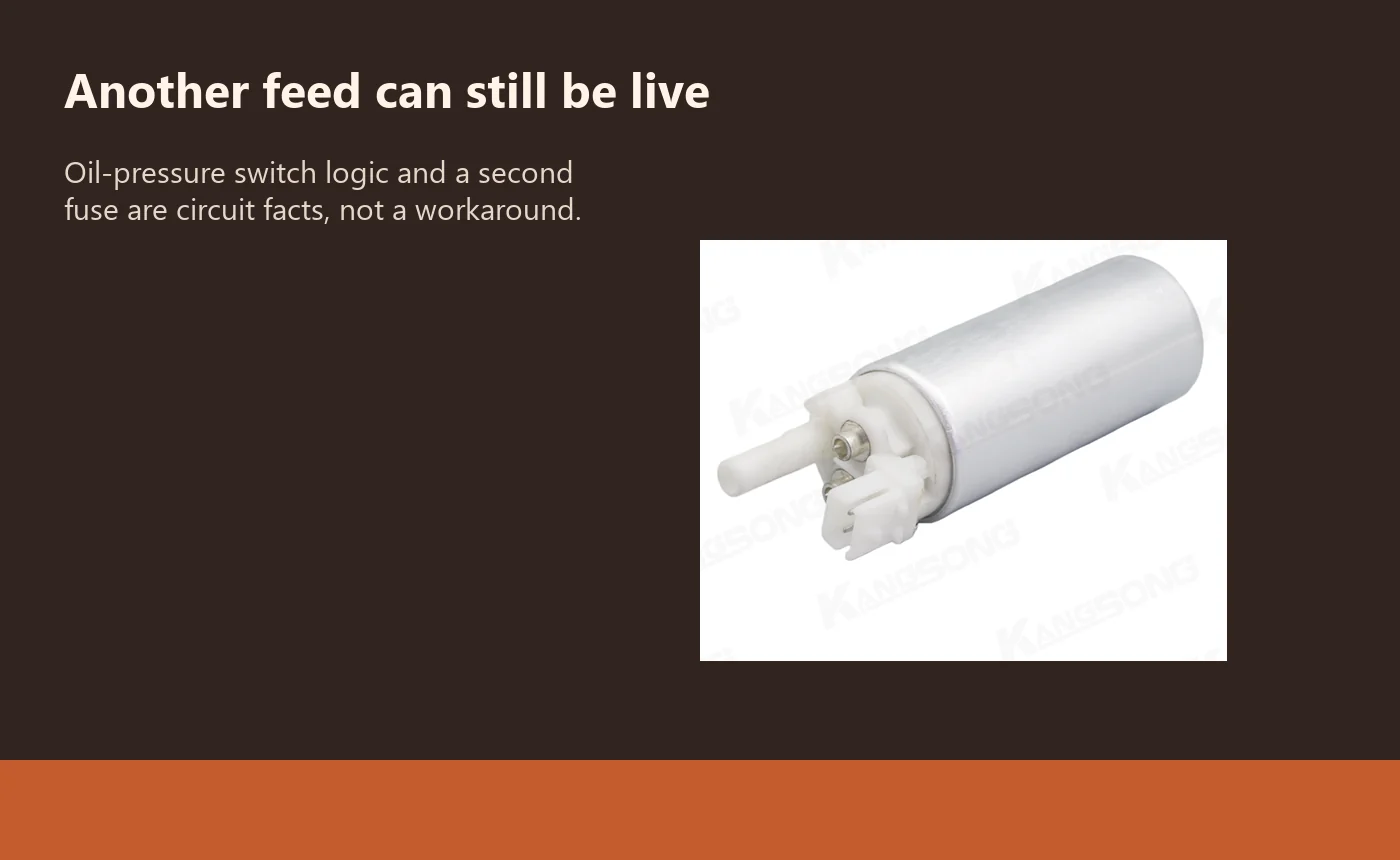
Voltage on both sides of an empty fuse socket, which one C4 owner measured while the engine ran, is a clue that power is arriving from more than the battery side of that cavity. Leave that socket unbridged.
Aftermarket taps, a welded relay, or a backfeed from another circuit can do the same thing. The useful question is which wire is still hot, read from the diagram for that year, with the engine off and the bay clear of fuel vapor.
A second feed means the pump may be fine and the circuit is not the open you think it is. It does not mean the pump is new, and it does not mean a customer should pull fuses on a running engine to “see what happens.”
What a still-running engine does not prove
The idle does not prove the pump is dead, healthy, or the right SKU. It proves only that fuel, or pump power, is still reaching the engine by some path.
A stumble-then-stall fits residual rail pressure. A normal idle fits a wrong label or a second feed. A carburettor engine may have no electric pump in the story at all.
A direct-injection engine may still have a mechanical high-pressure stage. Flooded oil, from a stuck injector, has even let an engine idle on fumes after the pump was unhooked.
That last case is fuel in the oil. It still fails as a reason to sell a pump.
Service counter conversations go bad when the observation gets compressed into one sentence: the engine ran without the fuse, so the pump is bad, or the opposite, it ran, so sell nothing. Both compressions skip the four readings.
The customer who wanted the van not to start in a parking lot, and who still got a start, was looking at residual pressure or the wrong fuse. That story is a warning about misreading a start. Security hardware is a different conversation.
What belongs in the next conversation is year, engine, whether the idle changed, and whether the lid name matches the diagram. What does not belong is a jumper wire, a hidden switch, or an order written because the engine refused to die on cue.
Choose the catalog until a dead electric pump is the job
Open the catalog. Order a printed-window electric kit only when that pump is the failed part on a vehicle the page actually names.
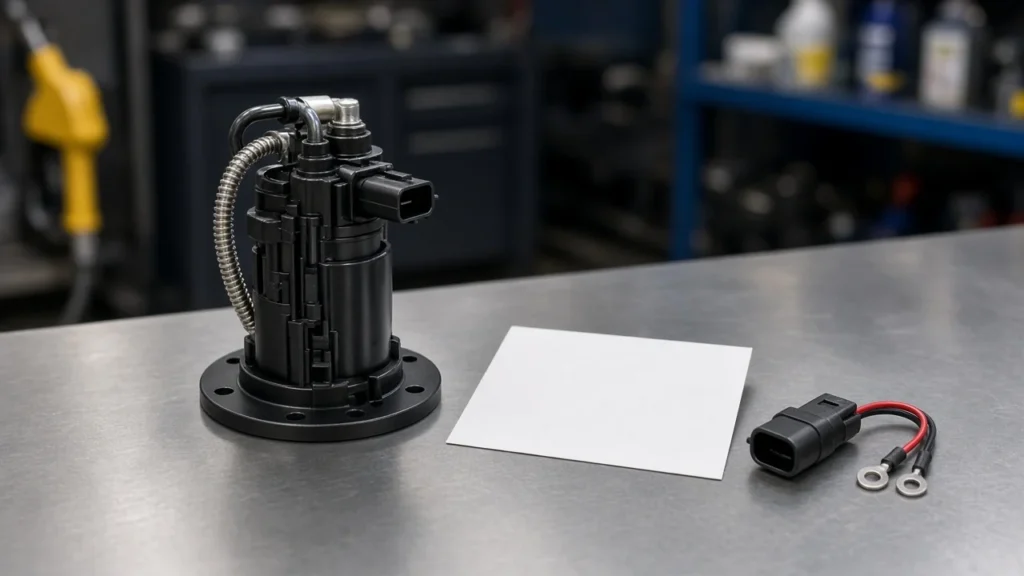
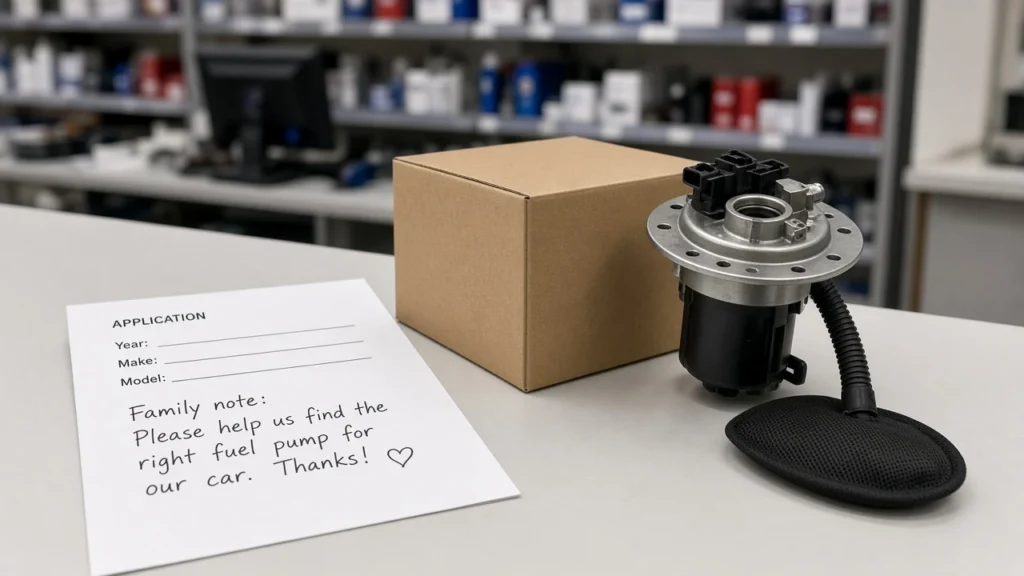
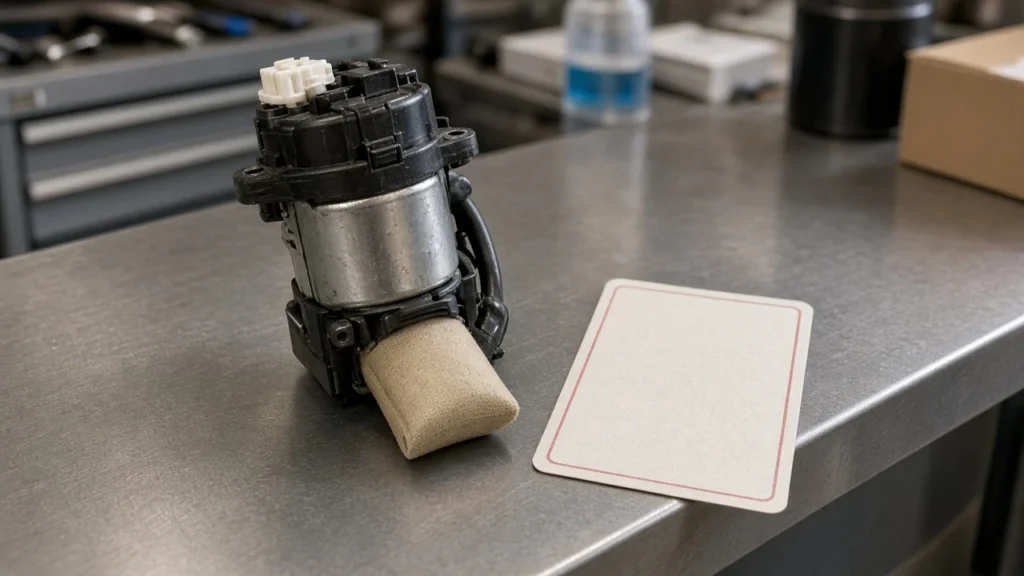
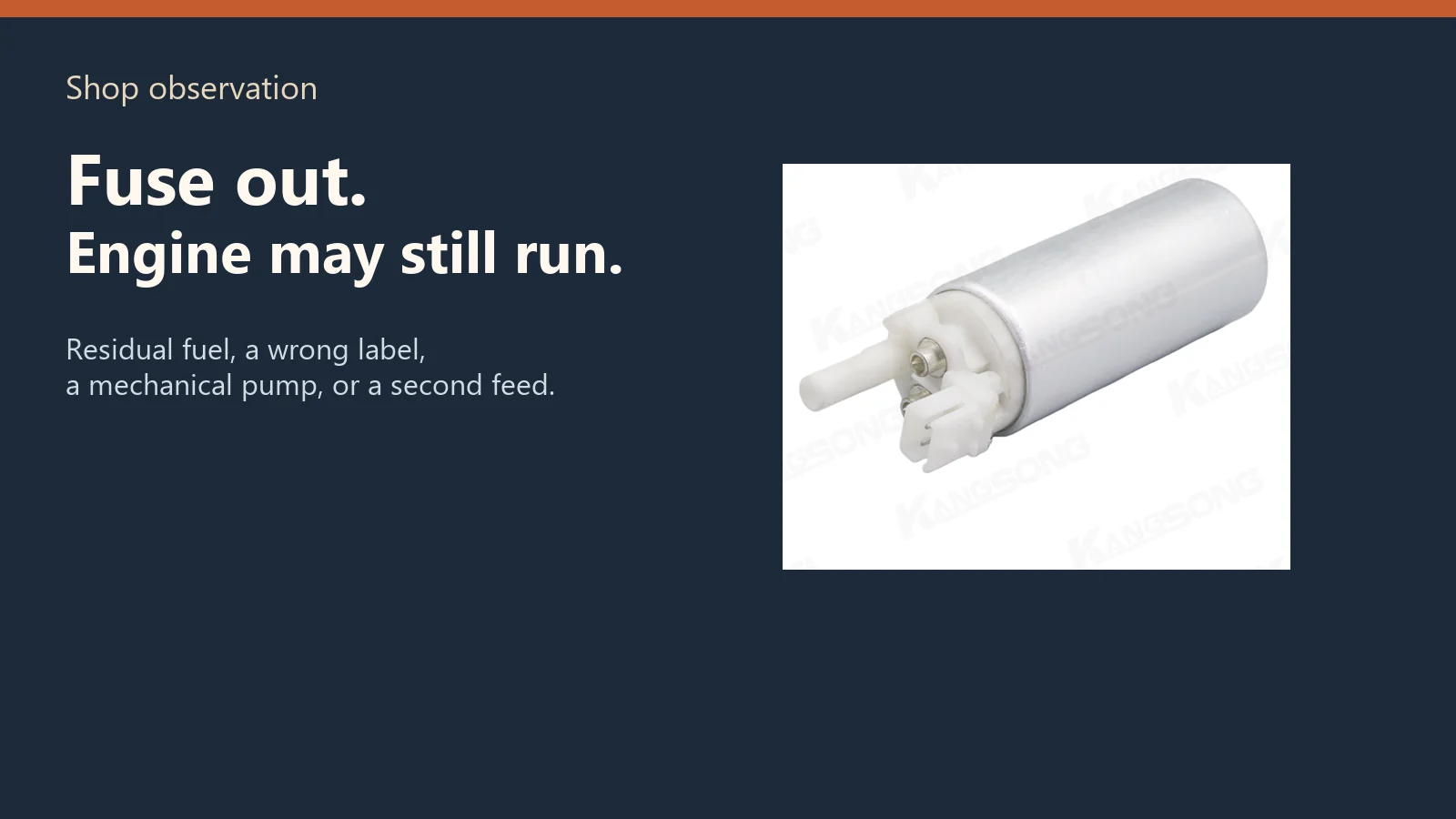
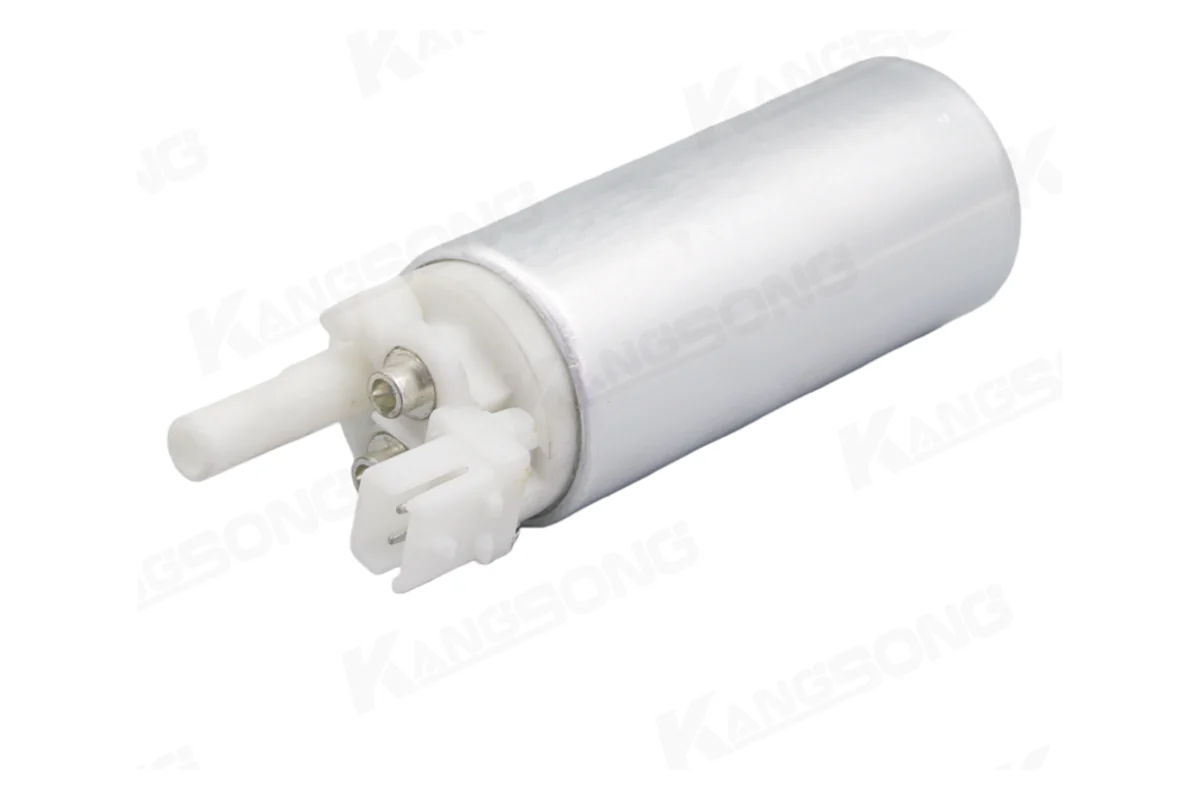
The fuse observation stops short of a pump SKU order. Kangsong’s electric gasoline fuel pump with installation kit is printed for 1987-1995 C/K 1500, 2500, and 3500 pickups, with interchange numbers that include 25168719 and E3902.
That window is the only job where this kit is even a candidate, and only after the counter already knows the electric pump itself is dead. A Maxima, an FD, a C4, a Transit, or a tractor that kept running with a fuse out is a different vehicle and a different fault.
| Counter already knows | Next click |
|---|---|
| Only that the engine still ran with a fuse out | Fuel pump catalog |
| The electric pump is dead on a 1987-1995 C/K 1500, 2500, or 3500 | Same catalog, then the printed kit for that window |
| The question is fuse role or why a fuse opened | Fuel pump fuses |
| The question is a continuity test | How to test a fuel pump fuse |
| The question is what a blown fuse feels like from the driver’s seat | Fuel pump fuse blown symptoms |
The catalog root is navigation. It does not assign a brand-for-brand match, and it does not turn a fuse story into fitment. Leave the kit on the shelf until the diagram, the idle, and the pump’s own power have been sorted on the truck the page names.
FAQ
How long can fuel already in the rail keep an engine idling?
Long enough to fool a hurry, and short of a promise. Forum reports range from a quick stumble to a rough idle that returns on the next start, because line volume and leftover pressure differ by engine. A smooth idle that never fades is a different reading, covered above, and it usually means the pump is still being fed.
Does a steady idle with the fuse out mean the pump is still powered?
Often, yes, if the note of the engine truly did not change. Residual fuel tends to fade. A speed relay, a second fuse, or an oil-pressure feed can leave pump power in place.
Confirm which device you removed against the diagram for that year before anyone talks about a new pump.
Why can a truck still run when one fuel-pump fuse is missing?
Some trucks label more than one fuse for the pump circuit, and some put the real feed in a different box from the lid the tech grabbed. Missing one fuse leaves the other path, or leaves a relay that was never the only feed.
Two C4 posts described paired pump fuses. An FD post described a front relay that only switched high speed.
Can a cam-driven fuel pump ignore an electric-pump fuse?
Yes. The diaphragm pump on many carburettor engines is moved by a camshaft eccentric. Removing an electric-pump fuse does not stop that rocker.
If the engine also has an in-tank feed pump ahead of the mechanical pump, that electric pump is a helper, and the cam pump can still move fuel for a while.
Is a vacuum chamber on an old combination pump a second fuel supply?
No. On those early pumps the extra chamber was a vacuum source for windshield wipers. The fuel diaphragm is the fuel pump.
Mixing the two chambers leads counters to hunt an electric fuse on a wiper port.
Should the counter order a pump because the engine still ran?
No. A still-running engine says fuel or pump power is still arriving. It does not name the pump as failed, and it does not name a SKU.
Order an electric kit only when that pump is dead on a printed window, such as the 1987-1995 C/K kit after the circuit has been ruled out.
What risk comes with pulling fuses on a running engine?
Stall in a bay, a restart nobody expected, and fuel spray when a fitting is opened because someone thought the stall meant the line was empty. Maxima posters talked about fuel in the eye. Treat the pull as a shop observation with fire risk, not as a customer trick or a security idea.
References
- Electric fuel pumps: check valve and residual pressure
- Fuel system diagnostics: oil-pressure switch in the pump circuit
- Why an FD still ran with the fuel pump relay out
- C4 still running with the fuel pump fuse removed
- Residual fuel after a Maxima fuel-pump fuse pull
- Tractor still ran with the electric fuel-pump fuse out