An electric car fuel pump is the electrically driven pump that moves fuel from the tank toward the carburetor or injectors on a petrol or diesel passenger car—not a part for a battery-electric vehicle. This guide shows how to match pressure class and mounting style, how to read free-flow ratings without getting trapped, how to confirm low pressure before you buy, and when a printed Kangsong application such as the C/K install kit or a Hyundai/Kia pump is the right next click.

What an Electric Car Fuel Pump Actually Is
It is the electric pump on a liquid-fuelled petrol or diesel car, not a battery-electric traction component.
Search wording makes that easy to miss. “Electric car fuel pump” often means “the car’s electric fuel pump,” while a true battery-electric vehicle (BEV) does not use a liquid fuel pump, fuel line, or fuel tank. The hardware you are selecting feeds an internal-combustion fuel system: gasoline / petrol; diesel ICE engines leave the tank under pump pressure so the engine can meter fuel.
On fuel-injected petrol engines, that pump is commonly mounted inside the tank. Older carbureted cars may still use a mechanical engine-driven pump. Some conversions add an external electric pump, but the job stays the same: move liquid fuel to the metering device at the designed pressure.
For petrol-engine type context beyond this selection page, see the sister guide on types of fuel pump in a petrol engine. For broader gasoline electric-pump language, see gasoline electric fuel pump.
In-Tank, In-Line, and Fuel Pump Assemblies
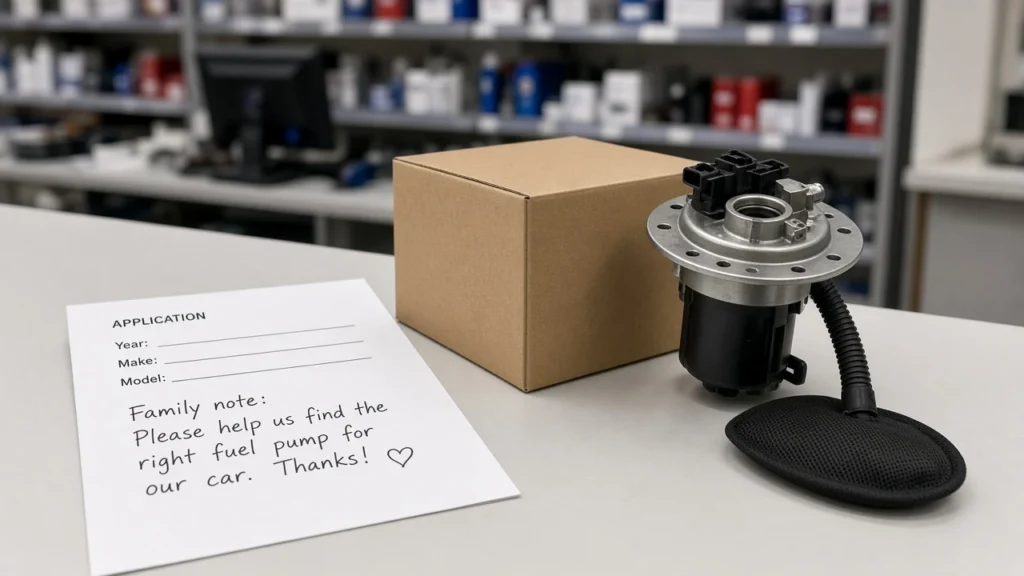
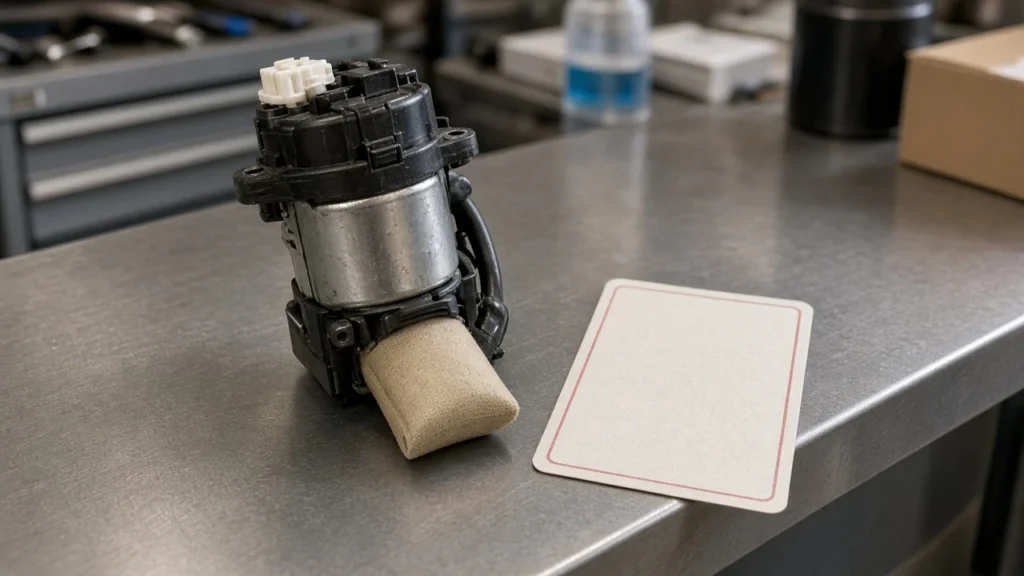
Most modern passenger cars use an in-tank electric pump, often packaged as an assembly with a strainer and a fuel-level sensor.
In-tank placement surrounds the motor with fuel, which helps cool the pump, reduces vapor handling problems on first prime, and keeps the unit quieter than many frame-mounted pumps. That package is frequently sold as a fuel pump assembly rather than a bare motor.
An in-line / external electric fuel pump mounts along the chassis or near the tank outlet. It can be easier to reach for service, but it runs louder and must be installed as part of a system designed for external pressure and filtration. Do not assume a universal in-line pump is a drop-in for every in-tank module—connector, hanging height, sender calibration, and pressure class all matter.
| Mounting style | Typical passenger-car role | Buyer note |
|---|---|---|
| In-tank module / assembly | Common on EFI petrol cars; often includes strainer and sender | Match OE package scope, not only the motor |
| In-line / external electric fuel pump | Retrofits, some carbureted systems, service-access builds | Confirm pressure class and plumbing before purchase |
| High-pressure engine-mounted pump | Direct-injection stages after a low-pressure in-tank feed | Do not confuse with the in-tank electric supply pump |
Sister pages on aftermarket in-tank fuel pumps and car fuel pump assemblies cover those contrast topics in more depth; this page stays on electric-pump selection for ICE cars.

Match Pressure Class to Carburetor or EFI
Choose the pump by fuel-system pressure class before you compare brands or free-flow headlines.
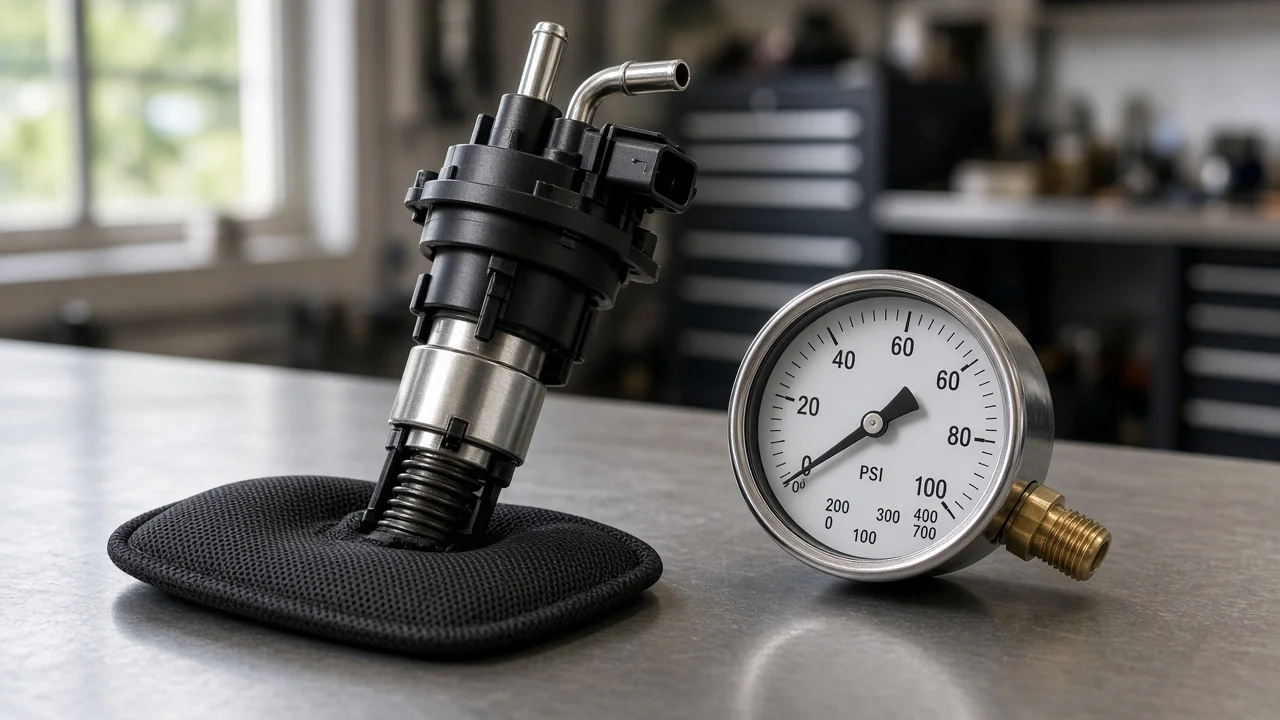
Carbureted systems need low pressure; electronic fuel injection (EFI) commonly needs roughly a 40–60 psi delivery class at the in-tank or supply pump.
Pressure class is the first hard filter after you confirm the vehicle is petrol or diesel ICE.
Carburetors typically run in a low band on the order of about 2–9 psi. Port-injection and throttle-body systems often expect in-tank electric pumps to deliver in a roughly 40–60 psi class.
Direct-injection layouts still use an in-tank supply pump, then raise pressure again with a separate engine-mounted pump. The electric car fuel pump you replace in the tank is still a supply-pressure part, not the extreme high-pressure stage.
| Fuel system | Pressure class to match | Practical selection cue |
|---|---|---|
| Carburetor | Low pressure (about 2–9 psi) | Electric conversion needs regulation so needle-and-seat hardware is not overdriven |
| Port / TBI EFI | About 40–60 psi class at the supply pump | Prefer OE-style in-tank pressure capability over a carburetor micro-pump |
| Gasoline direct injection | In-tank supply plus separate high-pressure pump | Replace the printed supply/module part; do not invent HPFP fitment here |
If you swap a mechanical pump for an electric unit on a carbureted engine, treat pressure as a controlled design choice, not a “more PSI is better” upgrade. A high-pressure EFI pump on a carburetor bowl is the wrong tool.

Flow Ratings, Free-Flow Numbers, and Voltage
Size fuel pressure / GPH flow at operating pressure and real voltage, not free-flow alone.
Listings advertise gallons per hour (or liters per hour) that look generous because free-flow ratings are taken with little back-pressure. As line or rail pressure rises, delivered flow falls.
Voltage at the pump terminals also moves the curve: a charging system near 13.5 V typically supports more flow than a weak 12 V feed under load.
A common industry sizing identity for gasoline is GPH = (maximum horsepower × BSFC) / 6, where BSFC is pounds of fuel per horsepower-hour.
For a naturally aspirated example at 350 horsepower and a BSFC of 0.5, that works out to about 29 GPH of required fuel mass converted to volume—an industry example for method, not a Kangsong dyno result. Forced-induction builds often raise the BSFC assumption.
Whatever number you calculate, compare it to the pump’s flow at your operating pressure, not only the free-flow headline.
Important: A large free-flow GPH number can still starve an EFI rail once pressure climbs. Confirm the curve—or at least the rated point—at the pressure your system actually runs, and verify voltage at the pump when diagnosing a “weak” unit.

Confirm Pressure Before You Replace the Pump
Hearing the pump prime does not prove correct pressure.
Owners often hear a brief hum when the key turns on and assume the pump is healthy. Field threads push back on that shortcut: a pump can spin and still deliver far below specification.
Before you order an electric fuel pump for car replacement work, confirm fuel pressure against the vehicle’s published range when a test port or gauge adapter is available. Also rule out obvious electrical faults—fuse, relay, or voltage drop on feed or ground—that mimic a dead pump.
Intermittent stalls that restart after a cool-down also deserve a pressure or volume check rather than a parts roulette. Sound is a clue; gauge readings and printed specifications decide the purchase.
Recommended Electric Fuel Pumps to Select by Printed Fitment
Use product 2551 or 2552 only when the printed application matches; otherwise open the product catalog.
Kangsong publishes application-scoped electric gasoline fuel pumps for conventional passenger and light-truck ICE systems. Fitment stops at what the product page prints—OE number / application years, models, and interchange lists. Do not stretch a Hyundai/Kia listing into a universal electric car fuel pump, and do not treat a C/K install kit as a battery-EV part.

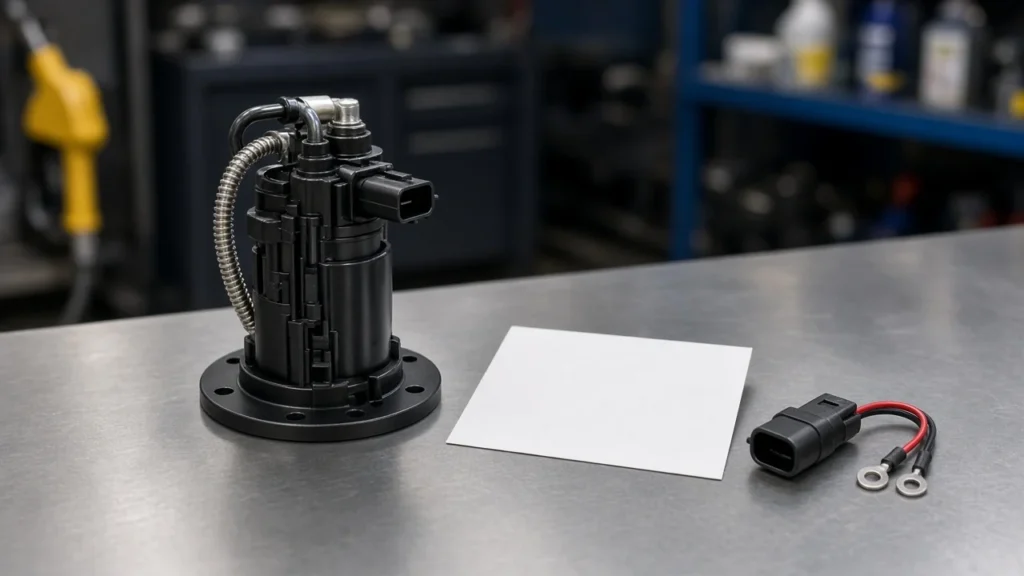
Product 2551 is scoped to 1987–1995 C/K 1500/2500/3500 pickup applications named on the page, including OE examples such as 25168719 and E3902.
On that page the printed selection fields include Gph 43.3–49.5 and Maximum Air Pressure 12–26. The listing also notes a 2-pin connector, accessories included, and an assembly with pump, sending unit, and housing.
Open the electric gasoline fuel pump with installation kit (2551) when your truck matches that print.
Product 2552 title scope includes Accent I (X-3) 1994–2000 and Sephia (FA) 1995–1997, with additional rows only as printed on the PDP.
The same listing prints Gph 43.3–49.5, Maximum Air Pressure 12–26, weight 0.30 KG, and size 170×80×85 mm.
Open the Hyundai/Kia electric gasoline fuel pump (2552) when those lines match.
| Product | When to open it |
|---|---|
| 2551 C/K install-kit pump | Printed C/K years and OE list match |
| 2552 Hyundai/Kia pump | Printed Hyundai/Kia application text matches |
| Products catalog root | Neither 2551 nor 2552 print matches |
If the printed lines do not match your vehicle, stop and use the products catalog rather than forcing a near-year guess. Browse the live products catalog for the vehicle you actually have.
When Aftermarket In-Tank and Assembly Pages Differ
Sister pages cover aftermarket in-tank and assembly topics in more depth—use them for contrast, not as duplicate guides.
An electric car fuel pump decision sometimes collapses into “do I need the bare pump or the full assembly?” and “how far can an aftermarket in-tank unit deviate from OE packaging?” Those questions are adjacent, not identical. Keep this page focused on ICE electric-pump selection: pressure class, mounting, verification, and printed fitment. Use the aftermarket in-tank and assembly sisters when you need that contrast, without replaying their full outlines here.
FAQ
Does an electric car fuel pump mean a part for a battery-electric car?
No. In normal parts language it means the electric fuel pump on a petrol or diesel car. A battery-electric vehicle (BEV) does not use a liquid fuel pump, fuel line, or fuel tank.
How do I choose pressure for my electric fuel pump?
Match the fuel system first.
Carburetors need a low-pressure band around roughly 2–9 psi. Many port-injection systems expect about a 40–60 psi class from the in-tank supply pump.
Do not put an EFI-class pump on a carburetor without a designed low-pressure arrangement.
Should I buy by free-flow GPH alone?
No. Free-flow ratings shrink as pressure rises, and low voltage at the pump further cuts delivery. Compare flow at your operating pressure and check supply voltage when a pump seems weak.
In-tank or in-line for a passenger car?
Most modern EFI cars are designed around an in-tank module or assembly. An in-line / external electric fuel pump can suit some carbureted or purpose-built external systems, but it is not an automatic replacement for every in-tank package.
Can I replace a mechanical pump with an electric one?
Sometimes, on carbureted engines, if you keep pressure in the low band the carburetor can tolerate and you wire the pump safely. It is not a universal swap, and EFI pressure classes are the wrong starting point for a carburetor bowl.
Does hearing the pump prove it is good?
No. A pump can hum during prime and still fail a pressure test. Confirm pressure to the vehicle specification before you replace the unit.
Which Kangsong pump fits my car?
Only the applications printed on the product page. Use the C/K install-kit pump or the Hyundai/Kia pump when those lines match; otherwise browse the products catalog.