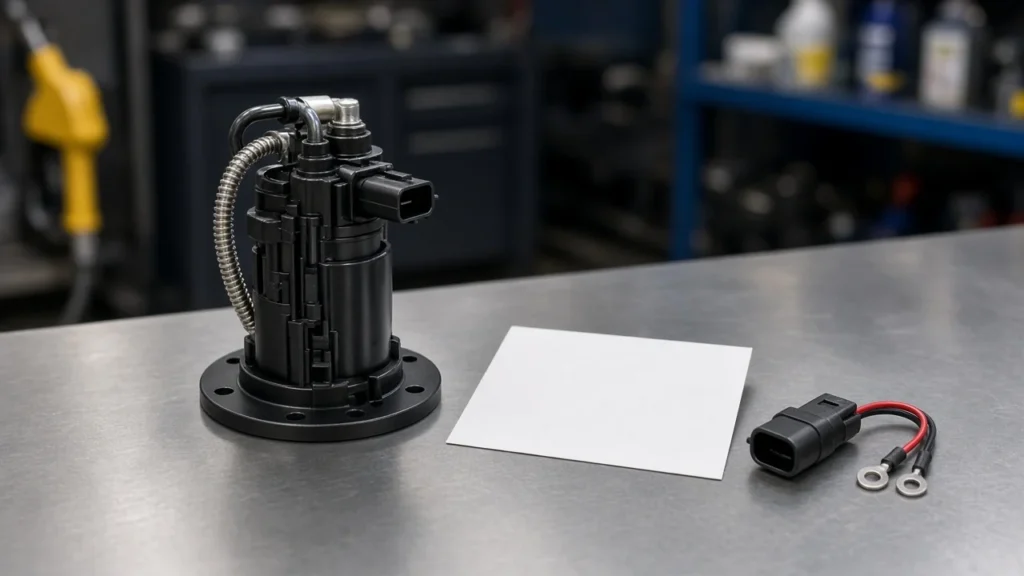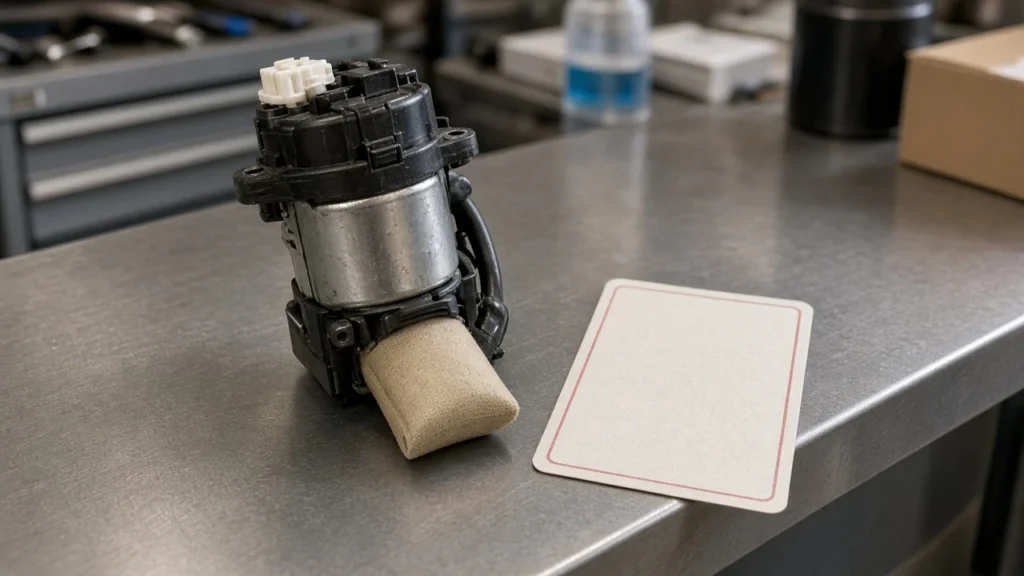
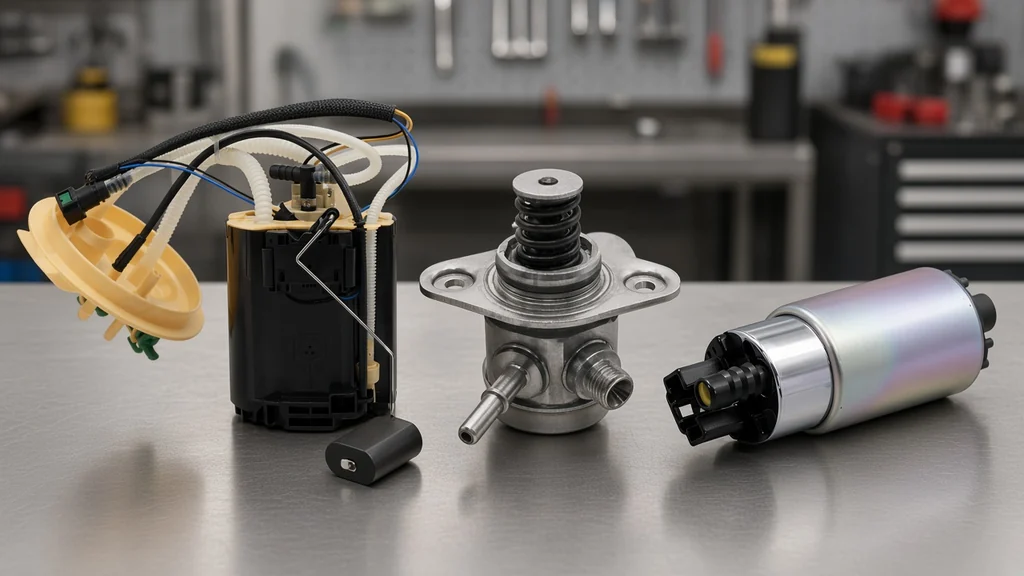
Anything sold as one of the diesel fuel pump types sits in one of two machine classes: a low-pressure supply pump that moves volume, or a high-pressure injection pump that meters and pressurises fuel for the cylinder. Zhejiang Kangsong (Kangsong, 浙江康松) works as an automotive fuel pump OEM / manufacturer; this article maps those diesel pump families so a Kangsong catalogue search starts from the right pressure class.
Product path: Freelander 2.2 diesel assembly · HIGH PRESSURE FUEL PUMP · Audi/VW 06L127025K HPFP · product-line hub
Below: the low-pressure family, the four injection families in ascending pressure order, a comparison across drive and application, the inline naming trap that costs buyers money, and where a printed Kangsong diesel assembly actually fits.
Two Pressure Families Behind Every Diesel Fuel Pump Name
One family supplies fuel at modest pressure and high volume; the other meters and pressurises it for injection.
Reference documentation for a unit-injector engine writes the split down in plain numbers. Low-pressure supply hardware in a unit-injector system runs below 500 kPa, while the high-pressure side of the same engine works below 2000 bar. Two parts on one engine, three orders of magnitude apart, and both of them get invoiced as a diesel fuel pump.
The vocabulary follows the split:
- Low-pressure supply stage: lift pump, transfer pump, feed pump, fuel supply pump, in-tank module.
- High-pressure injection stage: injection pump, fuel injection pump, P-pump, distributor pump, CP pump, high-pressure pump.
American counters usually reserve “lift pump” for the low-pressure stage so that “fuel pump” can mean the injection pump. Volume and pressure run in opposite directions between the two: the supply stage is high-volume and low-pressure, the injection stage is low-volume and high-pressure.
That is why the different types of diesel fuel pumps only make sense in two groups rather than as one long list. Get the group wrong on a quote and you are out by an order of magnitude on price, lead time and installation labour. Where each of those pumps physically sits along the fuel path is a separate question, answered in types of fuel pump in a diesel engine.
Low-Pressure Side: Lift, Transfer and Feed Pump Types
Among the types of diesel fuel pumps, the supply stage arrives as mechanical diaphragm or plunger pumps, gear and vane transfer pumps, and electric in-tank or external modules.
Mechanical diaphragm and plunger supply pumps typically work at 10-15 psi, so feeding an injection pump is a modest-pressure, high-volume job. A mechanical diaphragm pump or plunger pump rides on a cam lobe and produces whatever its spring is set for. An electric unit can sit anywhere between tank and engine, which is why the in-tank fuel pump module dominates modern vehicles and why external electric pumps are the usual answer on long fuel lines.
Rotary injection pumps blur the line, because most of them carry their own transfer pump inside the housing. On those engines the “lift pump” you can actually buy is a small mechanical or electric unit ahead of the injection pump, and the internal transfer stage is part of the pump you are replacing.
| Low-pressure type | Drive | Pressure class | Typical application | What a buyer matches |
|---|---|---|---|---|
| Mechanical diaphragm lift pump | Engine cam lobe | 10–15 psi mechanical class | Older mechanical-injection engines | Mounting face, cam spacing, fixed output |
| Mechanical plunger lift pump | Engine cam lobe | 10–15 psi mechanical class | Industrial, agricultural and conversion engines | Spring-set outlet pressure suited to the injection pump |
| Gear or vane transfer pump | Injection pump’s own shaft | Feeds the pumping element | Inside rotary distributor pumps | Usually not offered apart from the pump |
| Electric in-tank supply module | Electric motor, controlled by the engine module | Adjustable flow and pressure | Modern common-rail vehicles | Flange, sender, connector, regulated pressure |
| Electric external lift pump | Electric motor | Selectable low pressure | Retrofits and long fuel lines | Outlet pressure suited to the injection pump family |
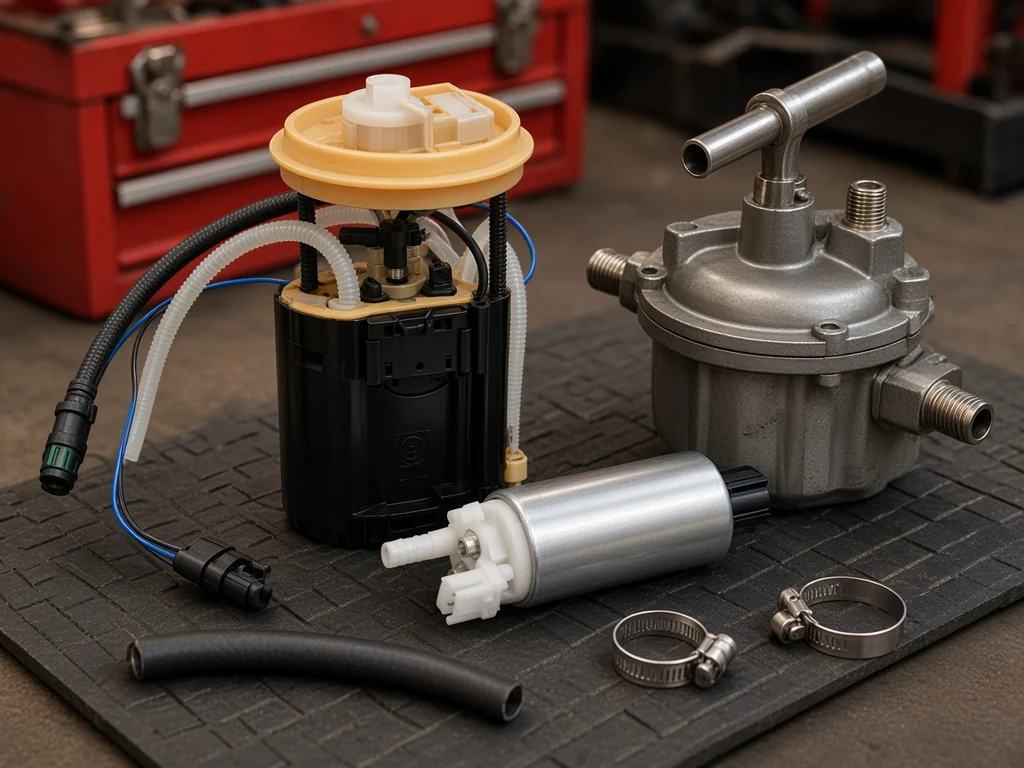
Tip: Match the low-pressure pump to the injection pump family rather than to the engine badge. Owners comparing rotary and inline installations point out that a rotary pump often carries its own built-in lift pump while an inline pump normally needs a separate one, so the two engines do not want the same supply hardware (ExplorOz VE versus in-line pump thread).
Shops that step outside factory supply hardware usually end up comparing aftermarket lift-pump systems, which the AirDog versus factory diesel lift pump comparison covers on its own page.
Inline Injection Pumps: One Plunger Per Cylinder
An inline pump carries one pumping element per cylinder inside a shared housing driven from the crankshaft.
Technical references describe the classic layout precisely: the pump houses as many pumping elements as there are cylinders, it is usually gear-driven by the crankshaft, and it is mounted centrally so every injection line can be kept short and roughly equal in length. Each element is a plunger and barrel pair, and injection volume is set by rotating the plunger against a cut-off port that lines up with a helical slot.
Bosch put the mass-produced helix-controlled inline pump into production in 1927, and the family is still recognisable today. The earliest inline injection pumps delivered 3,000-5,000 psi, while the Bosch P7100 fitted to 1994-1998 Cummins engines delivers 18,000 psi.
Inline pumps still hold their ground on large multi-cylinder engines: trucks, construction plant, static engines and agricultural vehicles. They are heavy and expensive, they can be rebuilt repeatedly, and their mechanical timing is what eventually pushed them out of emissions-regulated markets.
Owners in Cummins conversion threads describe the layout the same way a rebuilder would: a piston for every cylinder with a cam arrangement much like a valve train, which is exactly why the family flows more fuel than a single-element pump ever will.
Rotary and Distributor Pumps: One Plunger Serving Every Cylinder
A rotary pump uses one central pumping element plus a distributor head, which shrinks size and cost but caps pressure.
Instead of one element per cylinder, a distributor pump drives a single element from an axial cam plate. A spinning rotor makes a hydraulic connection with ports in the distributor head and sends each pressure pulse to the correct injector in firing order. Cutting the count of high-precision plunger-and-barrel parts down to one is what made diesel affordable in a passenger car.
The pressure numbers follow the construction. A Stanadyne DB2 produces 6,700 psi and a Bosch VE produces 17,000 psi, while the electronically controlled Bosch VP44 reaches 23,000 psi.
VE stands for Verteilereinspritz, the German term for distributor injection. The VP30, VP37 and VP44 pumps were the intermediate step where an electronic module took over part of the control while the pump stayed mechanically timed and engine-driven; the first four- and five-cylinder VW and Audi TDI engines pioneered them before moving to unit injectors.
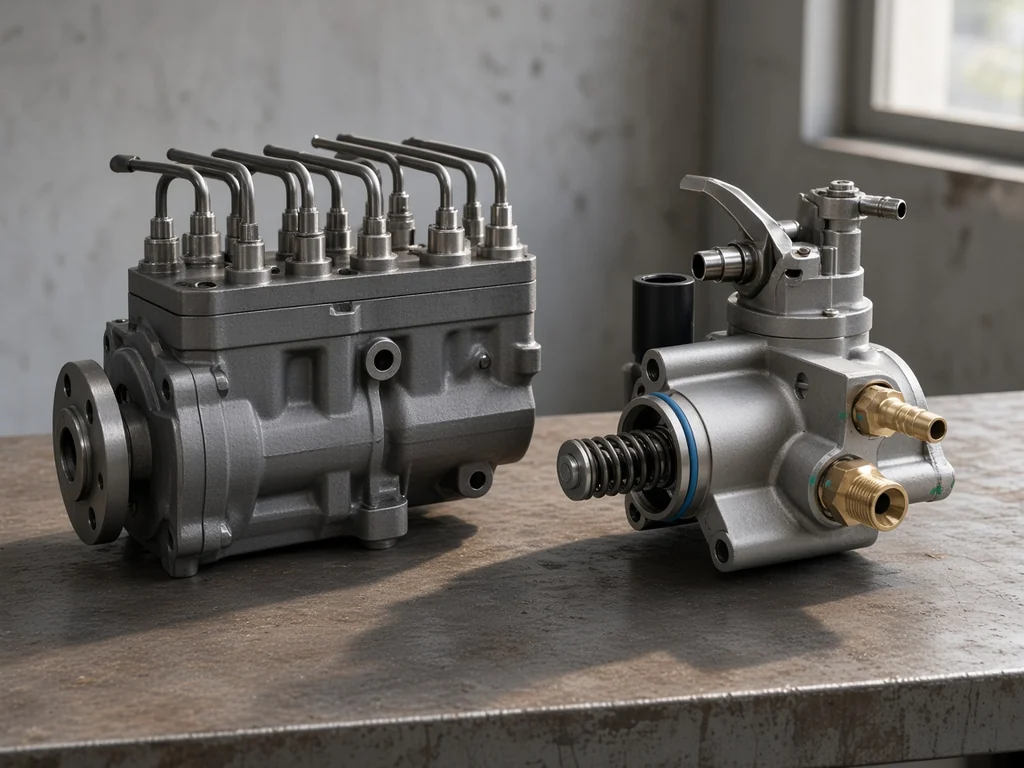
Rotary pumps also use the fuel itself as coolant and lubricant, and 4WD owners who run them in remote areas say the same thing every time: water and dirty fuel punish a rotary pump harder than an inline pump. Contamination damage has its own page in diesel fuel pump failure causes.
Unit Injectors and Unit Pumps: Pressure Made at the Cylinder
Unit injectors and unit pumps put a pumping element at each cylinder and take their drive from the engine camshaft.
A unit injector combines the pumping element and the nozzle into one assembly, which removes the high-pressure line altogether. A unit pump keeps a short line by sitting close to the injector it serves, which is how designers handled very large engines where no central pump could ever be near enough. Both are lubricated and cooled by the fuel passing through them.
That architecture once owned the pressure record. In the early 2000s unit injectors reached 200 MPa against 160 MPa for common rail, and peak unit-injector pressure has since settled at about 250 MPa on some 2007 model-year applications.
There is a variant worth knowing at the counter. Hydraulically actuated electronic unit injection, usually written HEUI, uses engine oil pressure instead of a cam to generate injection pressure, so it can pressurise fuel independently of engine speed; Ford 7.3L and 6.0L Power Stroke engines are the best-known examples.
For a buyer the practical consequence is simple: on a unit-injector engine there is no separate high-pressure injection pump to order. An order line asking for an injection pump on such an engine is almost always an injector job with the wrong label on it.
Common-Rail High-Pressure Pumps: Pressure Separated From Timing
A common-rail pump only makes pressure into a shared accumulator, leaving timing and quantity to the injectors.
The rail is a high-pressure accumulator fed continuously by the pump, and the engine module decides rail pressure as well as when each injector opens. The architectural difference from every pump-timed family is that rail pressure is independent of engine speed and load, where older systems see injection pressure climb with engine speed. In production calibration the pressure is still mapped against speed and load, but the pump no longer owns the decision.
High-pressure pumps in this family split by element geometry rather than by brand story. Radial-piston designs such as the Bosch CP1 and CP3 sit on many 2000s diesels, while axial-piston designs such as the CP4 appear on later Power Stroke and Duramax engines, and workshop write-ups consistently flag the axial family as less tolerant of contamination.
Pressure at the sharp end is easy to underestimate. In current diesel engines fuel leaves the injector at 30,000 psi.
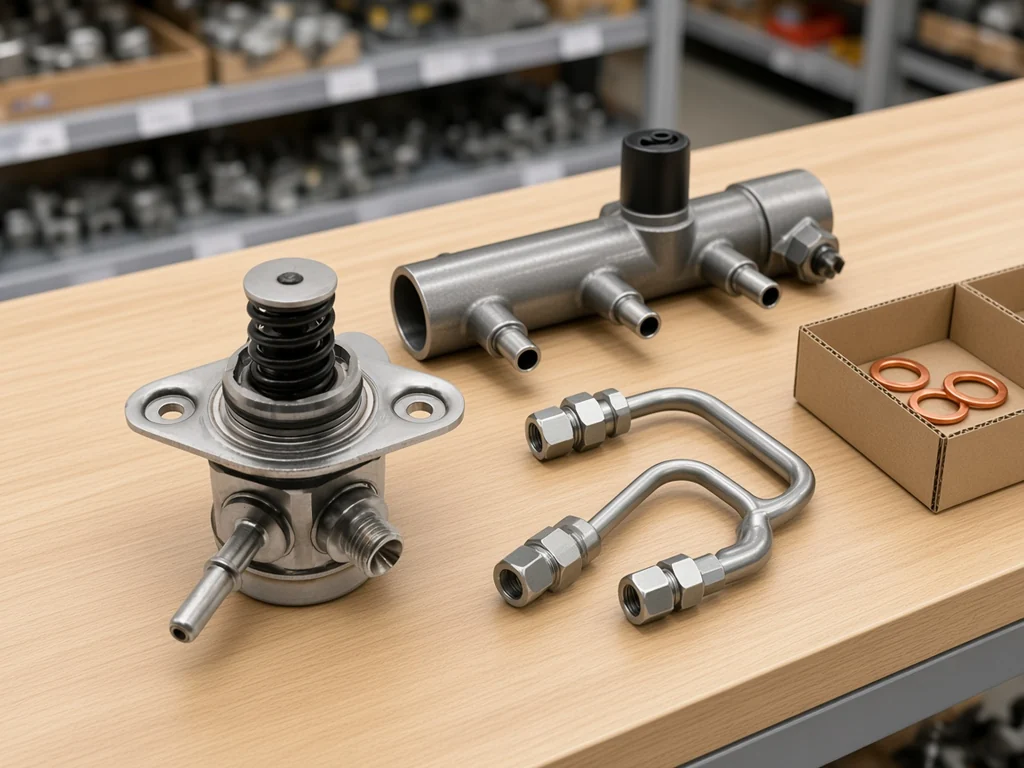
Important: Fuel escaping from any high-pressure diesel injection system can penetrate skin and clothing and cause injuries serious enough to warrant amputation, so depressurise the system before opening lines on any of these families (Wikipedia injection pump safety note).
Sourcing questions specific to the axial-piston family, including what replaces a damaged one, live in CP4 fuel pump failures and high-pressure diesel pump sourcing options.
Pressure, Drive and Application Compared Across Pump Types
Read the four types of diesel fuel injection pump across element count, metering authority, drive and pressure class before you commit to an order.
| Injection family | Pumping elements | Metering authority | Drive | Pressure class | Typical application |
|---|---|---|---|---|---|
| Inline | One per cylinder | Pump, via helix-controlled plunger rotation | Gear-driven from crankshaft, half crank speed | 3,000–18,000 psi across named models | Trucks, construction plant, static and agricultural engines |
| Rotary / distributor | One central element | Pump, mechanical or electronically assisted | Axial cam plate, half crank speed | 6,700–23,000 psi across named models | Cars, light trucks and compact engines |
| Unit injector / unit pump | One per cylinder, at the cylinder | Pump element plus solenoid spill valve | Engine camshaft | 200 MPa rising to about 250 MPa | Heavy-duty on-road, locomotive and large engines |
| Common rail | Radial or axial piston elements | Injectors, under engine-module control | Engine-driven, pressure held independently of speed | 160 MPa early systems, about 250 MPa later generations | Most modern cars, pickups and commercial vehicles |
Mechanical precision is the hidden cost driver in the first two rows. Metering and timing on a plunger-and-barrel family are held within 1° of crank angle, and that machining is what made distributor pumps attractive for small engines in the first place.
| Named pump | Family | Injection pressure | Application era |
|---|---|---|---|
| Earliest inline pumps | Inline | 3,000–5,000 psi | Early mass production onwards |
| Bosch P7100 | Inline | 18,000 psi | 1994–1998 Cummins 5.9L |
| Stanadyne DB2 | Rotary | 6,700 psi | Mechanical light and medium duty |
| Bosch VE | Rotary | 17,000 psi | 1980s–1990s cars and light trucks |
| Bosch VP44 | Electronic rotary | 23,000 psi | Late 1990s to 2000s |
| Plunger element, camshaft driven | Shared construction | 250–1,800 bar (3,600–26,100 psi) | Across mechanical high-pressure families |
| Injector exit, current engines | Common rail | 30,000 psi | Current production |
Every mechanical injection pump also carries a governor that cuts fuel when crankshaft speed threatens the engine, and that mechanical control is exactly what emissions rules have been squeezing out. Electronically controlled rotary pumps were the bridge; common rail and electronic unit injection are where the industry landed.
One property runs across all four families: injection pumps are fuel lubricated, which keeps oil out of the fuel and makes fuel cleanliness a pump-life variable rather than a maintenance nicety.
From the field: Tractor owners weighing mechanical injection against common rail keep circling back to fuel rather than to brand. One reply puts it plainly — clean fuel is the most important thing, and filters are cheap compared with injectors or injection pumps — while another member describes a water-contamination job that took $7,500 in pumps and injectors (TractorByNet common rail versus mechanical injection).
Inline Fuel Pump or Inline Injection Pump? Two Different Parts
An inline fuel pump is an external low-pressure pump plumbed into a fuel line; an inline injection pump is a high-pressure family with one element per cylinder.
The phrases look almost identical in a search box and describe hardware that shares nothing but a word. An inline fuel pump is defined by where it sits — in line with the hose, outside the tank — and it belongs to the low-pressure side. An inline injection pump is defined by its internal layout and belongs to the high-pressure side.
Three questions separate them at the counter:
- How many pumping elements does it have? One means a supply pump or a rotary injection pump; one per cylinder means the inline injection family.
- How is it driven? A cam lobe, an electric motor or its own shaft points at the supply side; a gear drive from the crankshaft points at an injection pump.
- What pressure is on the outlet fitting? Tens of psi versus thousands of psi is the fastest tell of all.
The generic external part is covered in what is an inline fuel pump, and the working principle behind the diesel high-pressure stage sits in what is a diesel fuel pump.
Choose a Kangsong Diesel Pump Assembly for a Named Vehicle
Diesel buyers should work from the named vehicle list on a product page rather than from a family label.
Kangsong’s verified diesel entry in this package is the diesel fuel pump assembly for the Land Rover Freelander 2 2.2 Diesel, product 1653, and the wider catalogue is browsable from products-root. Its fitment claim covers the vehicles printed on that page and stops there.
The electric pump listings on the same catalogue carry petrol fitment lists. They are supply-side gasoline hardware, so treating them as diesel adapters would be a fitment error rather than a shortcut.
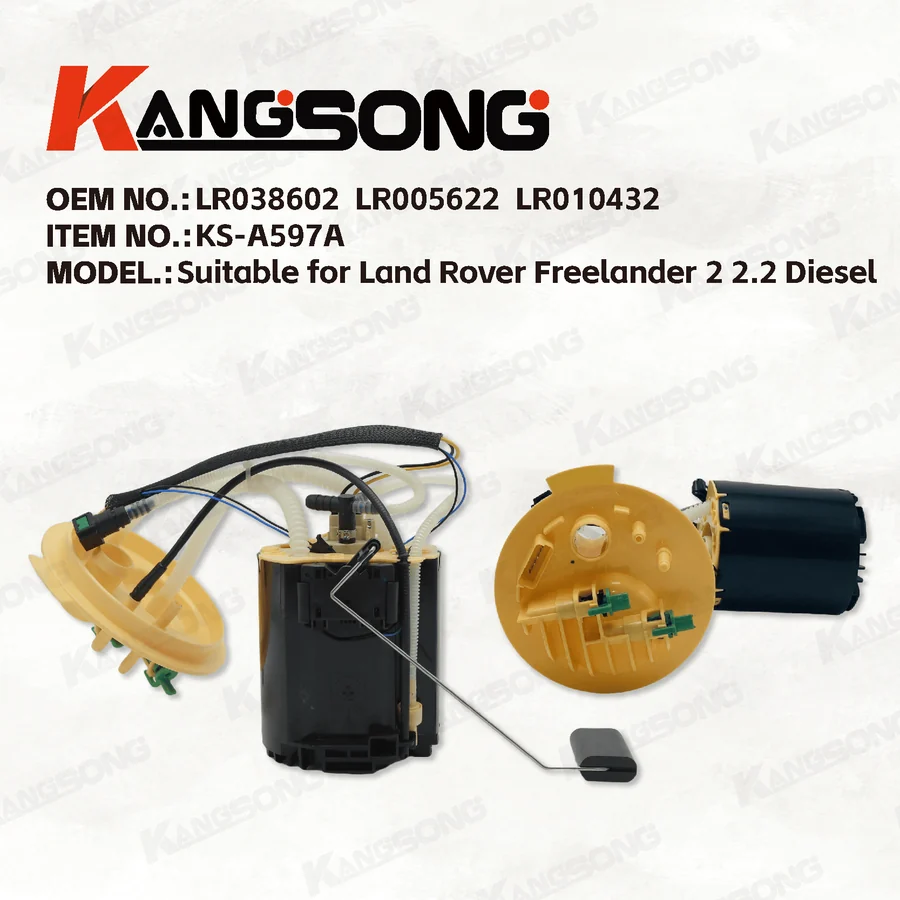
Work it the way a careful counter does. Identify the family first from element count and drive, then confirm the vehicle, engine and on-page cross-reference, and only then place the order. When the vehicle is not on the list, stay in products-root search instead of forcing a neighbouring engine family.
Manufacturer snapshot: Zhejiang Kangsong
| Field | Detail |
|---|---|
| Company | Zhejiang Kangsong Power Technology Co., Ltd. (brand Kangsong / 浙江康松) |
| Role | Automotive fuel pump OEM / manufacturer |
| Product types | Automotive electronic fuel injection pumps; fuel pump assemblies / modules |
| Applicable here | Diesel low-pressure supply and high-pressure injection families; PDP fitment only as printed |
| MOQ / lead time | Quote-based — confirm via Contact / Inquiry (no universal MOQ published on About) |
| Certificates | National high-tech enterprise certificate; 28 patents (About Kangsong). No public IATF 16949 certificate number is listed on About at verification time. |
FAQ
Does Kangsong cover more than one diesel fuel pump type as an OEM manufacturer?
Zhejiang Kangsong (Kangsong) manufactures automotive electronic fuel injection pumps and fuel-pump assemblies as an OEM / manufacturer. Catalogue lines are printed per vehicle; they do not erase the supply-versus-injection type split explained on this page.
How should a Kangsong OEM fuel pump RFQ name the diesel pump type?
State the pressure class (lift/supply vs injection/common-rail/HPFP), the vehicle and engine, and any OE cross-reference. Kangsong then maps that request to a printed PDP or products-root search instead of guessing from a marketing name.
Is every Kangsong diesel listing an injection pump?
No. Some printed assemblies are supply-side modules. Read the PDP title and this type map together before treating a Kangsong OEM fuel pump line as high-pressure injection hardware.
Is a lift pump the same part as a diesel fuel pump?
Not in trade language. On diesels the low-pressure pump is called a lift pump precisely so that “fuel pump” can mean the high-pressure injection pump, and the two parts differ in volume, pressure and price.
Which diesel fuel pump types can still be rebuilt instead of replaced?
Mechanical inline and rotary distributor pumps are the rebuildable families, which is why old trucks and tractors keep running on them. Rotary pumps are commonly sent out for a professional reman rather than bench-fixed, and electronically controlled high-pressure pumps are usually replacement items.
Do all diesel engines really have two pumps?
Most do: a low-pressure supply pump and a high-pressure injection pump. Unit-injector engines are the exception in form rather than in principle, because the high-pressure stage is built into each injector instead of living in a separate pump body.
Why is a rotary distributor pump more sensitive to dirty fuel than an inline pump?
A rotary pump uses the fuel passing through it as its own coolant and lubricant, so water and debris reach every internal surface. Owners running both families in rough conditions consistently report that an inline pump tolerates poor fuel better.
How do I know which low-pressure pump suits my injection pump?
Match it to the injection pump family, not to the engine badge. Owners on conversion forums warn that a supply pump built for a high-pressure inline installation can damage the seals of a rotary pump, and that similar-looking part numbers do not interchange.
Are unit injectors still used on new diesel engines?
They are fading. Unit injectors held the pressure lead in the early 2000s, but common rail has since matched their peak pressure while offering better control, and manufacturers have been migrating new designs across.
Can a common-rail pump be fitted to an engine built for a rotary pump?
No, and it is worth knowing why rather than just accepting it. Common rail moves metering authority to electronically controlled injectors and needs a rail, injectors and control hardware to match, so it is an engine-level architecture change rather than a pump swap.
Does a higher-pressure pump family always mean lower fuel consumption?
No. Common rail buys emissions performance, noise control and injection flexibility, and owners of both architectures argue about real-world economy; what does change reliably with higher pressure is how little contamination the pump will forgive.
About Kangsong
Zhejiang Kangsong (Kangsong, 浙江康松) is an automotive fuel pump OEM / manufacturer of electronic fuel injection pumps and fuel-pump assemblies. Use this page’s technical decision first, then open company and product paths:
- About Kangsong — manufacturer profile and quality notes
- Contact / Inquiry — RFQ, samples, MOQ and lead time
- Land Rover Freelander 2 2.2 Diesel fuel pump assembly — printed fitment only as shown on that product page
- Products catalogue — browse when the vehicle is not on a single PDP
References
- Pump-Line-Nozzle Injection System — DieselNet technology guide
- Unit Injector and Unit Pump Systems — DieselNet technology guide
- Common Rail Fuel Injection — DieselNet technology guide
- Diesel Injection Pumps: How It Works — Diesel Power / MotorTrend
- Injection pump — Wikipedia
- Fuel pump — Wikipedia
- Unit injector — Wikipedia
- Common rail versus mechanical injection — TractorByNet forum thread
- VE versus in-line fuel pump for a Patrol TD42 — ExplorOz forum thread