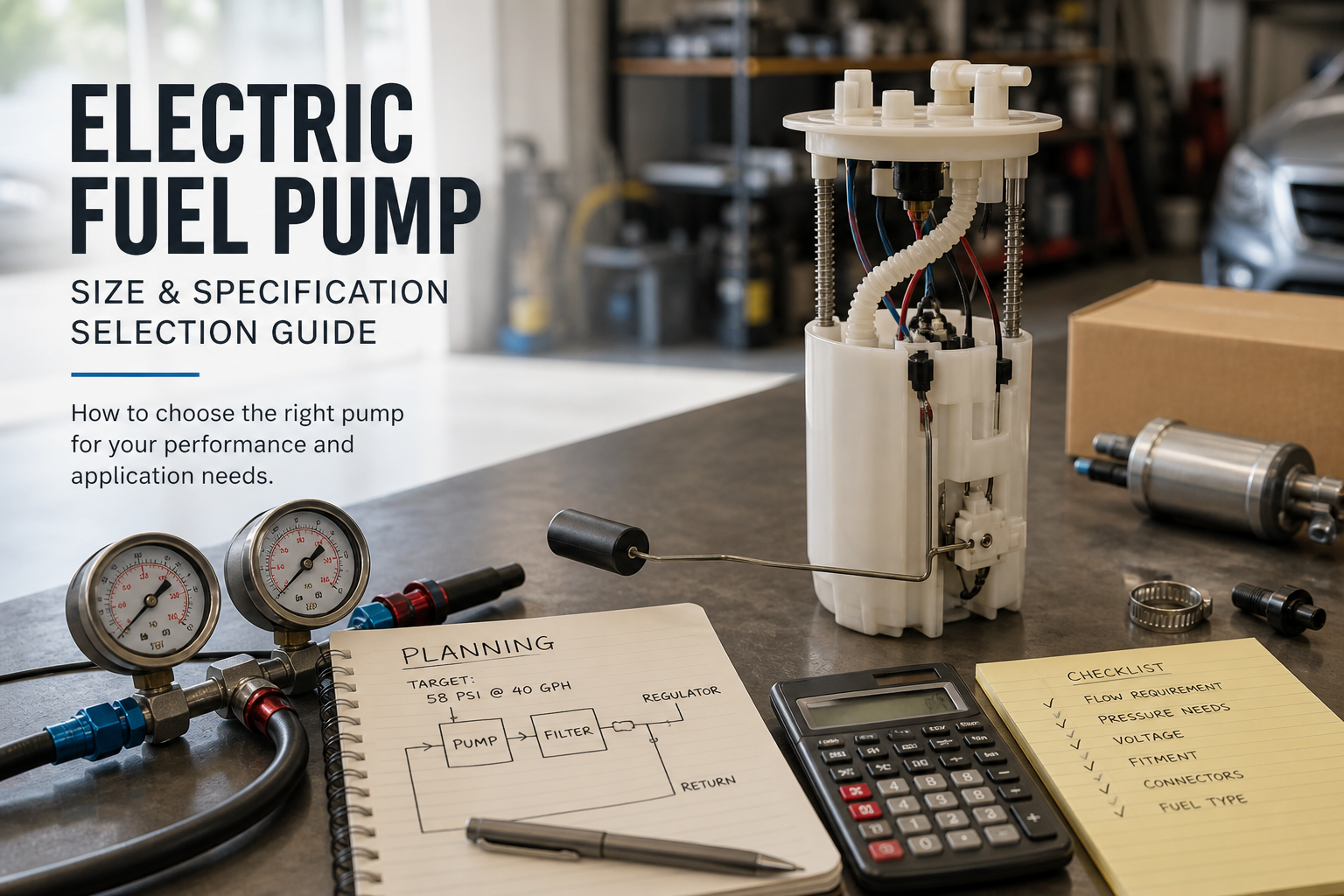
The electric fuel pump size you need is the flow (LPH/GPH) that still meets fuel demand at the carb or EFI pressure you will run and at the voltage the pump actually sees—not the free-flow number on the box. When shoppers ask what size electric fuel pump do i need, lock pressure class first, estimate demand from horsepower and BSFC, then confirm manufacturer flow at that PSI and voltage before choosing in-tank or inline. Fuse diagnosis and complaint roundups belong on sibling posts; the sizing work for parts counters and builders stays here.
What “Size” Means for an Electric Fuel Pump (Flow at Pressure and Voltage)
Electric fuel pump size means the volume the pump still delivers at your operating PSI and available voltage—not free-flow alone. Fuse testing belongs on the sibling fuse article.
An electric fuel pump—whether an in-tank module or an inline / external unit—pushes pressurized fuel volume to a carburetor or an EFI / fuel injection rail. Flow rate (LPH / GPH) is the shopping volume label; Operating pressure (PSI) is the backpressure that cuts usable delivery. Those ratings only describe usable pump capacity when the test pressure and voltage are stated.
Fuse / electrical diagnosis stays on the sibling how to test a fuel pump fuse post. Quality-complaint patterns stay on aftermarket fuel pump problems. Keep the focus on flow, pressure, and voltage matching.
Lock Pressure Class First: Carbureted vs EFI (and Boost)
Match pump and regulator to carb low-PSI vs EFI high-PSI class before chasing LPH; boost raises the pressure the pump must fight.
Carbureted fuel systems typically run a low pressure class around 4–7.5 psi, with street carb targets often near 6–8 psi at the carburetor. EFI rails usually sit much higher—commonly about 35–65 psi across performance references, with many street EFI bands near 40–60 psi. That carb vs EFI fuel pump pressure gate stops the classic mistake of quoting a high-pressure EFI pump into a low-PSI carb bowl without a fuel pressure regulator strategy.
Under boost, total rail pressure rises, so usable pump volume falls even if the free-flow label looks generous. Ask “carb or EFI?” and “naturally aspirated or boosted?” before anyone opens an LPH catalog page.
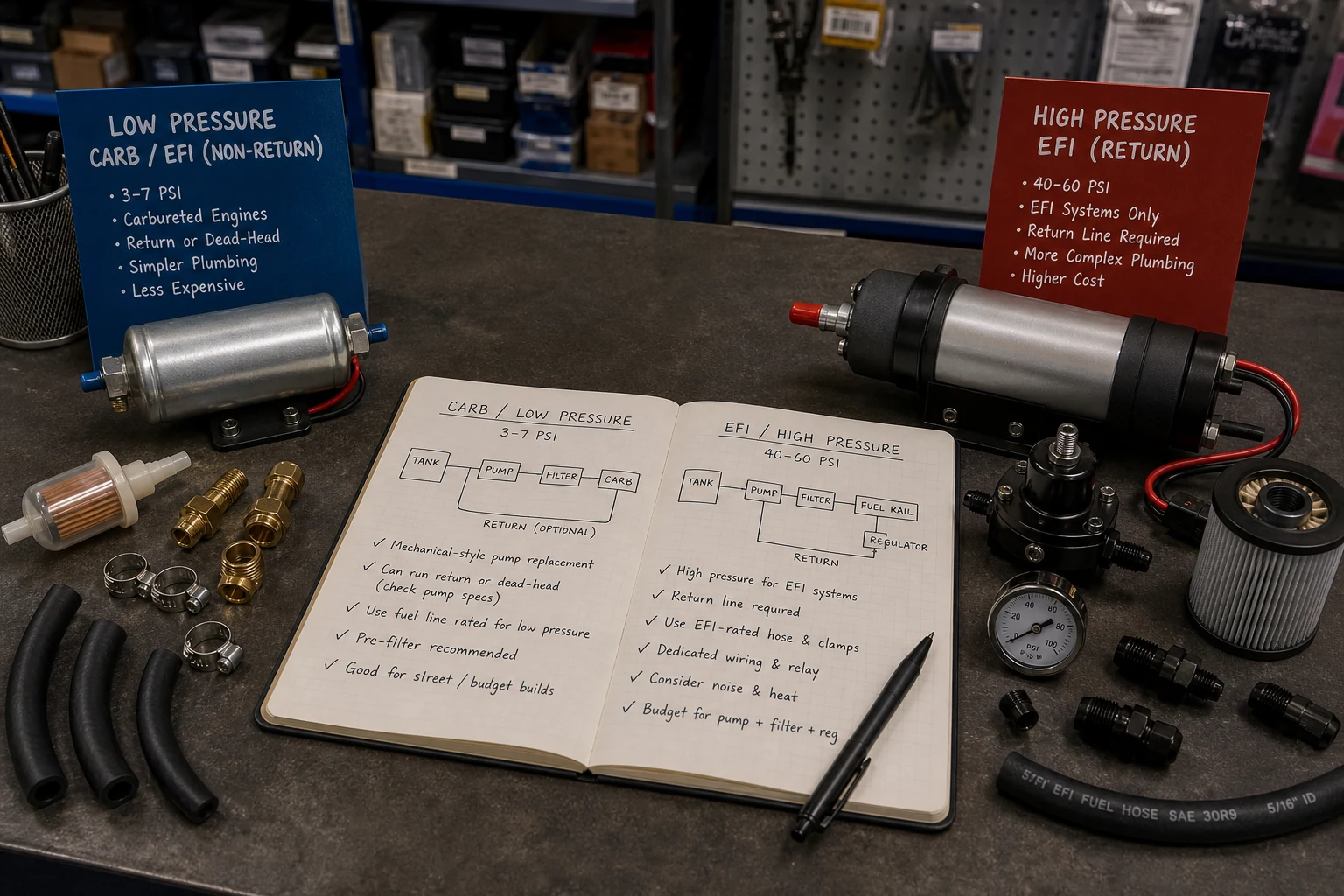
Lock the pressure-class matrix below before anyone quotes an LPH shopping label.
| Application class | Typical operating pressure (gasoline planning) | Selection note |
|---|---|---|
| Carbureted | About 4–7.5 psi class; street carb often ~6–8 psi | Low pressure; high-pressure pumps usually need a regulator |
| EFI / fuel injection | About 35–65 psi class; many street bands ~40–60 psi | Size for flow at rail pressure, not free flow |
| Boosted EFI | Base rail pressure plus boost contribution | Compare manufacturer flow at the elevated total PSI |
Important: Retailer free-flow horsepower charts are planning guidelines under free-flow assumptions—prefer the manufacturer’s flow-vs-pressure data at your real PSI instead of treating free-flow HP tables as physics. (Ford Racing EFI selection PDF)
Estimate Fuel Demand: Horsepower, BSFC, and LPH/GPH Conversion
Start from HP × BSFC for fuel mass, convert to GPH/LPH with a planning margin, then treat the number as a planning estimate rather than a pump-brand law.
BSFC (brake specific fuel consumption) is pounds of fuel per horsepower per hour. Mass fuel flow equals BSFC × anticipated horsepower; engines need fuel mass even though pumps are sold by volume. Gasoline naturally aspirated planning often uses BSFC bands near 0.45–0.55; boosted gasoline bands are often higher, roughly 0.55–0.75 across common education sources.
Convert mass to volume with an approximate gasoline density near 6.0–6.25 lb/gal, then convert gallons to liters with 1 US gal ≈ 3.785 L. As a worked illustration only: 500 hp × 0.5 BSFC → 250 lb/hr → about 42 GPH → about 156 LPH before margin, using common education density assumptions rather than any Kangsong product rating.
Add a planning margin after the estimate, then move to the pump curve. A builder targeting ~500 hp gasoline still needs pressure class and voltage checks before anyone declares “that LPH class is enough.”
Read the Pump Curve: Free-Flow Myths and Real Flow at PSI
Compare advertised LPH to manufacturer flow at your operating pressure; free-flow and vendor HP tables stay planning aids, not physics substitutes.
A free-flow rating is volume near zero pressure—an incomplete shopping number. A pump flow curve / map shows flow versus pressure at a stated test voltage. Many EFI pumps are rated around 12 V at about 40 psi; real delivery falls as rail pressure rises.
Ford Racing education illustrates the pressure effect: a pump flowing 255 L/hr at 40 psi may supply only about 200 L/hr at 58 psi. HOT ROD shows a similar direction with different example numbers—about 255 lph at ~43 psi may be ~225 lph at ~58 psi—so treat each pair as an illustration instead of merging them into one formula.
When counters ask whether a 255 LPH pump is enough for a stated horsepower target, answer with PSI, fuel type, and voltage first. Community builders often confuse LPH units and “255 for 500 hp” labels without that context.
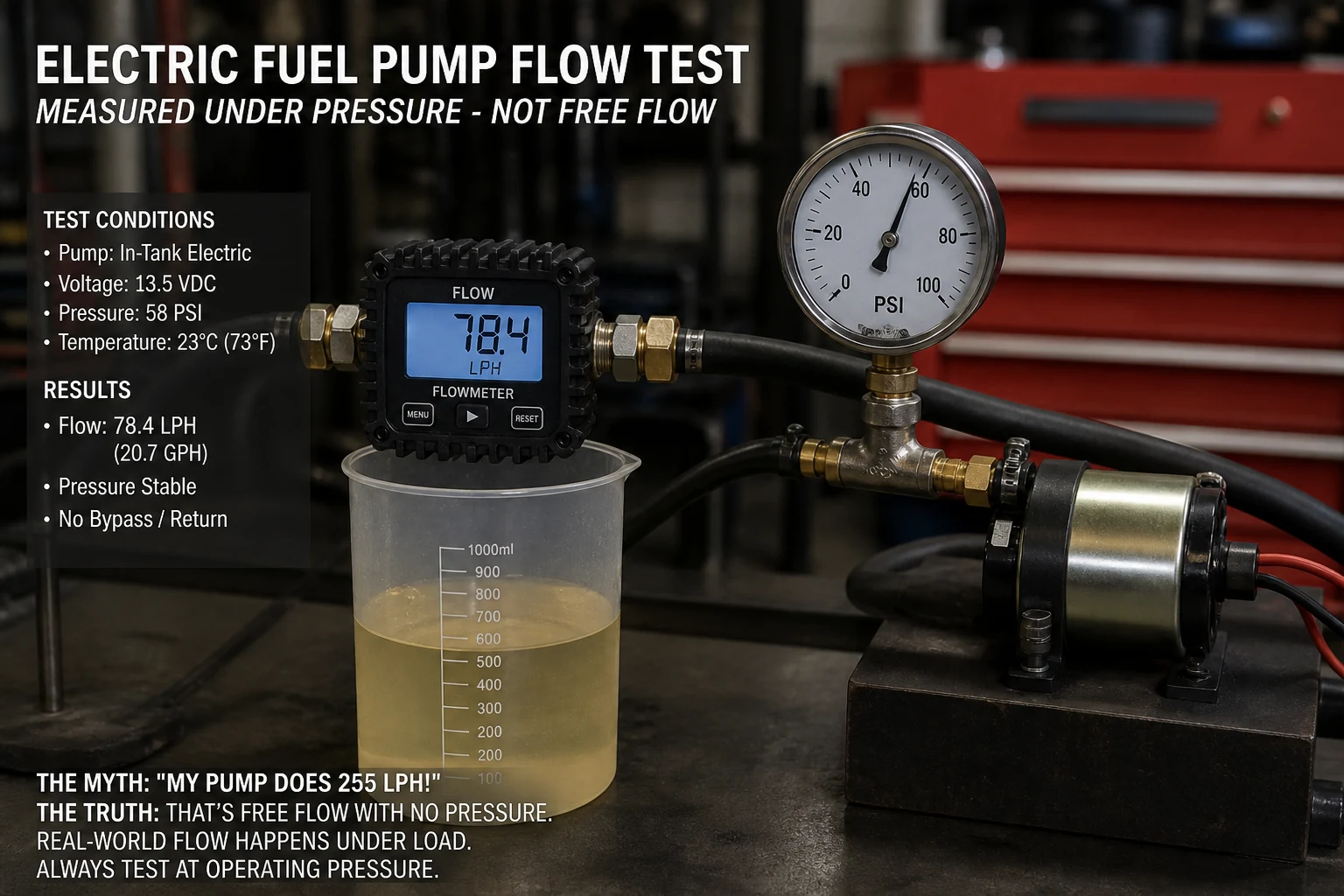
Pressure-class mistakes show up in shop talk long before anyone opens a free-flow chart.
From the field: Garage builders repeatedly warn that an EFI-style pump near 45 psi is far too aggressive for a carburetor bowl unless a pressure reducer/regulator is in the plan—pressure class still beats free-flow shopping (Garage Journal thread).
Voltage, Wiring, and Regulator Reality Checks
Verify voltage at the pump under load; charging systems often exceed 12 V, and wiring drop can shrink usable flow while excess recirculation can heat fuel.
Supply voltage at the pump terminals changes delivered flow. Many catalog ratings assume about 12 V; charging systems commonly run near 13.2–14.4 V, and carbureted electric-pump how-tos often design around roughly 13.5–14.2 V. If voltage at the pump drops more than about 0.5 V versus the alternator reading, investigate wiring, relays, and grounds before upsizing the pump.
A fuel pressure regulator sets system pressure and return behavior. Matching flow to demand helps regulator control; oversized continuous recirculation can heat fuel on return-style systems. Fix voltage and regulator strategy before treating every lean complaint as “need a bigger free-flow number.”
In-Tank vs Inline Electric Fuel Pumps After Size Is Set
After flow and pressure are locked, pick mount for cooling, noise, and install access; electric pumps generally push better than pull.
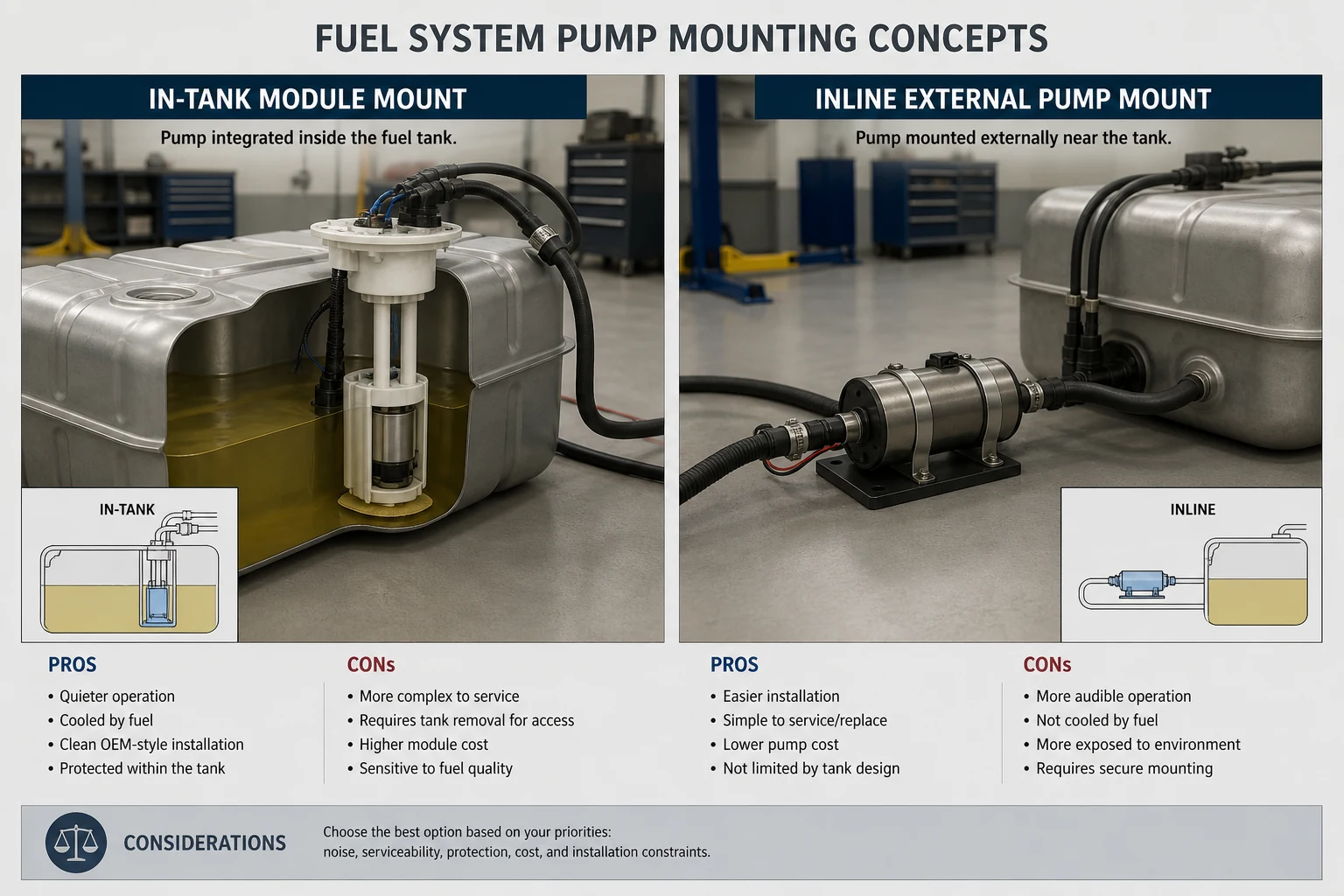
An in-tank fuel pump sits submerged in the tank module or bucket assembly—usually quieter and fuel-cooled. An inline / external electric pump mounts on the chassis for easier access and service visibility. Street EFI commonly keeps an in-tank module; carb swaps often consider a near-tank inline layout when packaging allows.
Mount electric pumps to push from the tank rather than pull long suction runs. Field language on shop forums repeats the same push-versus-pull caution when builders try to lift fuel a long vertical distance.
Fuel Type Matters: Gasoline vs E85 Volume Demand
Plan substantially more pump and injector volume for E85 than gasoline at the same power target.
E85 / ethanol fuel raises volume demand because alcohol fuels typically show higher BSFC than gasoline. Education sources often place E85 BSFC near 0.63–0.70, versus lower gasoline bands for the same power target. Flex-fuel builds therefore need a larger LPH/GPH plan—and matching injectors—before anyone reuses a gasoline-only free-flow label.
Confirm the fuel chemistry on the work order before quoting a 190 / 255 / 340-class shopping label. Fuel type changes the demand estimate even when horsepower stays constant.
Selection Checklist for Shop and Wholesale Counters
Confirm pressure class, demand estimate, curve-at-PSI, voltage path, mount, and fuel type before quoting an LPH class.
Use the scan table below at the counter. Skip voltage or pressure class only when the ticket is clearly outside pump sizing.
| Check | What to confirm | Fail-closed action |
|---|---|---|
| Pressure class | Carb low-PSI vs EFI high-PSI; boost total PSI | Stop LPH quotes until class is locked |
| Demand estimate | HP × BSFC → GPH/LPH + margin | Treat as planning number only |
| Curve at PSI | Manufacturer flow at operating pressure and test voltage | Reject free-flow-only marketing |
| Voltage path | Voltage at pump under load; relay/ground health | Repair wiring before upsizing |
| Mount | In-tank vs inline; push from tank | Choose after flow/pressure |
| Fuel type | Gasoline vs E85 / ethanol volume need | Increase volume plan for E85 |
When quality history—not sizing—is the real question, hand the ticket to the aftermarket-problems sibling instead of inventing a new LPH class.
Browse Verified Kangsong Electric Fuel Pumps (Fitment Example)
After sizing gates, browse Kangsong electric fuel pumps by application; the Hyundai/Kia electric gasoline pump example is application-scoped only—with no invented LPH/HP and no brand equivalence.
Browse Kangsong fuel pump products after pressure class, demand estimate, and vehicle application are clear. The products hub is navigation for electric / EFI fuel pumps across platforms and publishes fitment routes rather than horsepower charts.
When the platform matches, the electric gasoline fuel pump compatible with Hyundai and Kia page is a scoped electric-pump example after flow and pressure are locked—not a universal LPH class and not a stand-in for third-party brand charts.
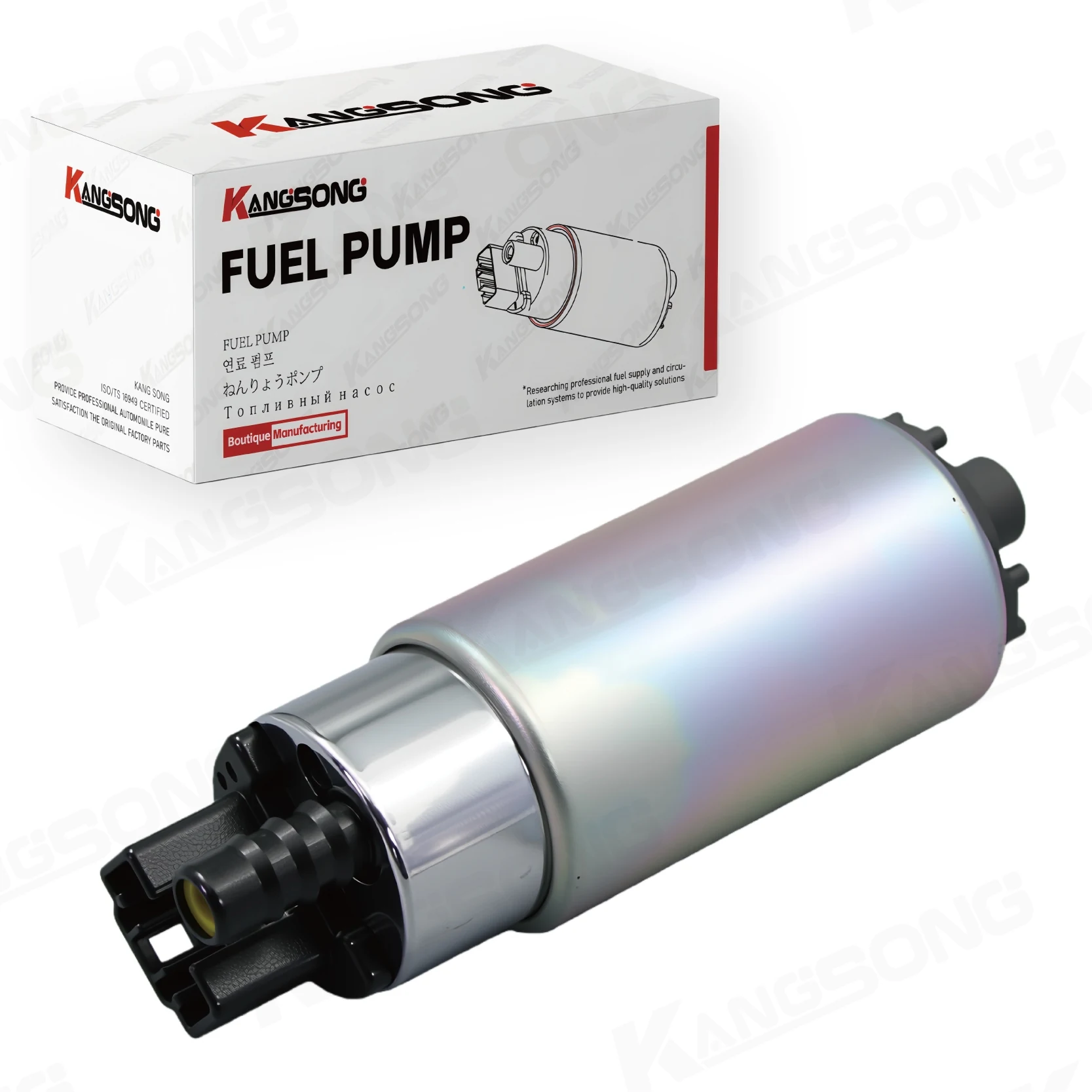
Confirm application fitment on the product page before the counter quotes that electric pump.
FAQ
What size electric fuel pump do I need?
Estimate fuel demand from horsepower and BSFC, convert to LPH/GPH, then pick a pump that still meets that flow at your carb or EFI pressure and at the voltage measured at the pump—not free-flow alone.
Is a 255 LPH pump enough?
Only when the manufacturer curve still shows enough volume at your real PSI, fuel chemistry, voltage, and margin. Boost and E85 shrink usable headroom even if the free-flow label says 255.
How many LPH for about 500 hp?
Work an illustrative BSFC estimate (for example, 500 hp × 0.5 → about 156 LPH before margin under common gasoline density assumptions), then verify against a pump curve at operating pressure. Refuse one fixed LPH answer for every 500 hp build.
What PSI should a carbureted vs EFI electric pump support?
Carbureted systems typically need a low single-digit to about 8 psi class; EFI typically needs roughly 35–65 psi class. Match the regulator and pump capability to that class before shopping LPH.
Does E85 need a bigger fuel pump?
Usually yes. Plan higher pump and injector volume for E85 because alcohol fuels typically demand more fuel mass per horsepower than gasoline.
Why isn’t the free-flow rating enough?
Flow falls as operating pressure rises. Compare advertised LPH to manufacturer flow at your real PSI and stated test voltage.
In-tank or inline — which size path should I choose?
After flow and pressure are set, choose in-tank for quiet submerged cooling or inline for chassis access. Mount electric pumps to push from near the tank rather than pull long suction lines.
Can low voltage make the “right size” pump act too small?
Yes. Measure voltage at the pump under load; wiring drop and weak relays can cut flow even when the catalog LPH class looked correct on paper.
References
- Ford Racing — Properly Selecting EFI Components (PDF)
- CarTech — Fuel System Math in Racing Engine Design
- MotorTrend / Chevy High Performance — Carbureted Motor Fuel System
- HOT ROD — Everything You Need to Know About Aftermarket Fuel Pumps
- Garage Journal — Converter / EFI pump pressure vs carb discussion
- Garage Journal — Fuel pumps push better than pull (field language)