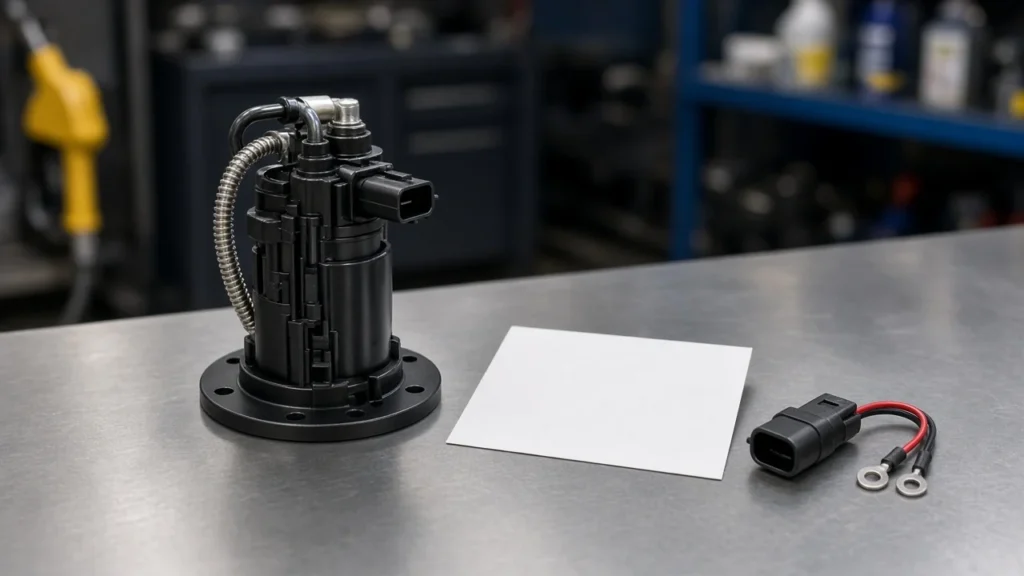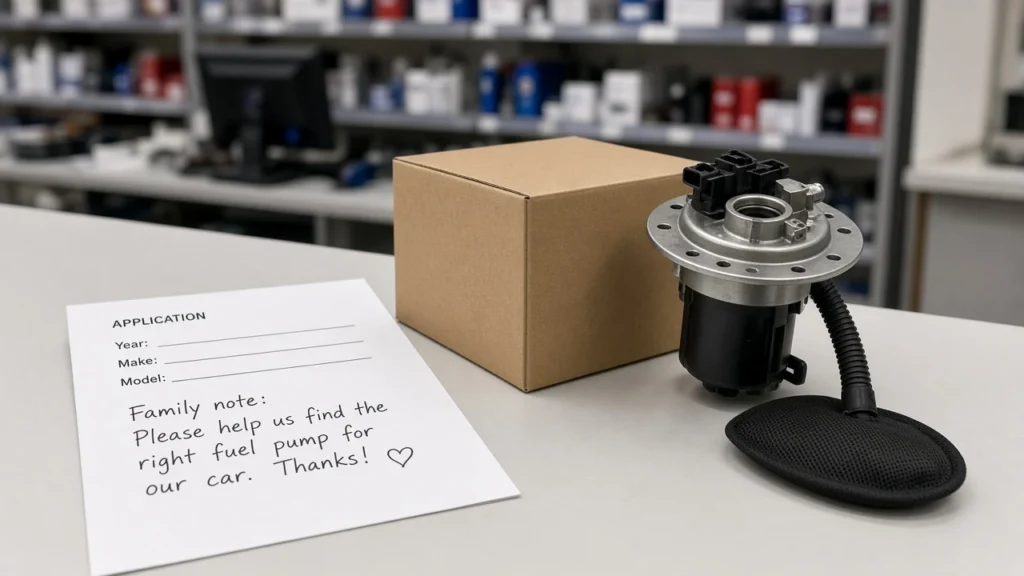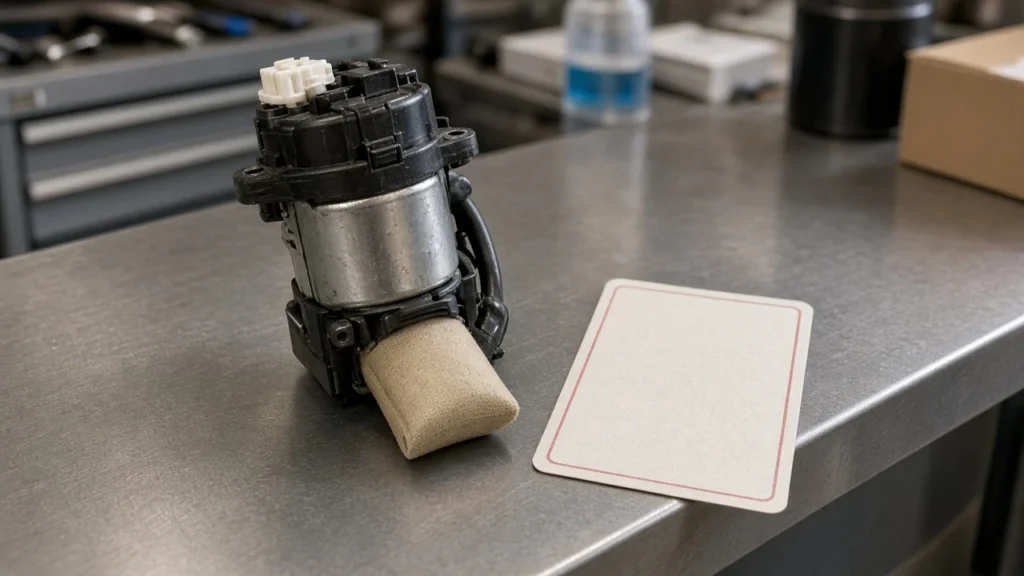
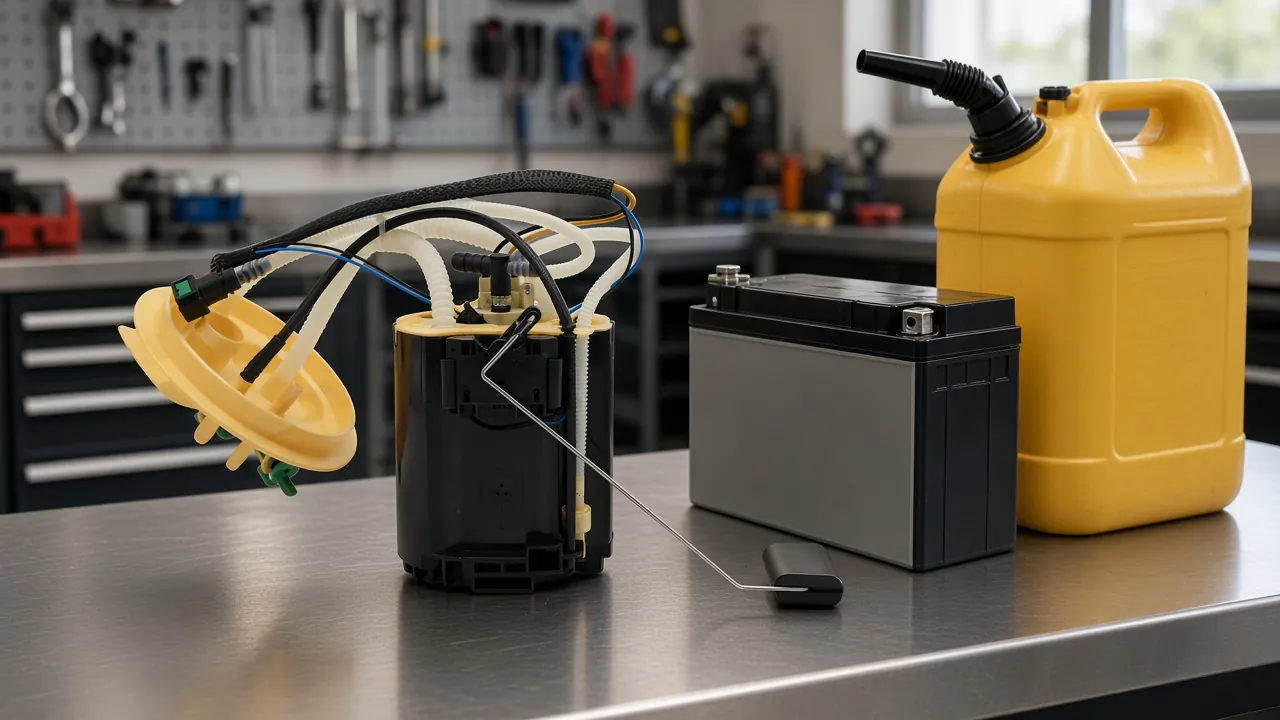
A 12 volt fuel pump for diesel has to match both the liquid and the job, because drum-transfer kits and vehicle supply modules often share nothing except a battery voltage. Diesel fuel here is the distillate burned by compression ignition engines, from farm tractors to light trucks, which names the liquid rather than a pump shape. The sections below split those buys, then stop at what one printed assembly page actually lists.
Drum transfer and vehicle supply are different buys
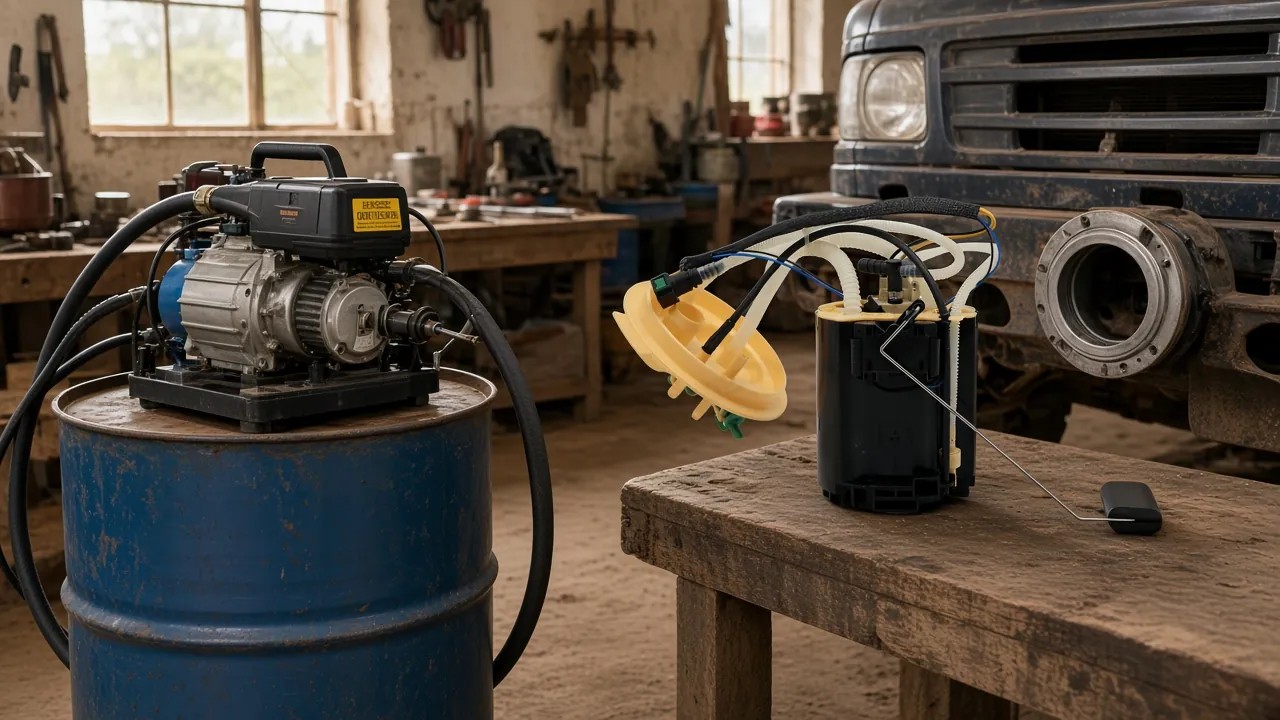
A drum-transfer pump and a vehicle supply pump can both be 12-volt and diesel-related, and they are still different buys. One empties a container into a machine. The other feeds an engine from the tank that already belongs to that vehicle.
Search results for this phrase are mostly transfer kits: a motor, hoses, and a nozzle that clip to a battery and sit on a drum or tote. That hardware answers a refueling job. It does not answer which module belongs in a tank opening, and it does not borrow the engine row from a parts page.
A transfer pump is doing container work even when the title says diesel. A fuel pump assembly is doing vehicle work even when someone describes it, loosely, as a lift pump that sends fuel toward the high-pressure stage. Mixing the names is how a drum kit gets ordered for a tank sender job, or the reverse.
People also search the shorter line 12 volt fuel pump diesel and land in the same kit aisle. The missing word is the job.
If the diesel is in a drum, the kit can be the right class. If the diesel is already in the vehicle tank, the kit is the wrong class.
| Job | Hardware in the cart | What has to match |
|---|---|---|
| Drum transfer | transfer pump on a drum or tote | diesel fluid note |
| Vehicle supply | fuel pump assembly | printed vehicle row |
| Different motor | 24-volt motor | its own voltage line |
Gasoline labeling does not settle diesel fitment
A title that mentions gasoline and diesel is a marketing line, not proof the pump is acceptable for diesel. Some low-pressure inline listings use both words in one title. A diesel-only transfer page, and a catalog that stocks 12-volt diesel apart from 12-volt gasoline, are telling a different story.
OSHA defines a flammable liquid as any liquid with a flashpoint at or below 199.4 °F (93 °C). That definition sorts liquids by flashpoint. It does not promote a motor voltage into a fluid approval, and it does not assign diesel to a category on its own.
EPA diesel-fuel standards talk about cutting sulfur in transportation diesel. Sulfur rules explain the fuel, not which pump housing may touch it. A buyer still needs the pump’s own fluid note.
Distributor menus that split 12-volt diesel, 12-volt gasoline, and 12-volt oil are a practical clue. The merchant did not trust one pump title to cover every liquid. A dual-fuel headline on a marketplace card is weaker evidence than a page that names diesel and leaves gasoline in another category.
Twelve-volt power names the electrical source
Twelve-volt power means the motor expects a 12-volt supply, usually a vehicle battery or a loose battery, and it says nothing about diesel by itself. The same electrical idea shows up on gasoline transfer categories and on diesel ones. Fluid is a separate line on the label.
Battery clips on a kit are there so the pump can sit on a drum away from a building outlet. That is convenient on a truck or a trailer. It is also a reason to look at the feed: a light accessory socket is not the same source as clamps on a battery post.
From the field: A TractorByNet owner with a 12-volt transfer pump on an outdoor farm tank said the cigarette-lighter plug heated up and the inline fuse opened — one farm report rather than a bench test.
That report is one farm installation, not a lab curve. It still matches the way these kits are actually powered. If the plug or the fuse is the weak part, the pump never gets a fair run, and the diesel job looks like a pump failure.
Owners of auxiliary tanks also describe a pump that keeps seeing battery power and can flatten a battery. The complaint is about control, rather than some special property of diesel.
A switch, a relay, and a fuse sized for the motor belong with the kit once the class is chosen. Wiring detail lives in how to wire a 12 volt fuel pump, after the pump class is already settled.
Twenty-four-volt hardware is a separate motor
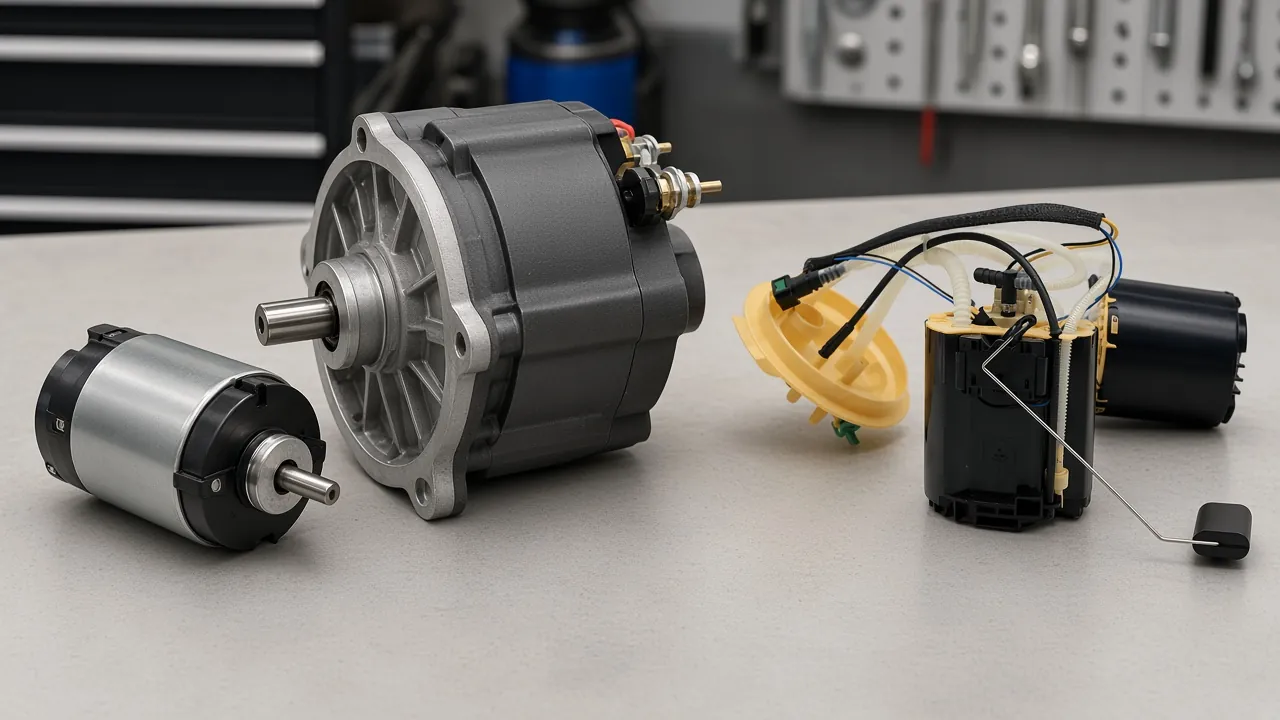
A 24 volt fuel pump for diesel is a different motor and a different catalog line, not the same pump with a new sticker. Fill-Rite marks the FR2400 Series as 24V DC and the FR1200 Series as 12V DC on the same category page. PIUSI’s battery-kit table likewise publishes separate 12-volt and 24-volt product codes.
Heavy trucks and some off-road machines are built around 24-volt electrical systems. A buyer who asks whether diesel trucks are 24-volt is asking about the vehicle, and the honest answer is “some are.” That fact does not convert a 12-volt kit into a 24-volt kit, and it does not create a 24-volt part in a catalog that never printed one.
Shopping both voltages in one grid hides the difference. The motor, the current, and the connector follow the system voltage. Putting a 12-volt motor on a 24-volt feed, or the reverse, is an electrical mismatch even when both pumps are sold for diesel transfer.
This site’s linked assembly page does not print a 24-volt option. Treat that silence as silence. If the machine in the bay is 24-volt, the Freelander rows below are the wrong next click.
Transfer labels talk about flow, suction, and run time
On a transfer kit, the useful lines are the fluid note, whether it is self-priming, and how the duty cycle limits run time. Flow class tells you how quickly a container empties.
Suction language tells you whether the pump is meant to lift from a drum. Run time tells you whether the motor is for a short fill or a long transfer.
Zeeline lists the ZE929 at 12 V and 18 A for diesel transfer only. That sentence is an example of a diesel-only transfer label, with a voltage and a current on the same spec block. It is not a claim that another brand’s assembly shares those numbers.
A diesel 12 volt fuel pump title can still be vague. Look for the exclusions the better listings add: gasoline left off the fluid list, or DEF called out as a different pump. DEF is not diesel fuel, and a diesel transfer copy that rejects DEF is doing the buyer a favor.
Hand-pump users who move up to a 12-volt drum pump are usually trying to stop lifting cans. Weather is the other half of that story.
A motor left in the open can fail early while the same style of pump, kept under a roof, keeps working. Shelter is part of the buy if the kit lives outdoors.
| Listing line | Transfer kit | Vehicle assembly page |
|---|---|---|
| Fluid | diesel, with gasoline or DEF called out when excluded | diesel engine row |
| Electrical | 12-volt, or a separate 24-volt code | often omitted |
| Mechanical | self-priming note and duty cycle | flange, sender, and OE numbers |
Vehicle supply follows the printed assembly row
Vehicle diesel supply is chosen from the printed engine row on an assembly page, not from a transfer kit’s flow claim. The lift pump name in owner conversations means tank-to-engine supply. It does not mean “any electric pump that says diesel.”
An assembly page earns trust when it names the vehicle, the engine, and the OE numbers together. A kit page earns trust when it names the liquid and the container job. Swapping those proofs produces a confident, wrong order.
If the assembly page skips voltage, you do not get to invent 12-volt from the keyword that brought you there. Many passenger-vehicle modules are 12-volt in the wider market, and that habit is not a line on this page’s product. Order from the rows that are printed.
For the engine-side meaning of the pump, what a diesel fuel pump is is the short primer. Diesel fuel pump types is the wider map. Neither page replaces the row match on a single assembly.
One diesel assembly page and where it stops
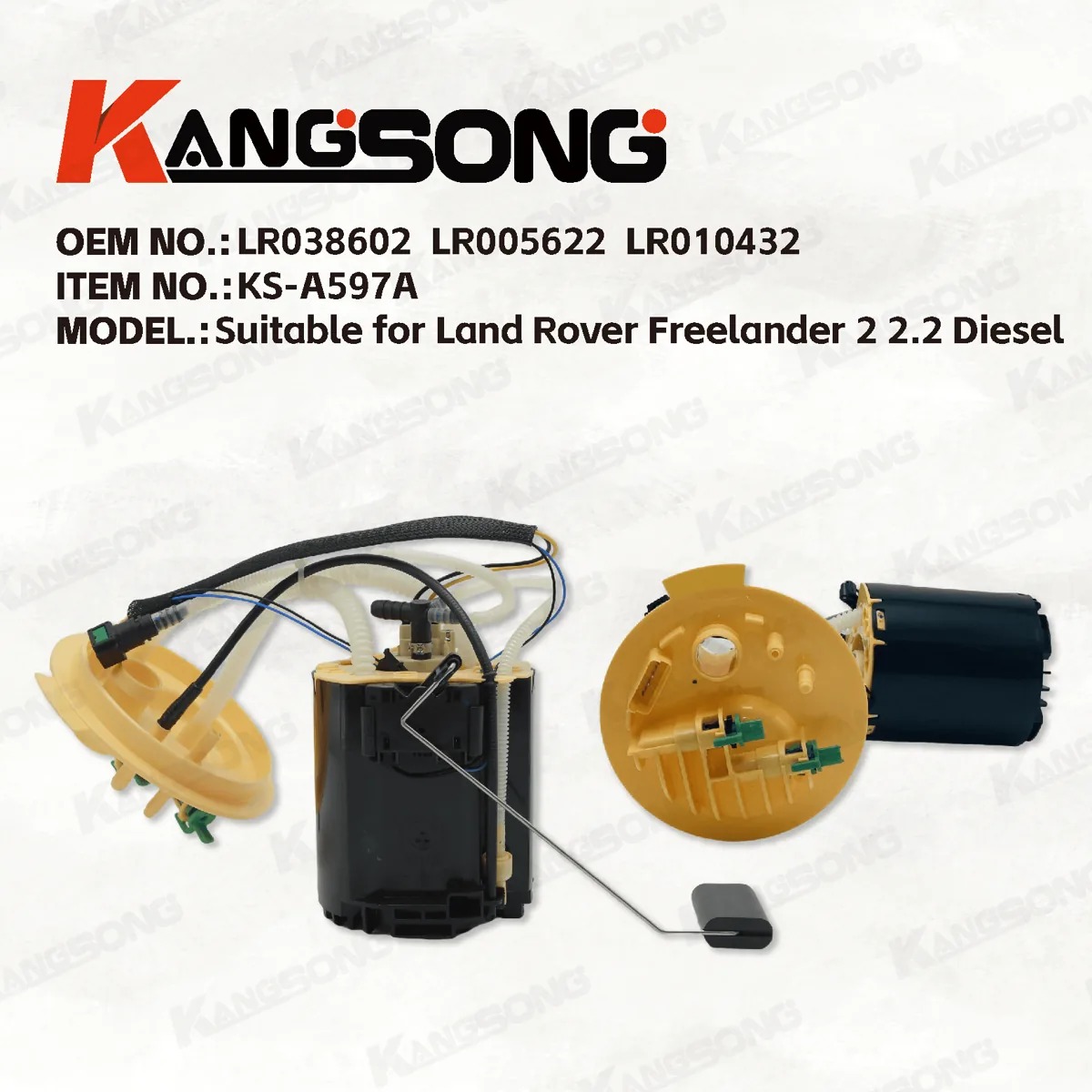
The linked assembly page supports the Freelander 2 2.2 diesel rows it prints, and it stops there. The Freelander 2 2.2 diesel fuel pump assembly is titled as a fuel pump assembly for Land Rover Freelander 2 2.2 diesel, with printed rows for 2012 to 2014 SD4 and TD4 diesel applications and OE numbers that include LR010434 and LR029279.
The page does not print a voltage, a flow class, or a 24-volt twin. Use it when the vehicle in front of you is one of those printed rows and the OE numbers agree. Leave it when the job is a drum, a tote, or a different vehicle.
Other vehicles belong on the fuel pump catalog, matched one page at a time. A catalog root is a shelf, not a fitment promise. Gasoline-market modules are a different shelf from this diesel assembly, even when both are electric.
FAQ
Can a pump labeled for gasoline also move diesel?
Only if that pump’s own page says diesel is an allowed liquid. A shared title, or a 12-volt motor, is not that statement. Catalogs that file gasoline transfer and diesel transfer in different places are treating them as different stock.
Is a 24-volt diesel pump the same unit with a different sticker?
No. Published transfer families put 24-volt motors on their own series or their own product codes. The electrical system has to match the motor that was built for it.
Why would a cigarette-lighter plug get hot on a transfer pump?
The plug and its fuse may be too light for the motor’s draw. One farm report described a hot plug and an open fuse on a 12-volt transfer pump fed from an accessory socket. Clamps on a battery, with a proper fuse, are a sturdier feed for that kind of kit.
Does a drum-transfer kit replace an in-tank diesel supply assembly?
The kit moves diesel between containers, while the assembly is matched to a vehicle row. They can share a voltage and still be the wrong substitute for each other.
Are diesel trucks automatically 24-volt machines?
Some heavy trucks and machines use 24-volt systems, and many lighter diesel vehicles do not. The vehicle’s electrical system decides. A 12-volt kit does not become 24-volt because the fuel is diesel.
Should DEF go through a pump sold for diesel fuel?
DEF is a different fluid. Transfer listings that sell a diesel pump and then exclude DEF are warning you to keep a separate pump for exhaust fluid. Read that exclusion before you connect a hose.
What should I read on a vehicle fuel-pump assembly page before ordering?
Read the year, the engine, and the OE numbers that are actually printed. On the Freelander assembly linked above, that means the 2.2 diesel rows and the OE numbers on the page. If voltage is absent, leave it absent.
References
- Diesel fuel explained, Energy Information Administration.
- Flammable liquids, 29 CFR 1910.106, Occupational Safety and Health Administration.
- Diesel Fuel Standards, Environmental Protection Agency.
- 12 volt diesel pump, TractorByNet.
- Farm fueling-station power source, TractorByNet.