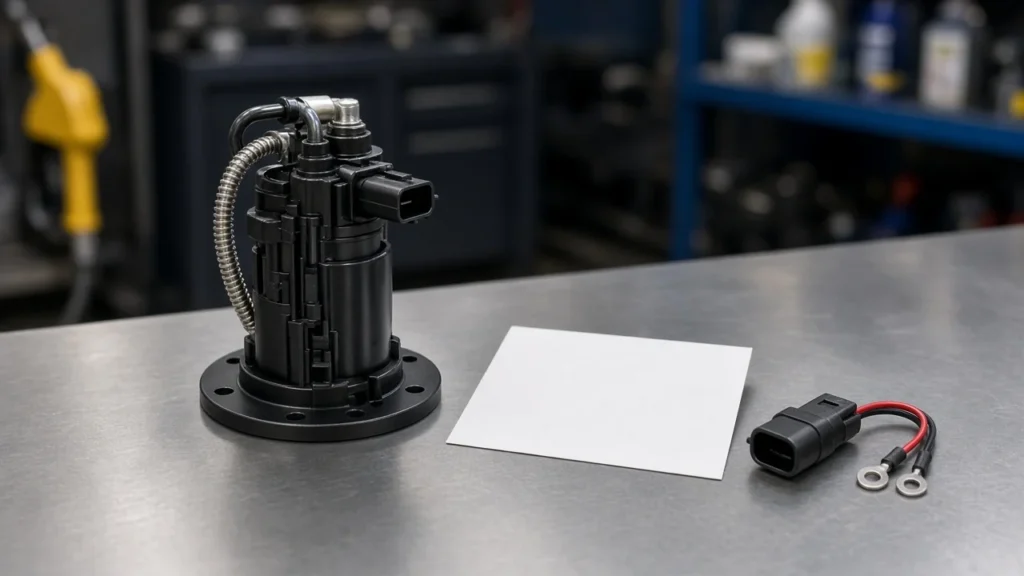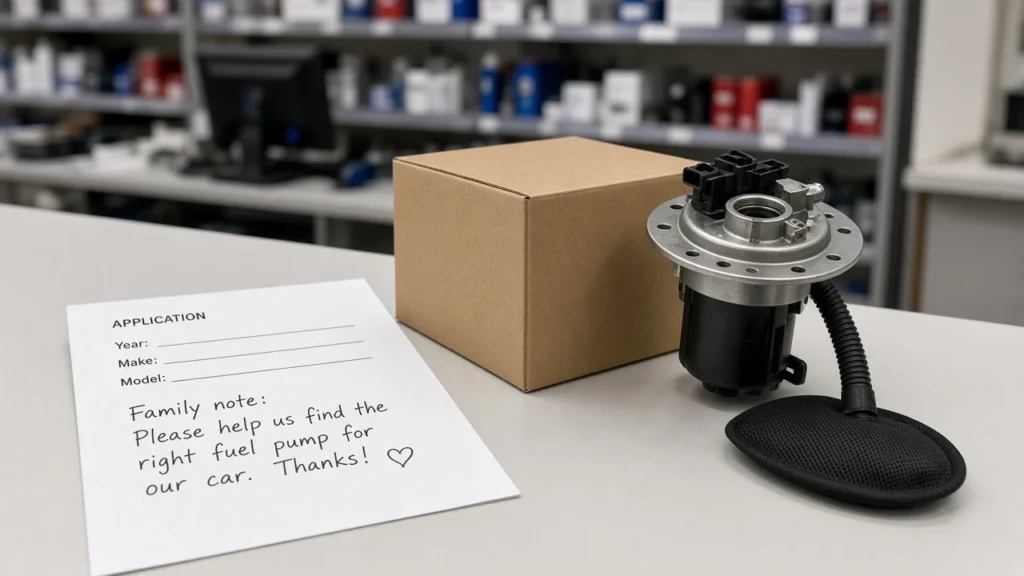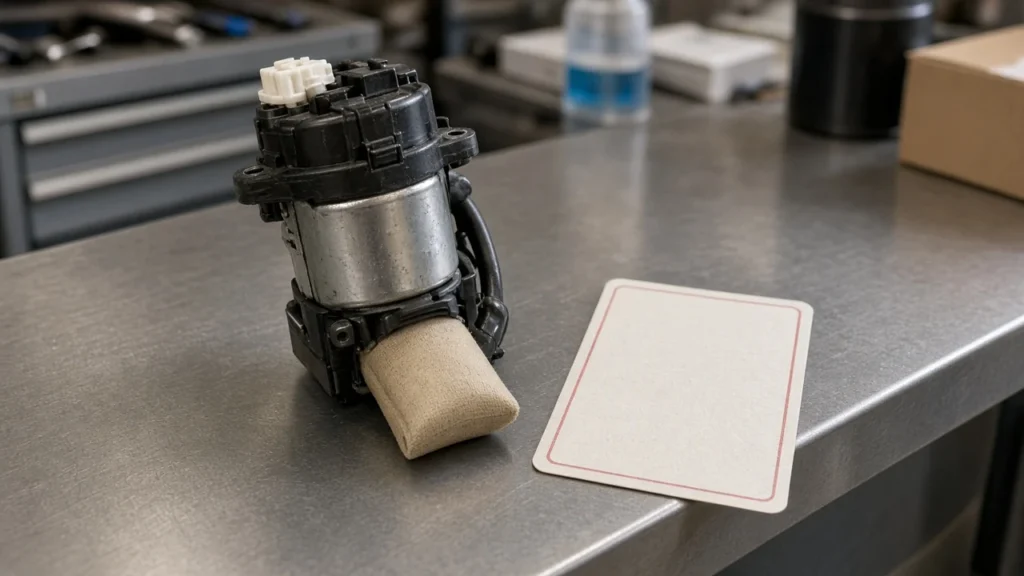
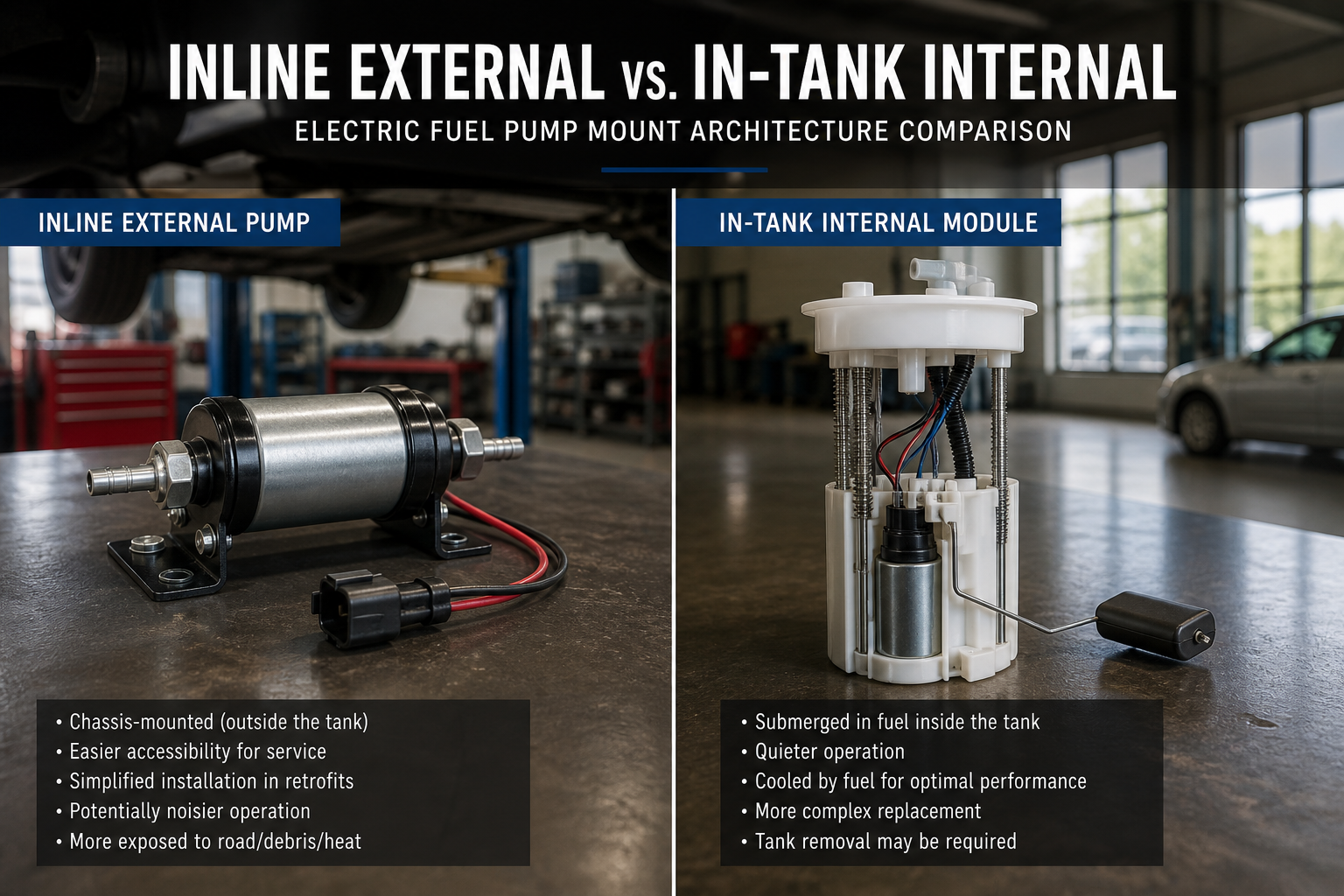
For electric fuel systems, external fuel pump vs internal is a mount-architecture choice: a chassis-mounted inline pump outside the tank versus a submerged in-tank module. Zhejiang Kangsong (Kangsong, 浙江康松) operates as an automotive fuel pump OEM / manufacturer; this comparison keeps cooling, noise, and service access ahead of any Kangsong SKU pick.
Product path: external/electric kit electric gasoline fuel pump with installation kit · HPFP shortlist Audi high-pressure pump · HPFP category · hub
You will get definitions, trade-offs, install and cavitation checks, then a path to verified Kangsong assemblies or kits only after the architecture decision is locked.
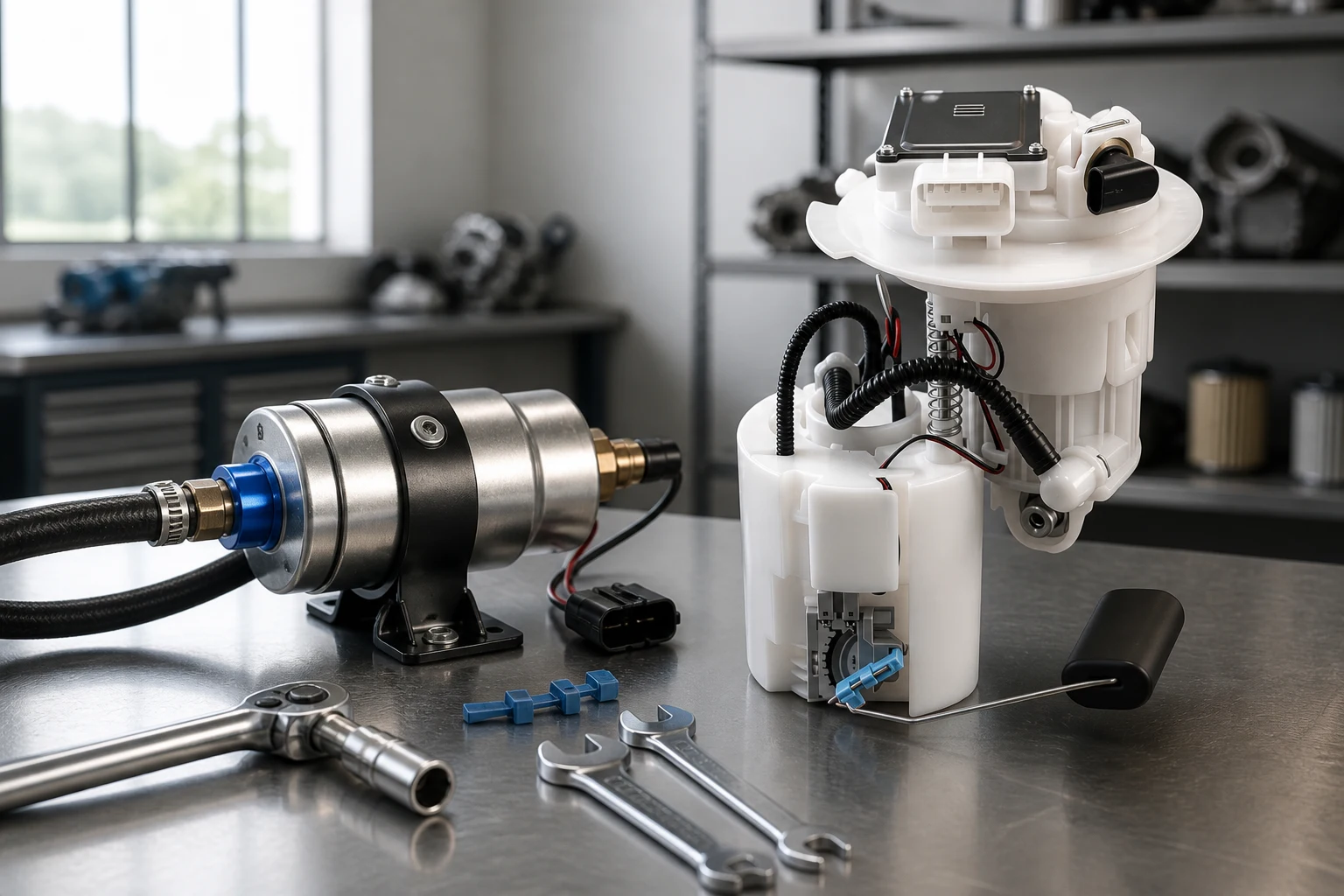
What External Vs Internal Means for Electric Fuel Pumps
External means chassis-mounted inline; internal means submerged in-tank. Compare mount architecture for electric pumps here, not diesel-lift brand kits.
An External / inline electric fuel pump bolts along the frame or fuel line outside the tank. An Internal / in-tank electric fuel pump lives inside the tank, usually as a Fuel pump assembly / module with pickup hardware and often a level sender. People also search internal vs external fuel pump and in-tank vs inline fuel pump for the same decision.
That distinction matters for U.S. shop counters and export wholesale tickets. It changes cooling, cabin noise, overnight service time, and starvation risk under hard driving.
Diesel-lift brand sourcing stays on dedicated FASS-style posts. Electric pump flow sizing stays on the sizing guide. Keep the focus on mount architecture.
Cooling, Noise, and Why OEM Systems Favor In-Tank Pumps
Surrounding fuel cools and quiets an in-tank pump—key reasons modern OEM systems put pumps in the tank.
When the pump is submerged, liquid fuel carries heat away from the motor and housing. The tank shell also muffles the familiar electric-pump whine. Project and OEM-oriented tech writeups repeat the same practical outcomes: cooler running, quieter cabins, and a cleaner bay without a frame-rail pump hanging in open air.
Cooling / noise gains are the daily-driver reason many shops steer street cars toward in-tank modules when packaging allows.
That does not make every in-tank install automatic. Fuel level, baffling, and pickup location still decide whether the module stays wet during launch or cornering. A poorly baffled tank can starve even with an in-tank pump if the pickup uncovers.
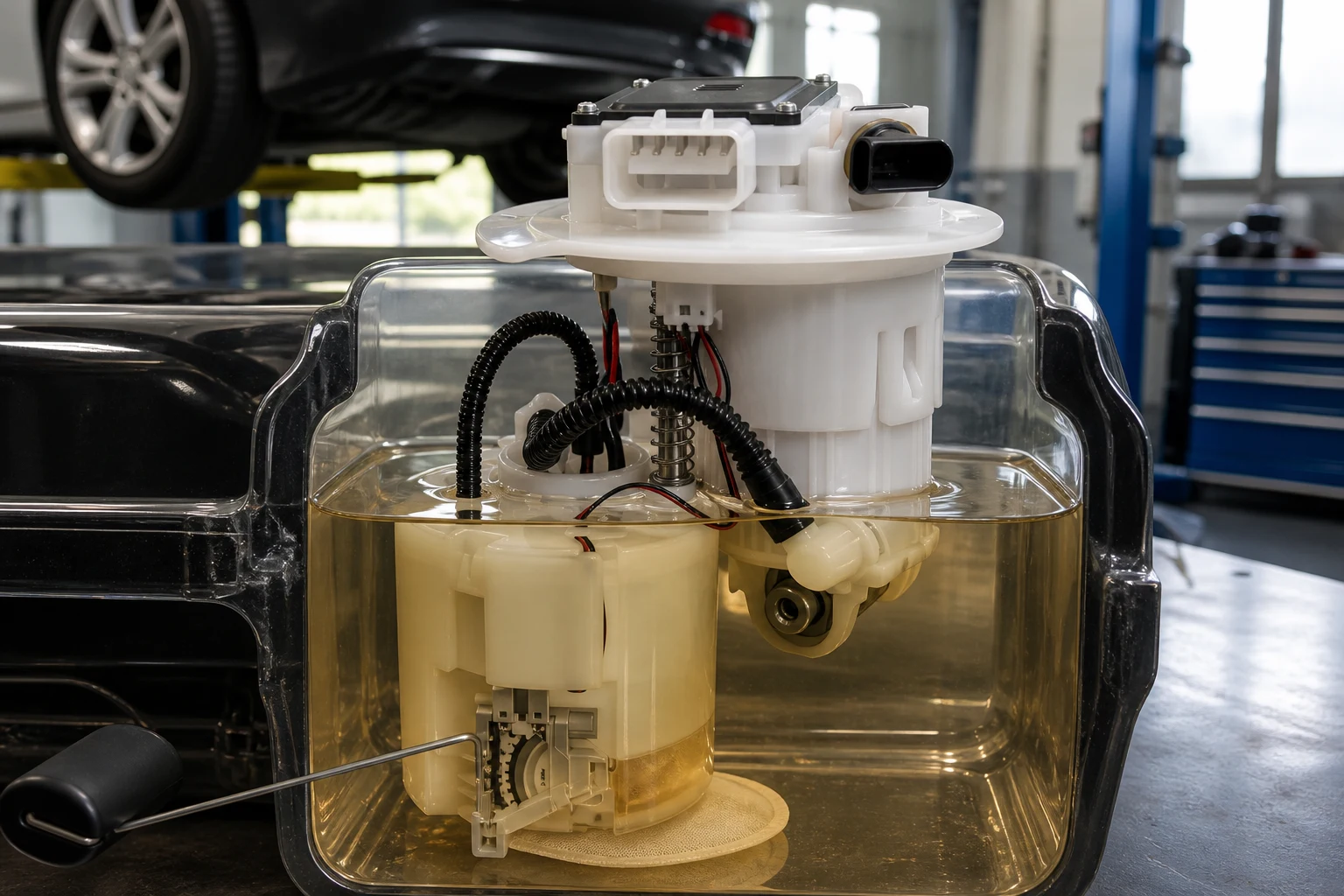
Builders on classic EFI-swap forums often say the quietest long-life path is in-tank when packaging allows—language that matches the cooling and noise physics above.
Service Access, Install Labor, and Stock-Tank Reality
External pumps usually win on frame-rail service and stock-tank simplicity; in-tank often means module or tank labor.
If a team needs to swap a failed pump between heats, an accessible inline unit on the chassis is faster than dropping a tank. Older cars without an access panel make that gap wider. Keeping a stock tank can also reduce fab cost on a mild street conversion when a bolt-on external pump and correct plumbing are acceptable.
Service access is the main reason race and temporary builds still choose external hardware.
The trade is consistency work later. External setups ask more from mounting height, inlet hose size, filtration upstream of the pump, heat shielding, and vibration isolation. In-tank conversions ask more up front—EFI-ready tank, retrofit module, or tank drop—then usually repay that labor with quieter daily manners.
| Factor | External / inline | Internal / in-tank |
|---|---|---|
| Location | Outside the tank on chassis / fuel line | Submerged in the tank module |
| Cooling | Relies on airflow and fuel throughput | Fuel surrounds and cools the pump |
| Noise | Often audible whine or buzz | Usually quieter; tank muffles sound |
| Service access | Typically easier frame-rail swap | Often tank drop or access panel |
| Stock-tank path | Common first step without tank fab | May need module, baffle, or EFI-ready tank |
| Primary risk if rushed | Heat, suction lift, inlet restriction | Low fuel uncover / poor baffling |
Use the table as a scan tool at the counter. Do not treat it as a brand ranking.
Mount Rules: Push Vs Pull, Height, and Inlet Plumbing
Mount external pumps low and near the tank so gravity feeds the inlet—electric pumps push better than they lift.
Performance fuel-system articles are blunt on Push vs pull: electric pumps prefer to push fuel forward under pressure rather than pull a long column of fuel uphill. For an external pump, that means mounting close to the tank outlet, preferably below tank level.
Gravity feed / low mount is the packaging test. Use a short, adequately sized suction path and a coarse inlet strainer—not a fine pressure-side filter jammed on the inlet.
If the chassis cannot put the pump low, starvation risk rises under acceleration and cornering. Classic swap threads describe exactly that failure mode: the car runs until the tank is half down, then leans out because the external pump is fighting suction and uncover. Rubber isolation mounts help noise, but they do not fix a high mount.
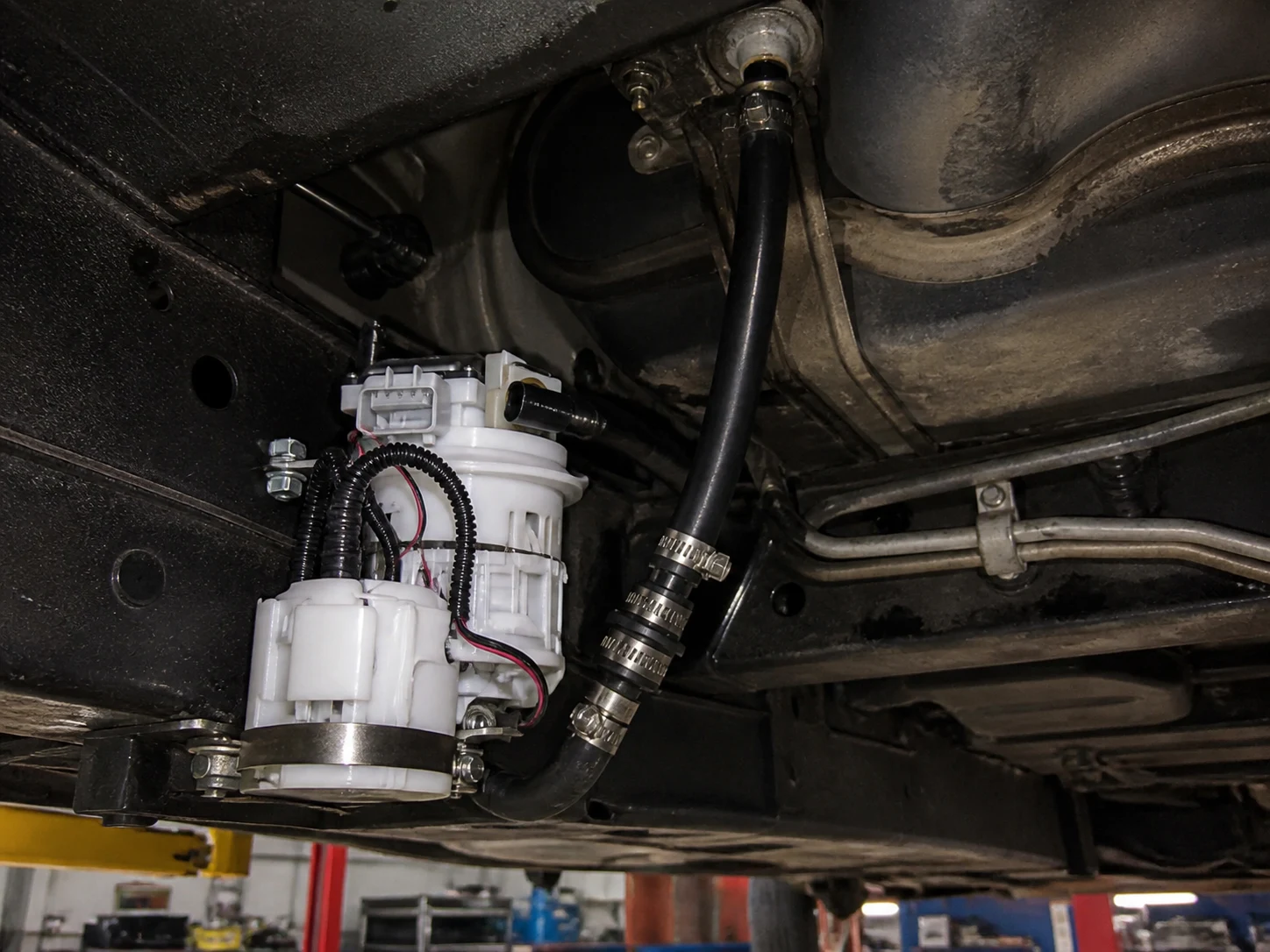
In-tank modules sidestep much of that lift problem because the pump inlet sits in fuel. External remains valid when packaging forces it—only if the mount and inlet plumbing still obey push-first rules.
Heat, Inlet Restriction, and Cavitation Risk
Excess heat or a restricted inlet can vaporize fuel in the pump, cutting flow and damaging hardware—fuel pump cavitation risk shops should treat as a system design issue.
Independent tech coverage describes the failure plainly: too much heat or too much inlet restriction can boil liquid fuel inside the pump assembly.
Cavitation / inlet vaporization shows up as sudden flow loss, bouncing gauges, grinding or ratchet-like pump sounds, and unstable pressure. Damage can remain after the root cause is fixed.
One cited teaching threshold associates serious vaporization risk with fuel temperatures above about 120°F (50°C) in high-flow contexts. Treat that as a warning band from the cited article, not a Kangsong lab number.
That physics is also why OEM systems typically put the pump in the tank: a flooded inlet reduces suction-side restriction. On external systems, keep heat sources away, avoid over-fine filters upstream of the pump, and size inlet plumbing for the flow you expect. Fine filtration belongs downstream on the pressure side after the pump is already fed.
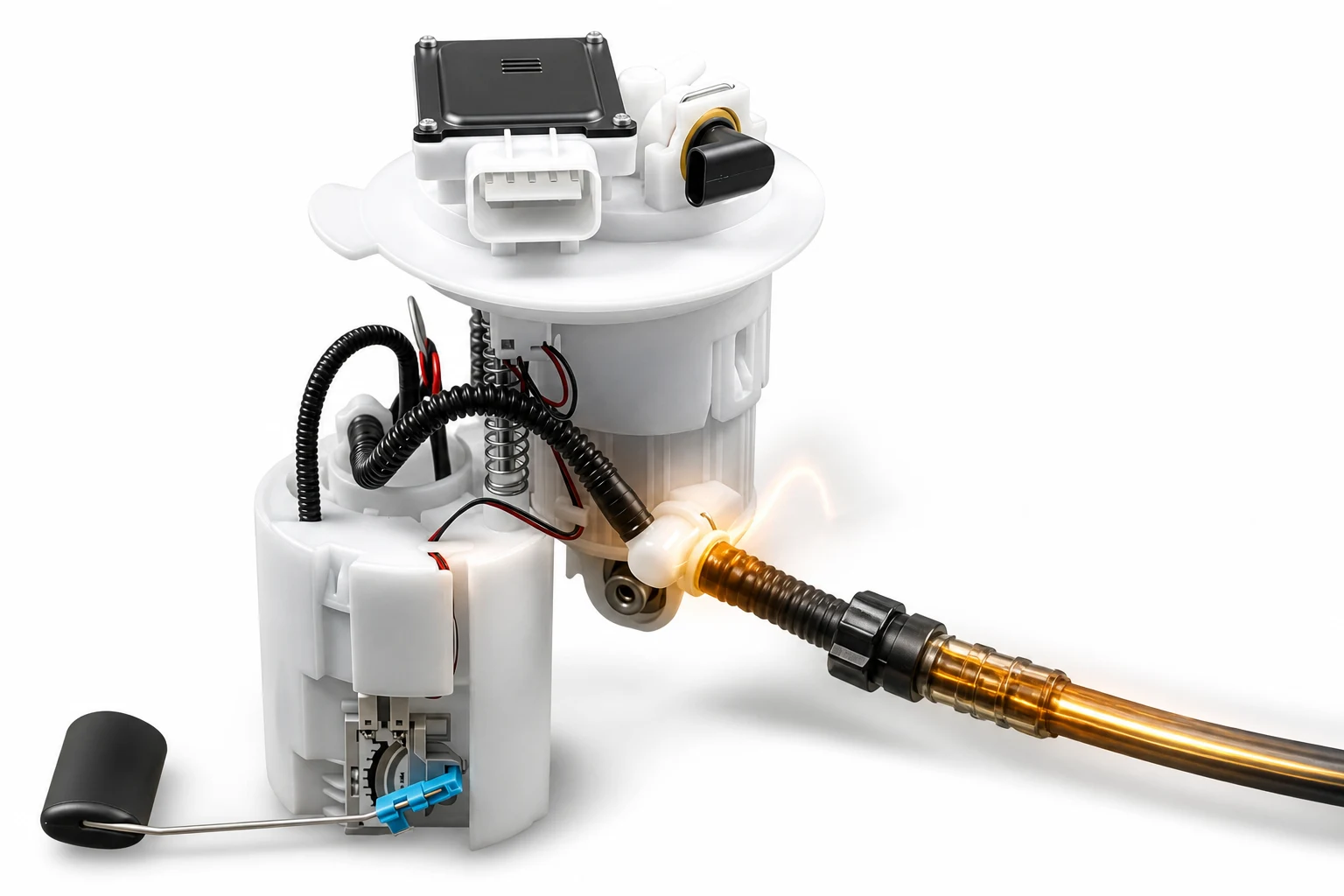
Important: If an external pump runs hot to the touch or the gauge starts bouncing under load, stop chasing only “a bigger pump.” Check inlet restriction, mount height, heat soak, and filter micron on the suction side first. (OnAllCylinders cavitation explainer)
Decision Matrix: Street, EFI Conversion, and Shop Counters
Prefer in-tank when packaging allows for quiet cool delivery; choose external when access or stock-tank constraints dominate—and still obey mount rules.
EFI vs carb pressure class still comes first. Carbureted street systems often live near about 6–8 psi at the carburetor.
Modern EFI conversions commonly target roughly 58–60 psi class rail pressure. Architecture must support that pressure system with the right pump and regulator strategy; mount choice alone does not create pressure.
After pressure class is clear, use the matrix below for the architecture ticket.
| Use case | Prefer first | Why | Watch-outs |
|---|---|---|---|
| Street daily / quiet cabin | In-tank internal | Cooler, quieter, OEM-like manners | Access labor; baffling at low fuel |
| Carb-to-EFI conversion with fab budget | In-tank when tank/module options exist | High-pressure electric delivery with flooded inlet | Confirm return/vent and regulator plan |
| Stock tank, minimal fab, temporary path | External inline | Faster install and service access | Must mount low/near tank; manage heat/noise |
| Race / easy overnight pump swap | External when rules allow | Service speed | Inlet feed integrity under load |
| Chassis cannot mount pump below tank | Strongly reconsider in-tank | External lift/suction risk rises | Do not force a high external mount |
From the field: Swap builders repeatedly report lean stumble when an external pump cannot sit lower than the tank—packaging beats catalog horsepower claims every time. (Tri Five forum thread)
For diesel-lift brand shopping questions, send readers to the dedicated FASS lift pump vs in-tank assembly sourcing guide rather than rewriting that intent here. For LPH/GPH sizing math, use the electric pump size selection guide when you need flow-at-pressure numbers instead of mount architecture.
How to Choose and Select Kangsong Fuel Pump Assemblies
After architecture gates, browse Kangsong assemblies by application; use vehicle-scoped examples only when years and OE refs match—browse links only, not an RFQ workflow.
Kangsong’s verified commercial path for this topic is the products hub, where electric / EFI fuel pump assemblies are listed by platform. The Kangsong fuel pump assembly catalog is the fitment-first next step after mount choice.
When the ticket is a Hyundai Sonata or Kia Optima match, the fuel pump assembly compatible with Hyundai Sonata & Kia Optima page documents OE refs 31110-D5500, 31110-C2500, and 31111-C110 for Sonata 2015–2019 1.6/2.0/2.4L and Optima 2016–2020 1.6/2.0/2.4L plus 2017–2020 3.3L.
That assembly is an in-tank-style fitment example after you decide mount architecture. It is not a universal external race pump and not a stand-in for third-party diesel-lift brands.
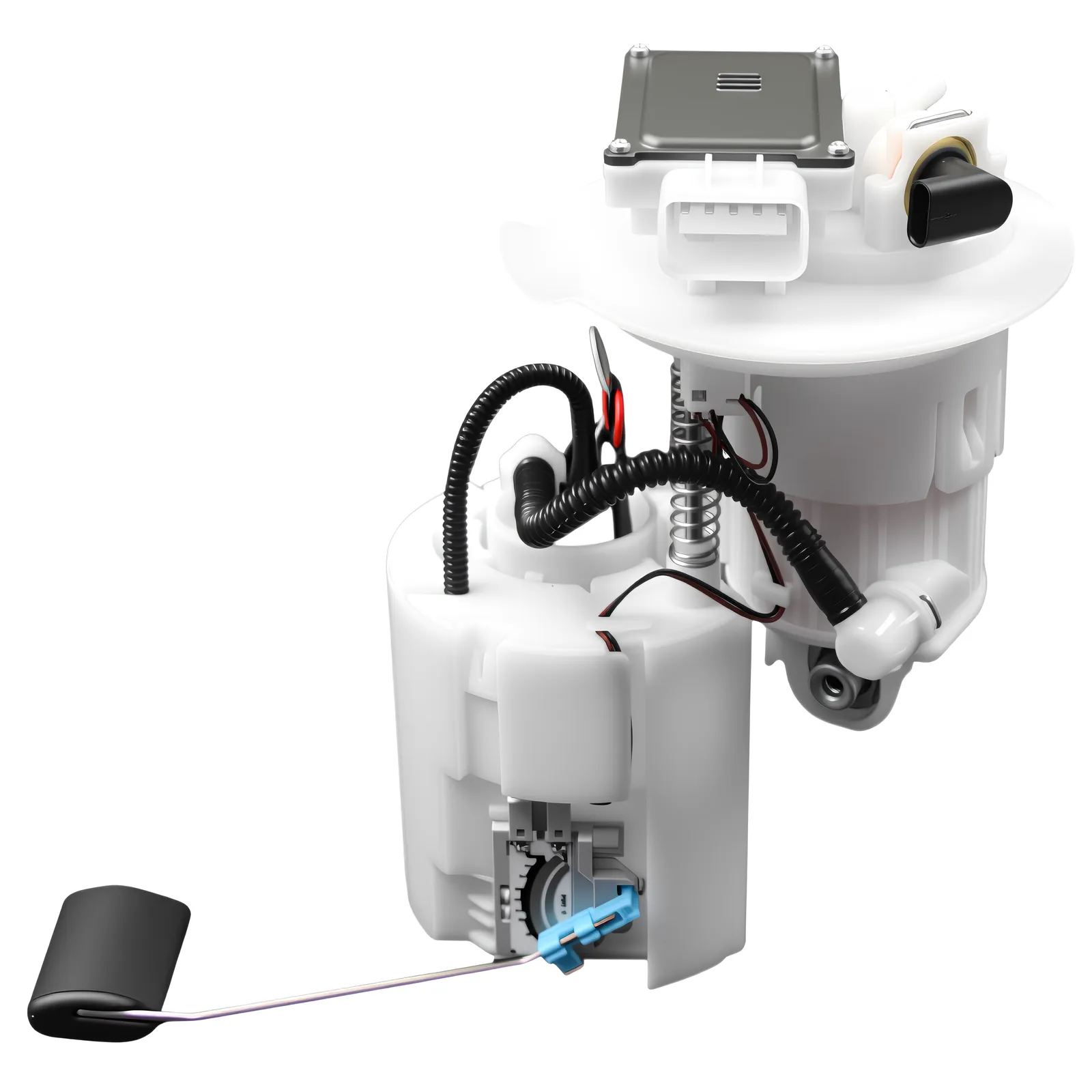
Choose and select from the catalog with the vehicle application first. If the platform is outside verified fitment text, stay on the products hub rather than inventing cross-brand equivalence. The next step is browse and confirm fitment—no quote form or enquiry checklist on this page.
Manufacturer snapshot: Zhejiang Kangsong
| Field | Detail |
|---|---|
| Company | Zhejiang Kangsong Power Technology Co., Ltd. (brand Kangsong / 浙江康松) |
| Role | Automotive fuel pump OEM / manufacturer |
| Product types | Automotive electronic fuel injection pumps; fuel pump assemblies / modules |
| Applicable here | Electric external (inline) vs in-tank modules for automotive fuel systems |
| MOQ / lead time | Quote-based — confirm via Contact / Inquiry (no universal MOQ published on About) |
| Certificates | National high-tech enterprise certificate; 28 patents (About Kangsong). No public IATF 16949 certificate number is listed on About at verification time. |
FAQ
Does Kangsong manufacture both external and internal electric fuel pumps?
Zhejiang Kangsong (Kangsong) is an automotive fuel pump OEM / manufacturer of electronic fuel pumps and assemblies. External versus internal remains a mount choice; each Kangsong PDP states the printed form and vehicle scope.
How does a Kangsong OEM fuel pump RFQ describe external vs internal?
Name the mount (frame-rail inline vs in-tank module), system voltage, and vehicle. Kangsong can then point to a kit such as the electric gasoline fuel pump with installation kit or another printed line in products-root.
Should Kangsong branding decide external vs internal for me?
No. Cooling, inlet head, and service access decide the architecture. Use Kangsong pages only after that architecture is fixed.
External fuel pump vs internal — which should I choose?
Choose by job: favor in-tank for quieter cooler daily delivery when packaging allows; favor external when service access or stock-tank simplicity dominates—then still obey low/near-tank mount rules.
What is the difference between in-tank and inline fuel pumps?
In-tank (internal) sits submerged in the tank module; inline (external) mounts on the chassis or fuel line outside the tank. Location drives cooling, noise, service path, and inlet-feed risk.
Are in-tank fuel pumps quieter and cooler?
Typically yes. Surrounding fuel carries heat and the tank muffles pump noise, which is why street-driven builds often prefer in-tank when they can.
Why do modern vehicles use in-tank pumps?
OEM systems favor flooded inlets for cooling, quieter operation, and reduced suction-side restriction compared with a remote puller-style external mount.
Can an external pump cavitate or vapor-lock?
Yes. Heat soak and restricted inlet plumbing can vaporize fuel at the pump, cutting flow and damaging the unit. Treat mount height, hose size, upstream filter micron, and heat shielding as first checks.
Where should an external electric fuel pump be mounted?
Low and close to the tank so gravity helps feed the inlet. Electric pumps push better than they lift; high mounts raise starvation risk.
Is an inline pump easier to service than in-tank?
Usually. Frame-rail access is faster than a tank drop on many older cars, which is why race and temporary setups still use external pumps.
In-tank or inline for an EFI conversion?
Prefer in-tank when an EFI-ready tank or module path exists, because high-pressure EFI wants consistent flooded-inlet delivery. External can work with correct low mount, plumbing, and regulator strategy.
About Kangsong
Zhejiang Kangsong (Kangsong, 浙江康松) is an automotive fuel pump OEM / manufacturer of electronic fuel injection pumps and fuel-pump assemblies. Use this page’s technical decision first, then open company and product paths:
- About Kangsong — manufacturer profile and quality notes
- Contact / Inquiry — RFQ, samples, MOQ and lead time
- Electric gasoline fuel pump with installation kit — printed fitment only as shown on that product page
- Products catalogue — browse when the vehicle is not on a single PDP
References
- Cavitation Explanation: What is Fuel Pump Cavitation — and How Can You Avoid It? (OnAllCylinders)
- How To Build The Proper Fuel System For Carbureted Motors (MotorTrend / Chevy High Performance)
- What are the differences between inline and in-tank fuel pumps? (NIMS Inc.)
- Inline or In-tank pump for 5.3L (Chevy Tri Five Forum)