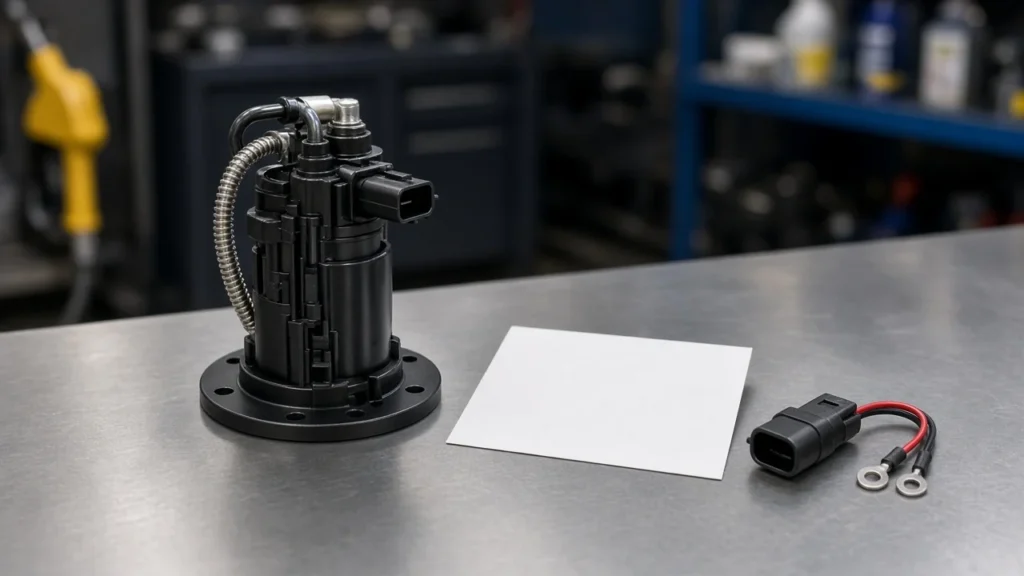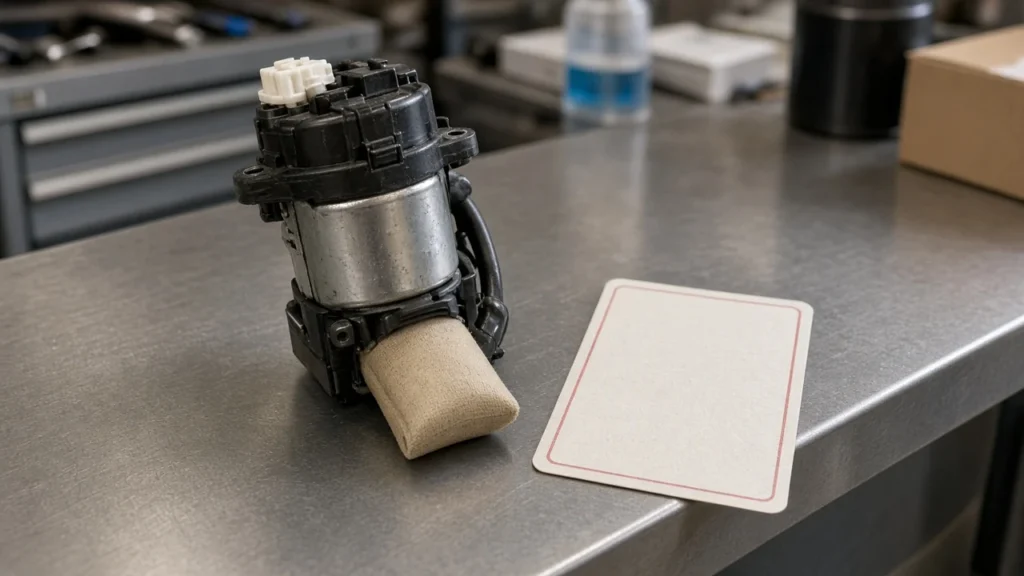
A what is a fuel pump prime connector question is really asking about a factory diagnostic access on the electric fuel pump power path: a test tap or priming terminal that lets a shop apply fused power so the pump can run outside the short key-on window controlled by the relay and powertrain module. This page defines that access, shows how it sits next to the relay and PCM enable logic, maps common OEM location classes, separates it from the tank’s main electrical connector and from mechanical primer bulbs, and closes with a scoped install-kit browse when the pump side is the confirmed fault.
What a Fuel Pump Prime Connector Is
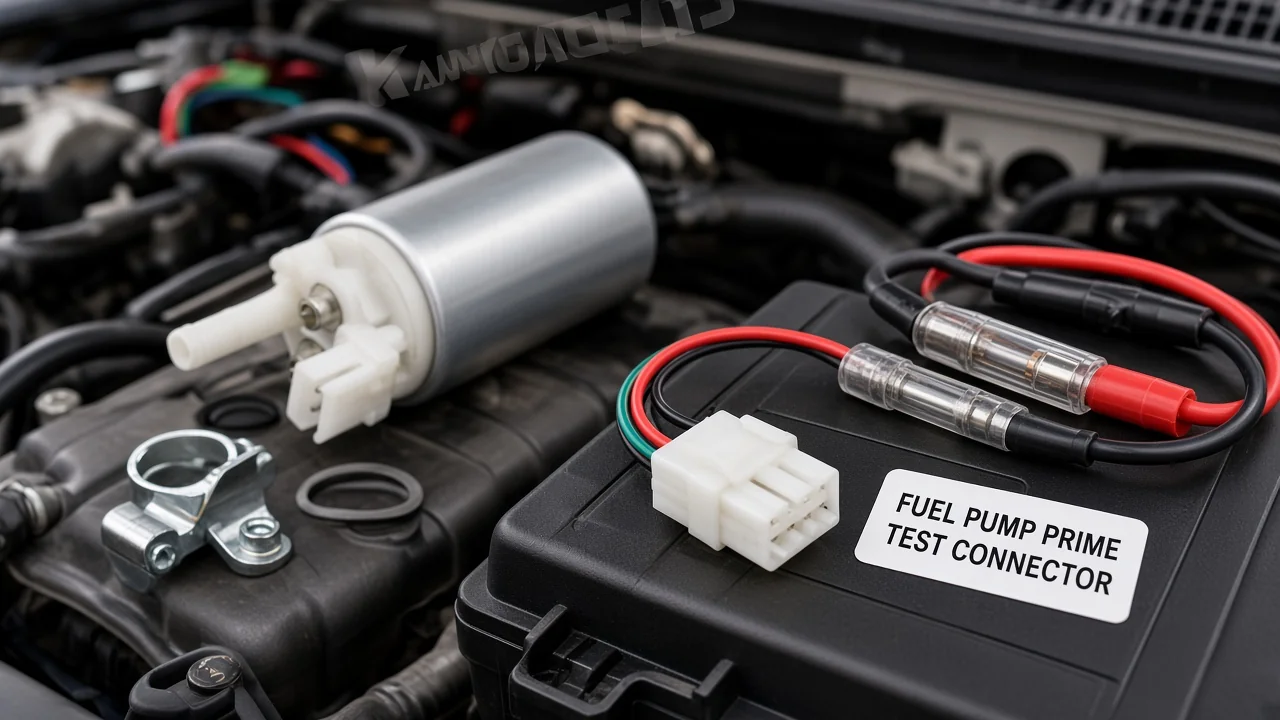
A fuel pump prime connector—also called a fuel pump test connector or priming terminal—is a service access the OEM leaves on the pump supply circuit so the pump can be energized on purpose. On assembly lines it historically helped prove the pump and fill dry lines before first start. In the bay it becomes a clean way to run the pump while you watch pressure, listen for a healthy motor, or move fuel under controlled conditions.
In plain language: it is not the plug you yank when you drop a tank. It is the jumper point that says “run the pump now” without waiting for a normal key cycle to finish its short enable pulse.
That definition matters for parts contacts because diagrams often print a lonely callout—“to fuel pump prime connector”—with no retail SKU behind it. The hardware is usually a single terminal, a small unused pigtail, or a labeled spade in a fuse/relay center. The job of the page you are reading is to make that callout mean something before anyone orders the wrong connector or the wrong pump.
How the Prime Connector Fits the Pump Power Path
Normal EFI behavior uses a fuel pump relay as the heavy switch and a PCM/ECM as the brain that turns that switch on. On covered GM truck diagnostics, for example, the control module enables the fuel pump relay when the ignition turns ON and drops that enable within about two seconds unless it sees ignition reference pulses. The pump therefore “primes” briefly on key-on and then stays quiet until cranking proves the engine is actually turning.
The prime connector sits on the supply side of that story. When you apply battery voltage through a fused jumper to the documented terminal, you are asking the pump feed to stay hot while you test.
On many platforms that path largely bypasses the module’s short enable window. On some later years, community wiring notes warn that the prime path still travels through non-operated relay contacts—so a silent pump on the jumper is not always “pump dead; replace now.”
Treat the prime access as a diagnostic lever, not a magic skip of every upstream part.
Tip: If a wiring diagram shows the prime lead tied into the relay’s unused contact set, confirm relay integrity before you condemn the in-tank assembly — source: LS1LT1 fuel pump jumper thread.
Shop nicknames vary: a fuel pump priming terminal in a fuse block and a fuel pump test connector on a harness branch are usually the same diagnostic idea.
Where OEMs Put the Prime or Test Connector
There is no single VIN-universal photo. Chevrolet service text for a documented V20 5.7L example states that the Fuel Pump Prime Connector is either a separate terminal near the Fuel Pump Relay, a point along the ECM harness, or terminal “G” in the ALDL connector. Later truck diagnostics place a UBEC prime terminal in the underhood bussed electrical center (UBEC) and tell the technician to read the cover map.
| Location class | What you are looking for | Typical shop cue |
|---|---|---|
| Near the fuel pump relay | Separate terminal or unused spade beside the relay | Fuse/relay center label or empty cavity next to FP relay |
| Along the ECM/PCM harness | Single-wire pigtail or capped connector | Engine-bay harness branch that is not mated to a sensor |
| ALDL / DLC style access | Documented ALDL terminal G (example) | Diagnostic connector pin assigned to pump power in the service book |
| Underhood electrical center (UBEC) | UBEC prime terminal on the cover map | Truck platforms with a prime callout on the UBEC lid |
Always follow the vehicle’s service information for the exact cavity. Color codes drift by platform—one owner guide photographs a green test connector, while another vehicle’s harness notes a gray power path—so color alone is a weak ID. The reliable ID is the service name plus the circuit that feeds the pump after the relay switch side.

What Shops Use the Prime Connector For
Shops reach for the prime connector when they need the pump running longer than a two-second key-on blip.
Common jobs:
- Confirm the pump motor spins and the feed circuit after the test point is intact.
- Build rail pressure while a gauge sits on a Schrader / fuel rail test port so low pressure is visible instead of guessed.
- Pre-run a dry system after filter or line work so the first crank is not a long, unhappy starter session.
- Move fuel out of a rail or tank path under controlled hose routing when the platform documentation supports that method.
Encyclopedia-level context helps set expectations without inventing a vehicle Spec: many port-injection systems live in a roughly 40–60 psi (3–4 bar) class at the rail when healthy. Your vehicle’s published range still wins if the service book lists one.
From the field: Experienced forum threads keep repeating the same practical rule—use a fused jumper to the prime connector, and do not leave the pump powered for a long unsupervised stretch while you walk away for parts — source: shop forum practice recorded in research (see References LS1LT1 / S10Forum).

What a Fuel Pump Prime Connector Is Not
Search results for this keyword mix four different objects. Keep them separated at the counter.
- Not the main fuel pump electrical connector. The module harness plug—often a multi-pin shell with a CPA or primary lock—is the part you disconnect when you replace the pump. Kangsong’s install-kit example lists a 2-pin main connector on the product page; that is still a harness interface, not the underhood prime tap. For release-tab order and stuck-CPA recovery, use the sister guide on how to disconnect a fuel pump electrical connector.
- Not a mechanical primer bulb. PAA questions about “primer pump bad” usually mean a squeeze bulb or hand primer on carbureted or certain diesel layouts. Different hardware, different failure mode.
- Not a fuel pump diode lesson. Clamping diodes and relay coils belong on their own definition page; do not stretch this article into diode theory.
- Not a fuse or relay sizing master guide. If the fuse opens or the relay chatters, move laterally to how to test a fuel pump fuse and relay-sizing sisters rather than rewriting those procedures here.
- Not a transfer-pump priming checklist. Industrial transfer pumps that need hose priming are outside this automotive diagnostic tap.
If a customer says “replace the prime connector” while pointing at the tank plug, translate the request before you quote plastic pigtails they do not need.
Safety Boundaries for Priming and Fuel Handling
Manual power means you own the risks the PCM normally limits.
Use a fused jumper. OEM diagnostic tables for covered Sierra platforms specify a 20-amp fused jumper between the battery-voltage side of the fuel pump relay switch circuit and the pump supply circuit.
That amp rating is procedure-scoped—not a universal fuse sticker for every car—but the pattern is clear: temporary power should be fused. Community practice on F-body and related platforms echoes the same habit with an inline fuse in the jumper lead.
Keep runs short. Once voltage is on the prime connector, the pump stays on until you remove it.
Long dry runs overheat in-tank motors that expect fuel for cooling. Stop when you have the pressure reading or the confirmation you came for.
Treat gasoline as a flammable liquid under shop rules. Keep containers covered when idle, clean spills promptly, and control ignition sources where vapor can travel.
Do not invent air-pressure transfer tricks to shove fuel out of a can or tank. If you open a rail Schrader or hose, plan containment before the pump starts.
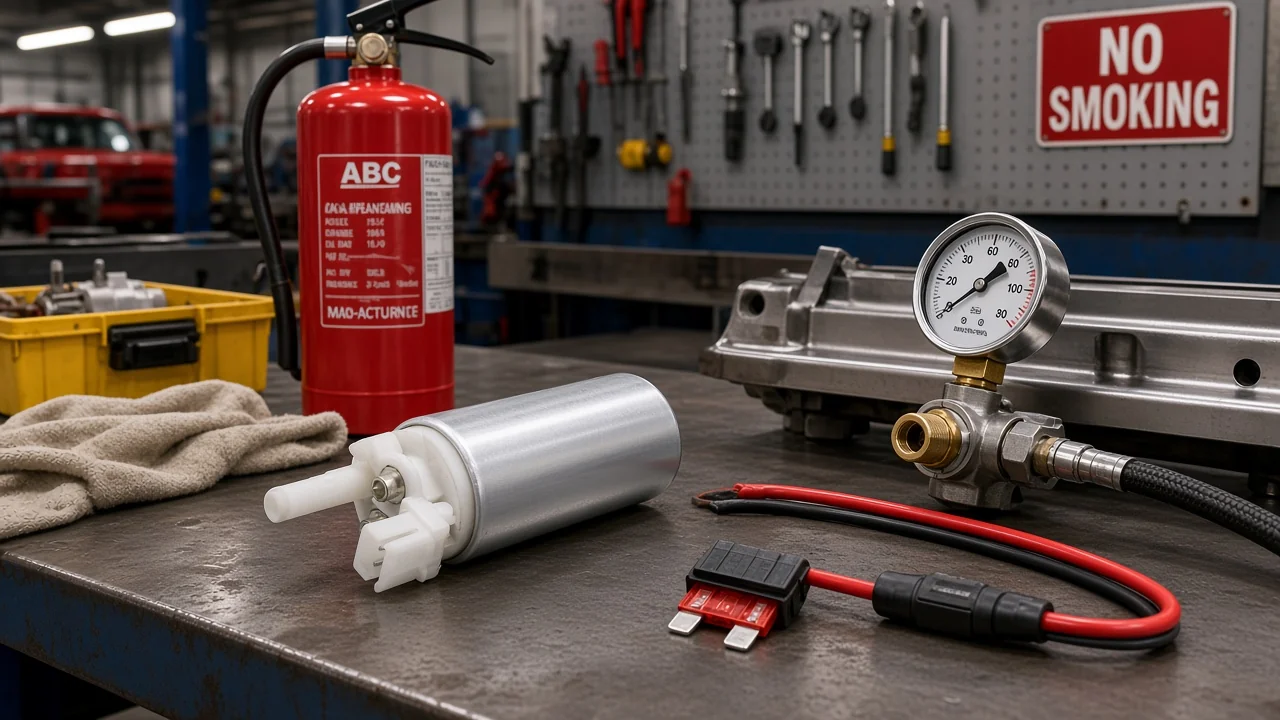
Important: Do not mate a prime/test tap into a nearby unrelated connector just because the colors look friendly. Vehicle-specific harness notes (for example, a gray pump power path next to a green connector that must stay separate) exist for a reason—wrong mating can backfeed circuits you did not intend to energize — source: vehicle harness documentation reviewed in research.
Reading the Result: Pump Runs or Does Not
Use the prime connector as a branch in the diagnostic tree, not as a one-step “buy pump” button.
| Observation with fused jumper on the documented prime terminal | Likely next focus | What not to assume |
|---|---|---|
| Pump runs; rail pressure enters the expected service range | Control side (relay coil command, PCM enable, oil-pressure/inertia interlocks if equipped) if the complaint was “no key-on prime” | That every upstream module is perfect—only that the pump/feed after the test point can work |
| Pump runs; pressure stays low | Restriction, filter, regulator, or weak pump under load | That “sound = healthy flow” |
| Pump silent; prime path is known to bypass the relay fully | Pump motor, ground, or feed wiring after the test point | That the PCM is automatically guilty |
| Pump silent; platform routes prime power through relay contacts | Relay contacts and socket first, then pump/feed | That the jumper “proved” a dead pump on every year |
| Pump runs only on jumper, never on key-on | Relay control circuit, fuse, or module enable path | That the pump itself must be replaced immediately |
When the feed side is healthy and the control side is the suspect, stay on electrical diagnostics. When the pump side is confirmed weak or dead, then sourcing a replacement assembly or install kit becomes the commercial step—not before.
Recommended Electric Fuel Pump Kits After a Confirmed Pump-Side Need
After the prime-connector branch points at the pump or its immediate feed—not at a stuck CPA tab and not at a mystery brand swap—browse a scoped electric pump with installation provisions instead of a random assembly photo.
Kangsong publishes electric fuel pumps and kits through the products catalog.
One concrete Product 2551 install kit example is the electric gasoline fuel pump with installation kit (WP product ID 2551): accessories included, main connector listed as 2Pins, flow listed at 43.3–49.5 GPH, with OE/year scope on 1987–1995 C/K 1500/2500/3500 pickups.
Confirm vehicle and OE fitment on that product page before ordering. Kangsong does not claim equivalence to third-party lift-pump brands, and this recommendation is not a default Sonata/Optima assembly slot.
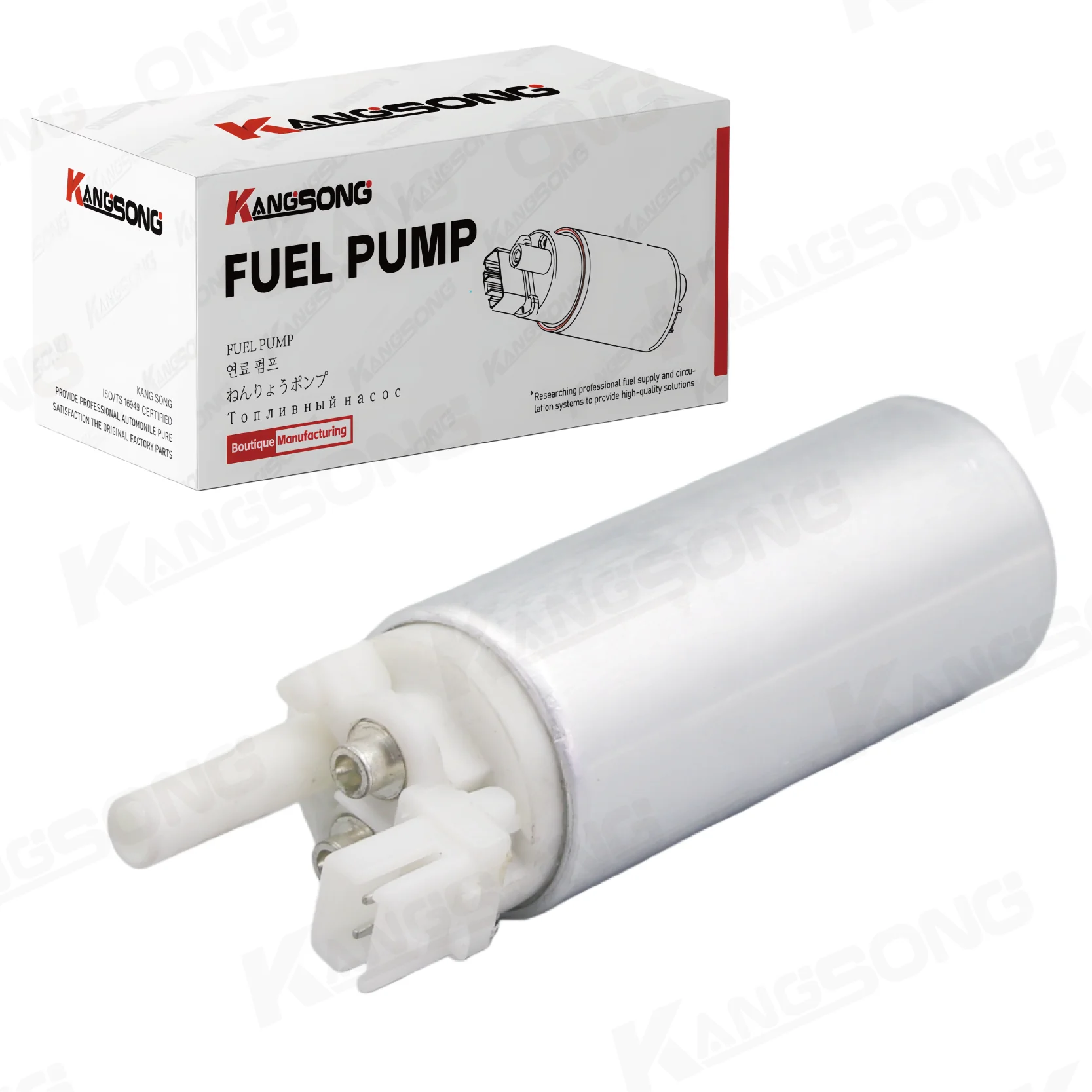
When fitment falls outside 2551’s window, stay on products-root and match the listed application. If the next question is still electrical rather than hydraulic, return to fuse testing or relay sizing instead of forcing a pump quote.
FAQ
What is a fuel pump prime connector?
It is a factory diagnostic or test access on the electric fuel pump supply path that lets a technician apply fused power so the pump can run outside the normal short key-on enable window.
Where is a fuel pump priming terminal usually located?
Documented patterns include a terminal near the fuel pump relay, a point on the ECM harness, an ALDL pin such as terminal G on covered Chevrolet text, or a labeled prime terminal in an underhood electrical center. Always verify against the vehicle’s service cover map.
How do you manually prime a fuel pump with the connector?
Use a fused jumper to the documented prime/test terminal, run the pump only as long as needed for pressure or flow confirmation, and follow flammable-liquid shop hygiene if fuel will move or spill.
Is the prime connector the same as the fuel pump electrical connector on the tank?
No. The tank/module harness plug is the R&R connector with lock tabs. The prime connector is an underhood or diagnostic jumper access.
For disconnect technique, use the sister disconnect guide.
Does a running pump on the prime jumper prove the relay and PCM are good?
No. It mainly shows the pump and feed after the test point can work. Some years still route prime power through relay contacts, so interpret results with the platform wiring in hand.
What if the pump does not run when I jump the prime connector?
Check that you are on the correct terminal, confirm fuse and ground integrity, then inspect the pump feed and the pump itself. If the platform’s prime path depends on relay contacts, test the relay before condemning the pump.
How is this different from a mechanical primer bulb?
A squeeze primer or hand primer is separate hardware. A fuel pump test connector is an electrical access for an electric pump circuit.
Why does the pump only run for about two seconds on key-on?
On covered OEM procedures, the module enables the relay briefly and drops it without engine reference pulses. That short prime is normal; continuous run for testing is what the prime connector is for.
References
- Fuel pump — Wikipedia
- OSHA 29 CFR 1910.106 — Flammable Liquids
- Chevrolet Workshop Manuals — Diagnostic Connector Fuel Pump Locations (Fuel Pump Prime Connector)
- GMC K Sierra 2005 — Fuel Pump Electrical Circuit Diagnosis (prime terminal / fused jumper)
- LS1LT1 Forum — Fuel Pump Jumper Wire?
- S10 Forum — Fuel Pump Priming Terminal