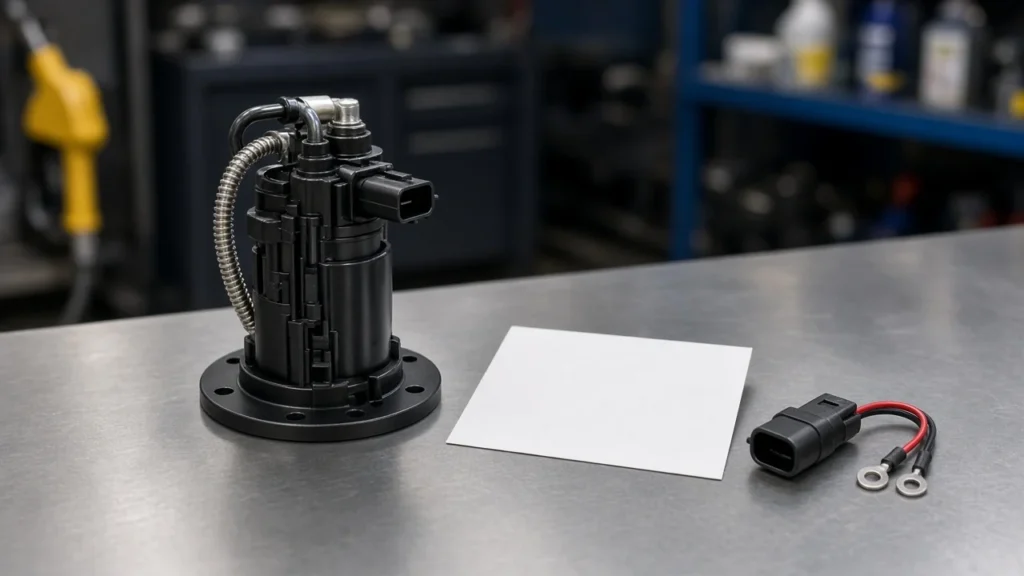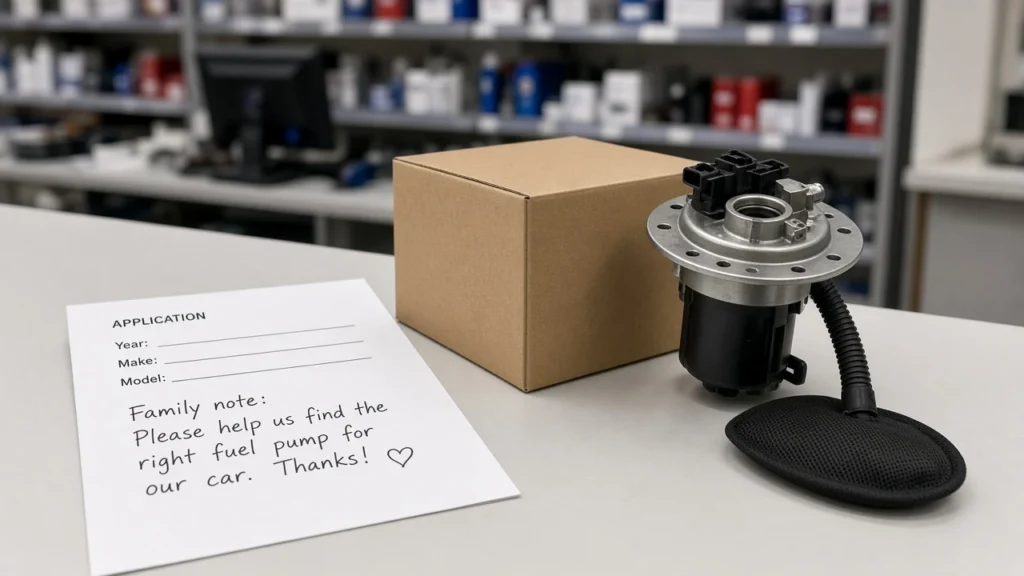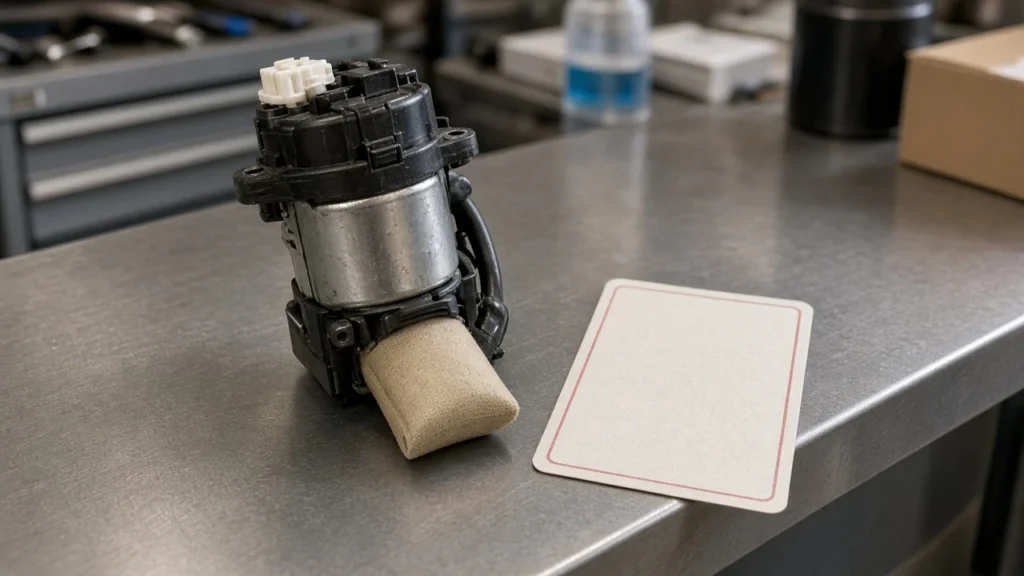
A purchase order that only says universal electric fuel pump 12v has not yet named a carton. The counter still needs the mount, the vehicle window, any flow the sheet already prints, and the pin count.
Walk those four fields before anyone pulls a box. The only gasoline window on this page is the 1987-1995 C/K kit, and every other job goes back to the catalog root until a sheet names it.
A catalog adjective still leaves the carton on the shelf
The words name an electric pump and stop before a bin location. A picker who has only the phrase is still standing in the aisle.
On a gasoline injected car, the pump has to move fuel from the tank to the injection system through the fuel line. That sentence describes the job. It does not describe which box to take.
Catalog pages already show the split. One electric-pump listing can say universal and still mark the unit external, with two wires and two terminals.
A second listing can promise broad use and still print more than one supply voltage on that family. The adjective rode along with the SKU. The SKU stayed specific.
Crash rules for fuel systems talk about spillage after a collision. They never hand the counter a part number, so a federal fuel-system rule cannot finish this line.
Treat the purchase-order line as a shelf ticket with blank boxes. If mount, years, flow, and pins are blank, the ticket goes back to the buyer.
In-tank or external inline is the mount the sheet has to print
The sheet has to say in-tank or external inline before anyone walks to a shelf. Those two words point at different hardware.
On injected gasoline cars, the usual electric pump lives in the tank, and the fuel around the motor is part of why that spot is typical. An in-tank fuel pump is often packed with a strainer and a level sender. That package is a module, not a loose canister you clamp to a rail.
An external fuel pump sits in the line, outside the tank. An inline electric fuel pump is that external case. A page can still stamp universal on it and, on the same screen, say the body is external.
From the field: A restorer said an EFI in-tank pump made more pressure than the carburetor could take, and a reply asked why the pump had to stay in the tank — archived owner thread.
The carburetor owner wanted fewer extra parts, not a lecture. The reply still separated “in the tank” from “on the frame rail.” Mount is the first blank because it chooses the bin.
A longer look at external and internal layouts sits on its own page, external and internal fuel pumps. This line only needs the word the sheet already printed.

If the purchase-order line says only “universal,” ask which of those two mounts the old part used. Guessing from the adjective puts the wrong shape in the carton.
The vehicle years and truck family belong on the line
Years and the truck family are what make a gasoline pump a specific carton. A decade and a cab family are narrower than the word universal, and that narrowness is the point.
Inside the printed gasoline window, KS-360501 is the electric pump with installation kit for 1987-1995 C/K 1500, 2500, and 3500 pickups. The interchange text includes 25168719 and E3902. Those marks are the window a counter can file.
A different decade, a different cab, or a diesel tank is outside that print. Send that job to the product catalog and wait for a sheet that names the truck.
How a gasoline electric pump sits in the fuel system, apart from this window, is its own article: gasoline electric fuel pumps. Do not borrow that page’s examples to stretch this C/K print.
Importers sometimes receive a spreadsheet that repeats one phrase down fifty rows. Each row still needs its own years and family. Shared wording at the top of the sheet does not copy a window onto the next row.
Write the years the way the sheet writes them, including both ends of the range when both ends are printed. “Late 1980s trucks” is a conversation. “1987-1995 C/K 1500/2500/3500” is a pick.
Copy a flow number only when that sheet already prints one
Copy the gallons-per-hour figure only from the sheet that already shows it. A number you remember from a different listing is someone else’s pump.
On the KS-360501 sheet the flow line reads 43.3-49.5 Gph. Keep that range beside this part number. Pasting it onto another electric pump because both say 12 volt in a catalog would invent a universal flow, and this page will not do that.
The same sheet prints Maximum Air Pressure 12-26. Read that as an air label. It is not a fuel-pressure rating, and it does not become the pressure for every electric pump in the aisle.
Shopping titles and overview boxes like to hang a pressure band and a flow band on the adjective. Those bands belonged to whatever listing the box summarized. Leave them there.
When the sheet in your hand has no flow figure, leave the flow cell blank and say so. An empty cell is more honest than a borrowed GPH.
How to read flow at a stated pressure, rather than as a free-flow boast, is handled on the fuel pump capacity page. Use that page when the question is the test method. Use this page when the question is whether your line already shows a number.
If two suppliers print two different flows for two different windows, stock them as two parts. The shared adjective is not a license to average the numbers.
The main connector’s pin count is a line field
Count the pins on the main connector and write that count on the line. The harness in the truck already has a mate, and the mate has a shape.
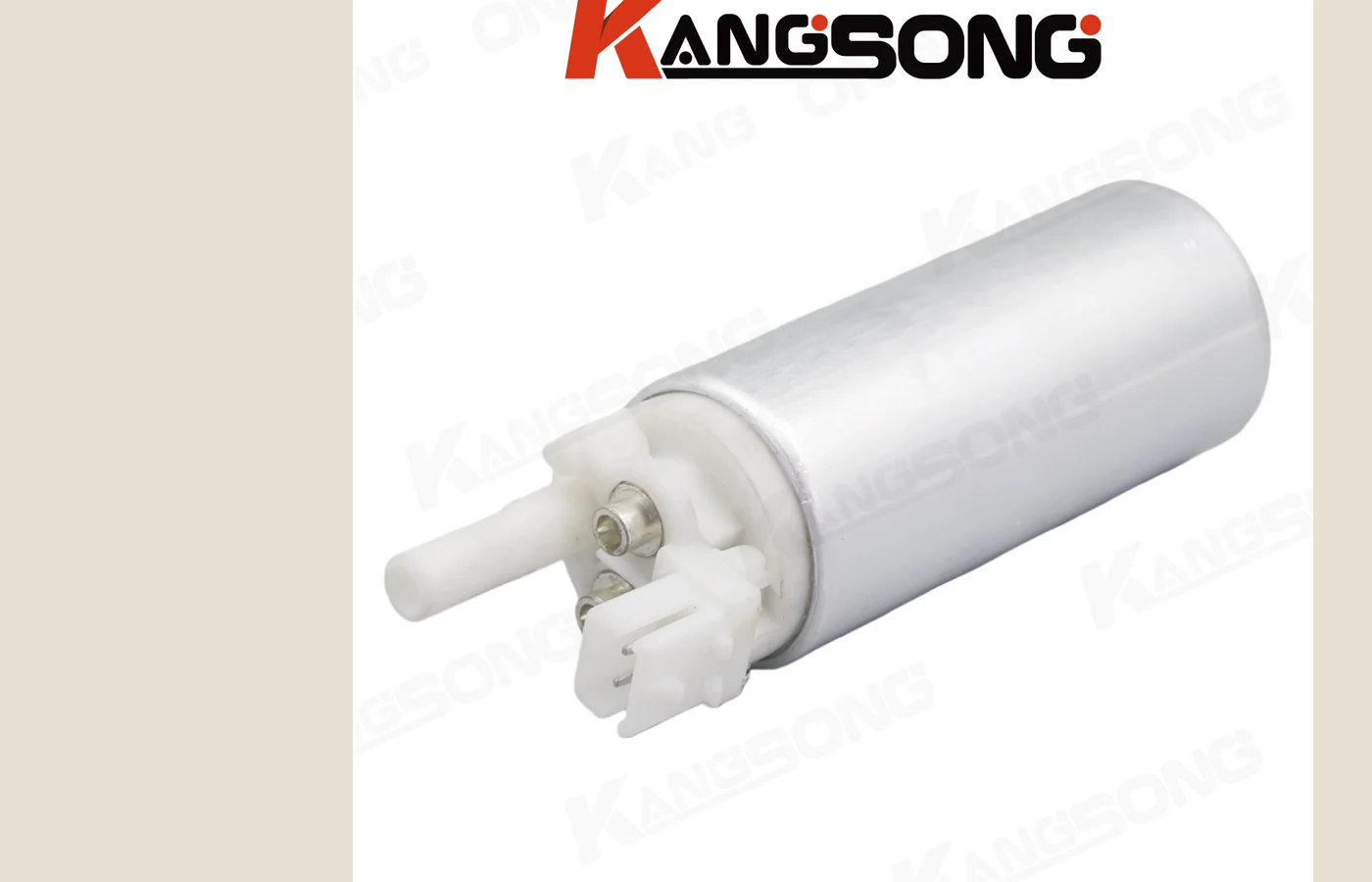
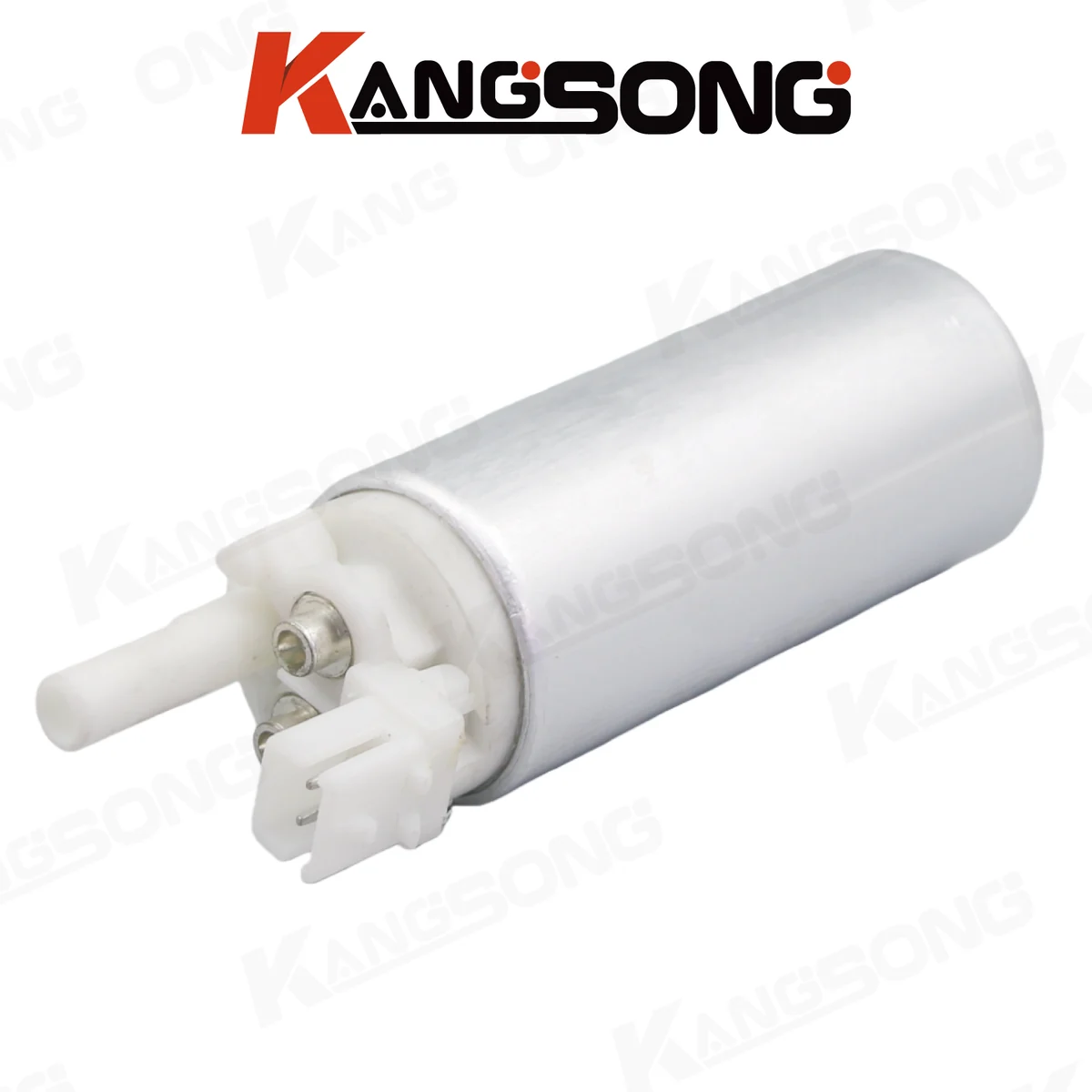
KS-360501 prints 2 pins on the main connector. The close-up of that end shows a two-pin plug next to the outlet tube. A buyer who says only “12 volt electric fuel pump” has not said whether the plug has two pins or some other count.
External catalog pumps can print two wires and two terminals while still wearing the word universal. That is a plug description for that listing. Copy it only when it is the listing you are buying.
Leave wire size, fuse, and current off this ticket. Those figures belong on the specific sheet, and this adjective does not carry them.
A counter can still be helpful. Hold the old plug next to the photo and match the pin count you can see. If the counts differ, stop and ask for the sheet that belongs to the truck, rather than forcing the C/K pump into another harness.
Which gasoline pump fits the printed C/K window
KS-360501 fits the printed 1987-1995 C/K gasoline window and nowhere else on this page. Operating voltage on that page is DC 12V, and the installation note puts the part in the tank space the truck already uses.
The sheet also limits ambient temperature to a band from -40 C to +85 C, and it says accessories are included. The photographs here show the pump element: canister, outlet, and the two-pin plug. Order from the printed window, not from the crop.
Use KS-360501 for the 1987-1995 C/K gasoline window when the truck is a 1987-1995 C/K 1500, 2500, or 3500 and the fuel is gasoline. Interchange marks on that page include 25168719 and E3902.
Hold the order when the truck is outside that window, when the fuel is diesel, or when the line only repeats the catalog adjective. Those jobs need their own sheets. Kangsong does not offer a pump whose name is universal.
Maximum Air Pressure 12-26 stays an air label on this kit. Do not read it as the fuel pressure of a universal part, and do not export the 43.3-49.5 Gph line to a different window.
How a counter reads a line before the carton moves
A pickable line shows mount, vehicle window, flow if printed, and pin count together. One missing field is enough to keep the carton on the shelf.
| What the buyer wrote | What the counter can do | What still has to be printed |
|---|---|---|
| Only the catalog adjective | Hold the ticket | Mount, years and family, flow if any, pin count |
| Mount plus the adjective | Choose a bin, not a truck | Vehicle window and the plug |
| Full C/K window, in-tank, 2 pins, sheet flow | Pull KS-360501 | Nothing further on this page |
Read the row from left to right with the paper in your hand. If your paper matches the third row, the C/K kit above is the carton. If it matches the first row, you are still collecting fields.
| Field on the C/K sheet | Printed value | What it decides |
|---|---|---|
| Vehicle window | 1987-1995 C/K 1500/2500/3500 | Which trucks this kit covers |
| Mount | In the fuel tank | In-tank module, not a rail clamp |
| Main connector | 2 pins | Which plug the harness must mate |
| Flow | 43.3-49.5 Gph | This sheet’s flow only |
| Air label | Maximum Air Pressure 12-26 | Air label, not fuel pressure |
| Supply | DC 12V | Supply printed for this kit |
A useful purchase-order line for this kit can read: in-tank, 1987-1995 C/K 1500/2500/3500, gasoline, 2 pins, flow 43.3-49.5 Gph as printed, KS-360501. Drop any truck that cannot wear that whole sentence.
When the next row is a different mount or a different decade, start again. The adjective can stay in the email subject. It cannot stay as the only text in the quantity column.
FAQ
Is there a universal fuel pump?
The word shows up on catalog lines, including lines for a single external pump with its own wire count. It does not by itself name a mount, a truck, or a carton.
How many amps does a 12 volt fuel pump use?
No current figure is printed for a universal line, and this page will not invent one. Use the current the specific sheet prints, or leave the cell blank.
Can an electric pump feed a carburetor?
Sometimes owners try, and sometimes the carburetor cannot live with the pressure of an injection pump. The forum note above is that objection. Match the pump to the fuel system on the sheet instead of assuming every electric pump is gentle enough.
Does the pump line need a relay called out?
Only if the sheet or the harness notes already name one. This page does not add a relay, a fuse, or a shortcut for power.
What wire gauge belongs on a universal pump order?
No gauge belongs to the adjective. If the sheet prints a wire size, copy that size. If it does not, do not fill the blank from memory.
Which electric fuel pump is the best one to stock?
Stock the pump whose sheet matches the truck in front of you. For a gasoline 1987-1995 C/K 1500, 2500, or 3500, that printed match is KS-360501. For anything else, the catalog root is the next stop, not a second guess at this kit.
References
- Fuel pump, encyclopedia account of where electric gasoline pumps usually sit.
- How gasoline cars work, U.S. Department of Energy description of the pump and the fuel line.
- Standard No. 301, Fuel system integrity, law-library text of the crash fuel-system standard.
- Low-pressure in-tank pump for a carburetor, archived owner thread on mount and carburetor pressure.