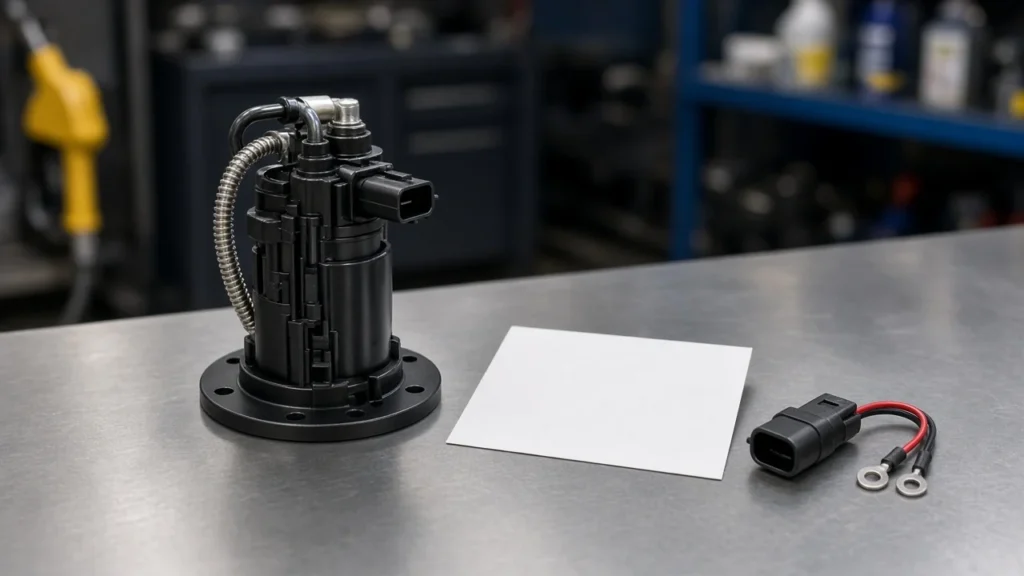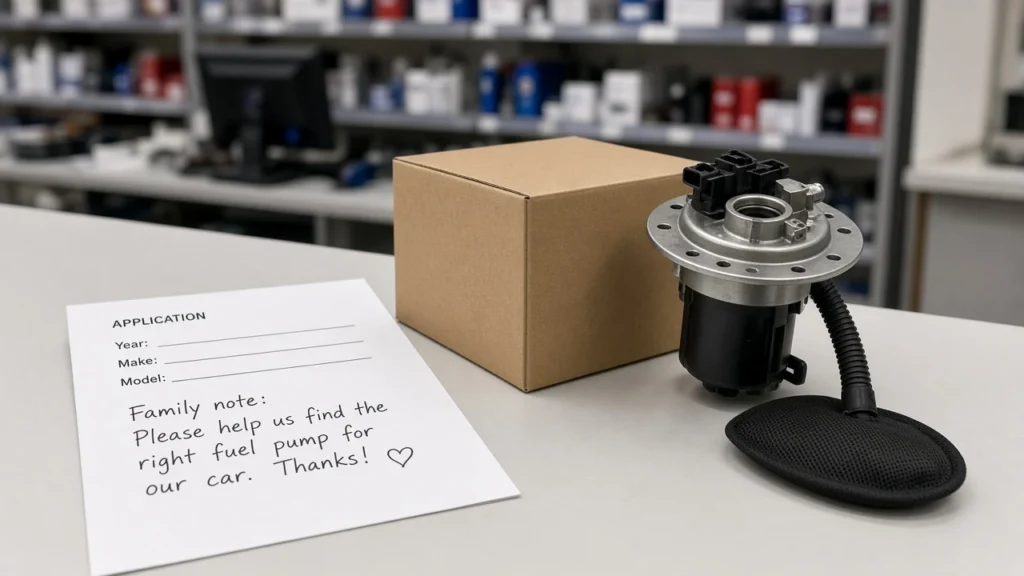
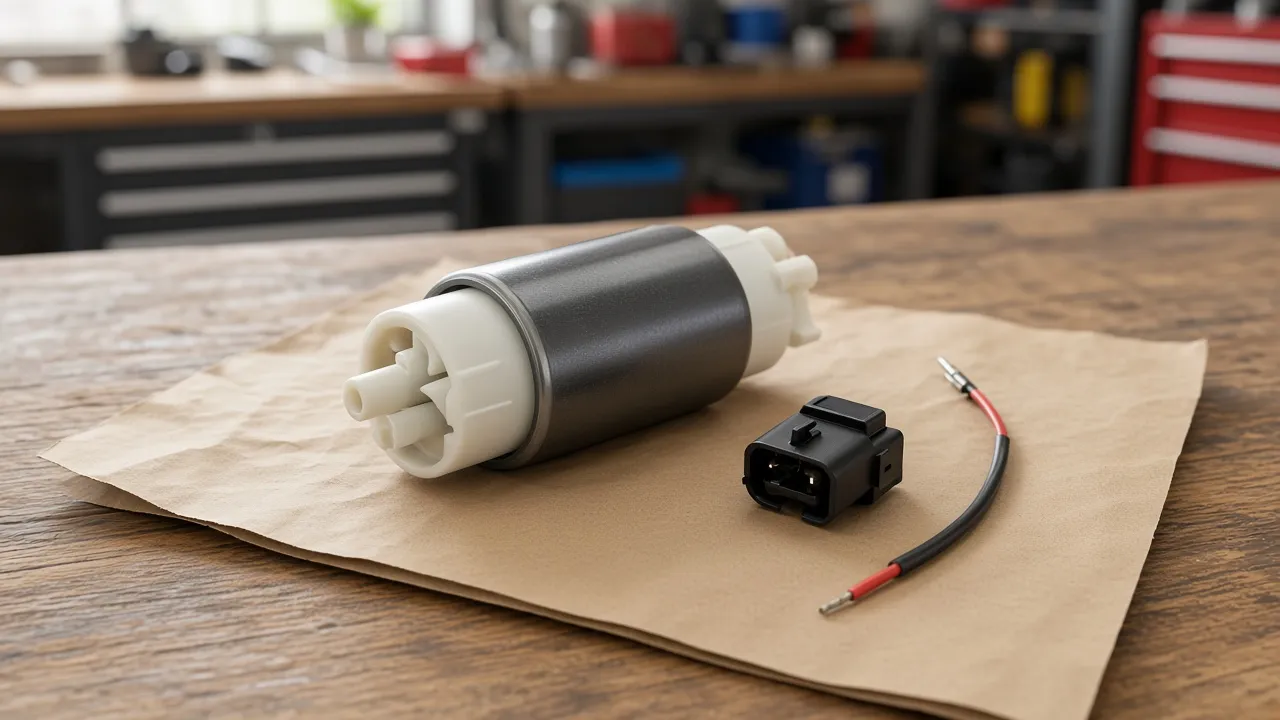
A shop reuses the vehicle plug only when the aftermarket sheet and that plug already agree on pin count, polarity, twelve-volt supply, ground, and the fuse already in the circuit. aftermarket fuel pump wiring is that match, read off the listing before anyone cuts a harness. The sections below cover the lines a counter should see, the colors a blank sheet does not invent, and why two relay kits can quote different wire sizes for the same kind of job.
The coil-and-contact layout for a ordinary twelve-volt pump already sits on the twelve-volt fuel pump wiring page. What follows stays with the sheet and the plug.
Which printed lines decide whether the vehicle plug stays
Pin count, a polarity mark when the sheet prints one, twelve-volt supply, a ground path, and the fuse amp rating already in the vehicle decide whether that plug stays.
Counters get into trouble when a listing says “electric pump” and the truck still has a module plug with a fuel-level sender in the same shell. Those are different cavities.
A feed and a return can share a two-cavity shell. A sender, a sender ground, and a pump feed cannot share that same shell just because both parts move fuel.
Read the sheet the way you would read a packing list. Each line is either on the page or it is blank.
A blank amp line is a blank amp line. A video that used gray for power on a different truck does not fill it.
| Sheet line | What “printed” looks like | What a blank line means for the plug |
|---|---|---|
| Pin count | A number of cavities on the main fuel pump connector | Stop if the vehicle plug has more cavities than the pump |
| Polarity mark | A plus, a minus, or a color callout on this sheet | Leave color to the vehicle diagram |
| Supply | A twelve-volt statement for this pump | Confirm the truck is a twelve-volt system before the plug goes on |
| Ground | A return called out, or a two-pin pair that implies one | Treat the return with the same care as the feed |
| Fuse already there | The amp number on the fuse in the vehicle | Keep that number; a larger fuse is a different circuit |
What a two-pin listing can share with the plug
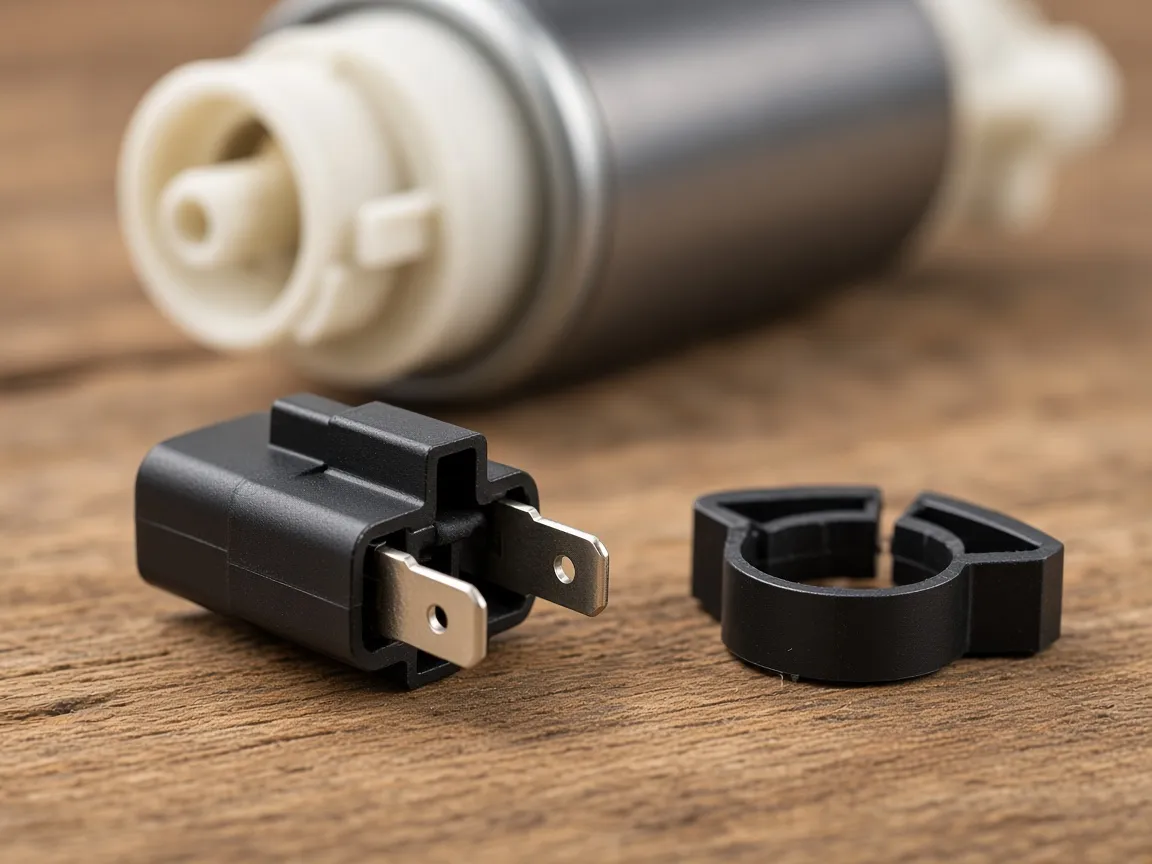
A 2-pin connector can share a feed and a return with a two-cavity vehicle plug. It cannot share a sender circuit that lives in a larger shell.
Racetronix’s harness catalog, read on the same day as this research, splits in-tank leads, bulkhead adapters, and sender-module adapters into different part numbers. That split is the practical clue.
A pump motor and a level sender are neighbors in the tank, and they are still different circuits. Landing a sender wire on a pump terminal, or the other way around, is how a gauge and a pump fail together.
The worked example on this page prints two pins and an OE-comparable harness with no pigtail. “No pigtail” means the listing is not handing you a color-coded tail to splice by memory.
The fuel pump connector on the truck is the one you compare with those two pins. If the truck shell has four or five cavities, the sheet and the shell are describing different jobs.
When polarity colors are printed, and when they are blank
Pump polarity counts only when this sheet, or the diagram for this vehicle, actually prints it. A live search panel for this topic said fuel-pump wire colors vary by make and model, then offered gray, red, and pink-with-black as if they were interchangeable.
Kit colors change with the kit. Holley’s harness sheet uses a blue lead for pump positive and a grey lead for a ground that can land under the relay screw. Tanks uses orange for pump positive and black for ground.
Those colors belong to those kits. There is no shared color code to paste onto a pump whose sheet never mentions color.
If a plus and a minus are molded next to the terminals, follow those marks. If the sheet is silent, open the vehicle diagram or meter the plug with the pump circuit commanded on.
Guessing from a forum photo is how reverse polarity shows up later as a ruined motor. Delphi’s harness note says the same thing in shop language: when the old wiring and the new wiring are not identical, use the diagram that came with the new part.
How 12 V, ground, and the existing fuse share one decision
Twelve volts at the pump is only half the circuit. The ground path has to be clean, and the fuse amp rating already in the power center has to stay the rating printed on that fuse.
The worked listing prints a DC 12 V supply as its working voltage. That sentence is the voltage window for this part. It leaves amp draw blank, and it says nothing about whether the truck’s old feed is thick enough.
MOTOR’s 2003 method calls a ground-side reading of about 0.1 V or less a sound return when the circuit is live. On that same page, a positive-side drop greater than 0.1 V points to a damaged feed or connector.
A key-on reading can still look like battery voltage, because a meter barely loads the wire. The loss shows up when the pump is actually running.
That loss is the voltage drop people miss when they only check for “power.”
A Carter diagnostic chart flags the job when the positive and negative drops together exceed 1.5 V with the pump still energized. That 1.5 V figure is the chart’s combined limit.
It is a different yardstick from MOTOR’s per-side figure, so the two numbers stay on their own pages. Both still point at the same shop habit: test the circuit while the pump is in it.
AA1Car’s fuse guidance is blunt about the part you put back in the box. Replace a blown fuse with the same amp rating.
A larger fuse protects the wire less, not more. The fuel pump relay is the other half of that box.
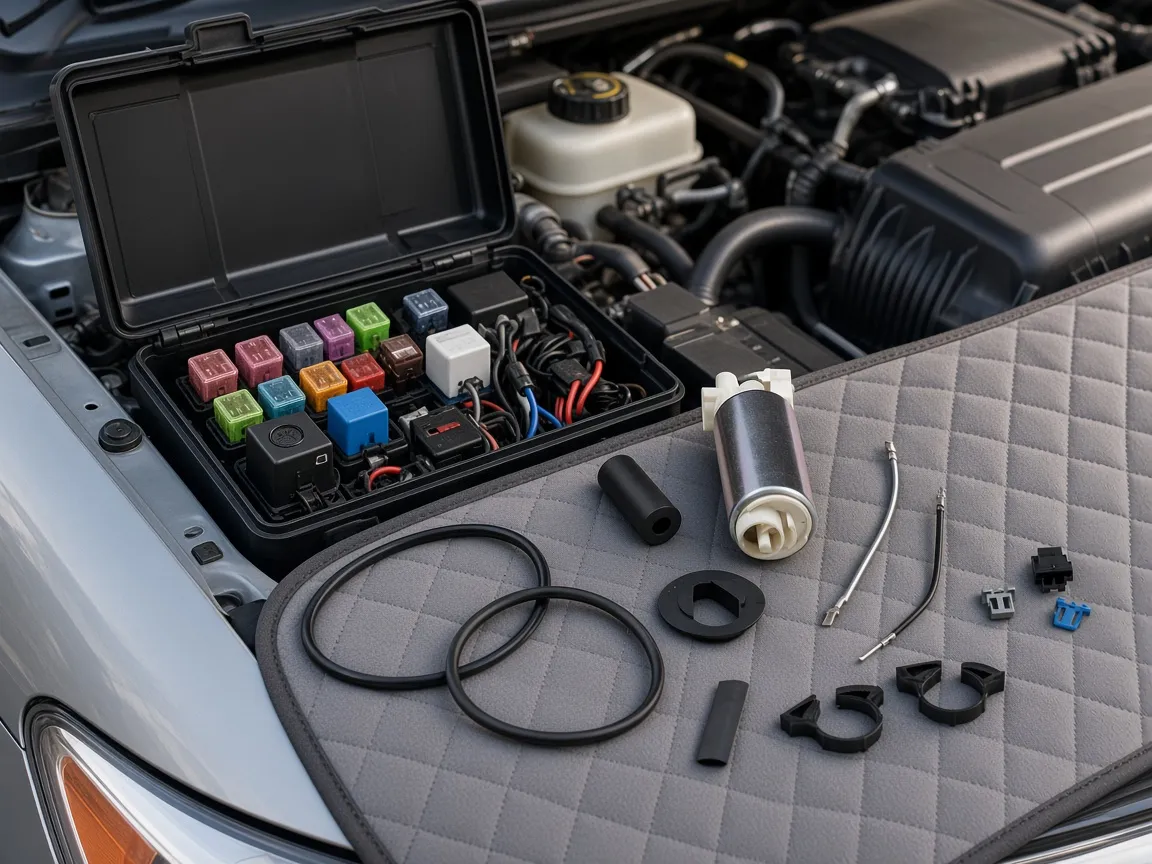
A cube that looks identical can be rated for a different load, or wired differently inside. Swapping by shape alone is how a headlamp relay ends up asked to carry a pump.
Radium’s instruction sheet says most factory fuel-pump wiring, and the protection around it, cannot carry the extra current of a high-flow aftermarket pump. That warning is about pumps that draw more than the circuit was built for.
It does not write an amp number onto a listing that left the amp line blank. If the sheet in your hand has no amp line, you do not borrow Radium’s number, Tanks’ number, or a video’s number to fill it.
Why relay-kit numbers are not the pump sheet
A relay kit prints the wire and the fuse that belong to that kit. Those figures are real for the kit. They are not the missing lines on a pump listing.
Radium’s 17-0031 sheet prints a 40 A relay and a 25 A fuse for a circuit they describe as up to 30 A. The Tanks RLYFP sheet prints a 50 A relay and a 30 A breaker, and it limits the pump load to not above 30 A.
Science of Speed, writing about an S2000 factory lead a bit larger than 16 AWG, says that lead was sized for less than 10 amps and points its own buyers toward an upgrade around 13 amps. An AI overview on the same query swung between “15 to 20-plus amps” and “over 10 to 15 amps,” and between 10-gauge and 14-to-16 gauge, in two renders on the same day.
| Source read 2026-10-07 | What that sheet prints | What it does not do |
|---|---|---|
| Radium 17-0031 | 40 A relay, 25 A fuse, 10 AWG leads, circuit described up to 30 A | It does not rate KS-360501 |
| Tanks RLYFP | 50 A relay, 30 A breaker, 12 gauge power, 14 gauge trigger, load not above 30 A | It does not rate KS-360501 |
| Science of Speed S2000 kits | Factory lead a bit over 16 AWG, described as under 10 amps | It does not rate a C/K listing |
Use the table when a buyer slides a kit across the counter and asks you to copy its gauge onto the pump. The gauge is the kit’s.
The pump sheet still has to speak for itself. If it does not print a gauge, the honest answer is that the gauge is not on this listing.
What changes when the new sheet and the plug disagree
When the new sheet and the vehicle plug disagree, the new diagram is the one that matches the part you are holding. The old shell does not get forced into a pin count it does not have.
From the field: A truck-forum poster hoped to reuse trailer-brake wire already in the harness, and another user answered, “big pump and stock wires don’t get along.” — PerformanceTrucks fuel pump wiring thread
That exchange is a buying objection from one thread. It shows the habit a spare harness wire encourages, because the wire is already routed.
Convenience has no current rating of its own. If the pump sheet is silent on amps, and the only evidence you have is “the wire is already there,” the electrical check is still open.
A mismatch can be small or large. Two pins against two cavities, with a printed plus and minus, is a match you can talk through.
Two pins against a five-cavity module plug is a different part. So is a sheet that shows a pigtail color code when the pump in the box has none.
Delphi’s point still holds without turning this page into a crimp lesson: identical-looking wires are not identical until the new diagram says so.
Shops sometimes jumper a relay socket to see if the pump runs. AA1Car describes that fused jumper as a test. If the pump then runs, the relay is the suspect.
Put the fuse back when the test ends. The jumper stays a test lead.
Which C/K pump sheet fits the plug you already have
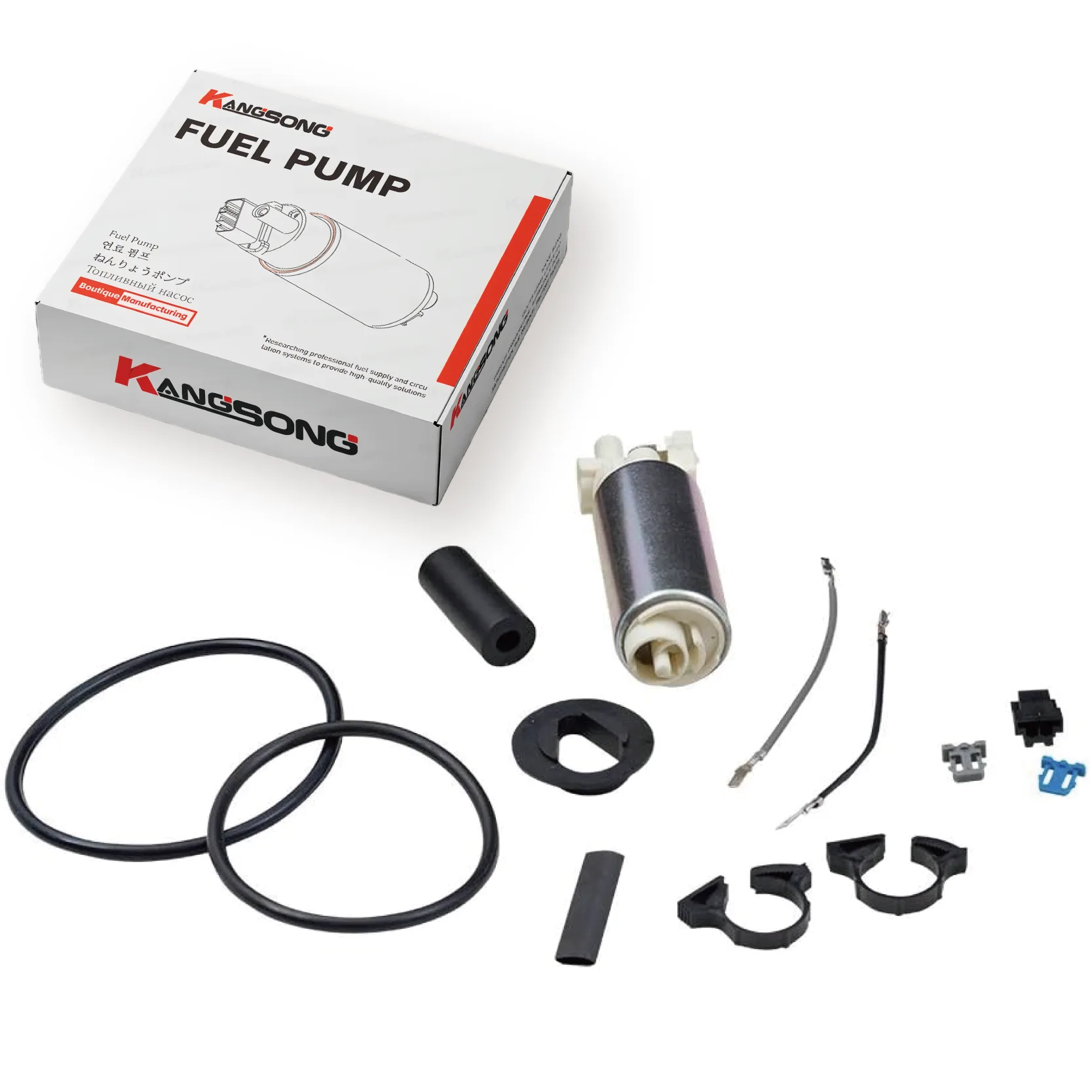
KS-360501 fits this check inside the window the page prints: 1987–1995 C/K 1500, 2500, and 3500, with OE examples 25168719 and E3902, a 2-pin connector, a DC 12 V supply, and 43.3–49.5 Gph. The harness line says the listing is OE-comparable and has no pigtail. Open the KS-360501 electric pump listing and compare those lines with the plug on the vehicle.
The same page does not print an amp draw, a wire gauge, or a polarity color. If the job needs those three, this listing does not supply them, and another sheet has to.
A plug with more than two cavities, or a truck outside that C/K window, is outside this fit as well. For a different application, start from the fuel pump catalog and read that product’s own electrical lines the same way.
The useful close is dull on purpose. Count cavities.
Look for a polarity mark on this sheet or on this pump. Confirm the truck is twelve-volt.
Look at the fuse amp rating already in the box and leave it at that rating. If a relay kit is on the counter too, read its gauge as the kit’s gauge.
Then decide whether the vehicle plug stays.
FAQ
Can I wire my fuel pump straight to the battery?
Pump current belongs on a fused feed, with the trigger on a small circuit. A bare battery lead leaves the wire as the fuse.
The twelve-volt wiring page covers how that fused feed is usually built. This page only asks whether the fuse already in the truck is the right rating for the pump on the sheet.
What color wires go to the fuel pump?
Whatever this sheet or this vehicle diagram prints. Kit colors change from brand to brand, and a search panel for this query listed several conflicting examples in one answer. A blank color line on the pump listing stays blank.
Can I straight wire my fuel pump?
A straight battery connection skips the fuse and the fuel pump relay that normally carry the load. Use it only as a momentary test with a fused jumper, the way a relay diagnosis is done, and put the protection back when the test is over.
What happens if I wire my fuel pump backwards?
Reverse polarity is a known way to damage a DC pump when the plus and minus were marked and then swapped. If the sheet prints a polarity mark, follow it. If it prints nothing, find the vehicle diagram before the terminals are landed.
What happens if you wire a fuel pump wrong?
The usual misses are a sender wire on a pump pin, a feed on the return, or a plug with the wrong cavity count forced together. The pump may not run, the gauge may lie, or a connector may heat. Matching the new diagram to the shell prevents that mix-up.
Can I run a fuel pump without a relay?
The relay is what lets a small trigger control a high-current motor. Some tests bypass it for a moment.
Leaving it out, or replacing it with a cube of the wrong rating, puts the load on a circuit that was not built for it. Kit pages exist because builders add that relay when the factory path is too small. Those kits still do not invent the amp line on the pump sheet.
Does a 2-pin aftermarket pump always fit a two-cavity vehicle plug?
Only when the two cavities are the pump feed and the pump return, and the polarity is known. A two-cavity shell that is actually a sender pair, or a module plug that looks small until you count the wires, is a different connector.
The KS-360501 sheet is a 2-pin example for its printed C/K window. Other shells need their own count.