What is a fuel pump diode? It is a one-way suppressor—most often a flyback or freewheeling diode across a fuel-pump relay coil or pump lead—that clamps inductive kickback / back EMF when the circuit turns off.
That clamp keeps switches, ECU drivers, and nearby electronics from absorbing the turn-off spike. This page defines the name, separates flyback, isolation / anti-backfeed diode, and OEM diode-pack roles, then covers polarity, failure patterns, and boundaries. Kangsong does not sell a diode SKU; when the pump hardware itself is next, browse an electric fuel pump + install kit (2551) under the published fitment scope.
What a Fuel Pump Diode Is
A fuel pump diode is the field name for a semiconductor diode used in a fuel-pump control or motor circuit, almost always acting as a one-way clamp rather than a power switch or a fuse.
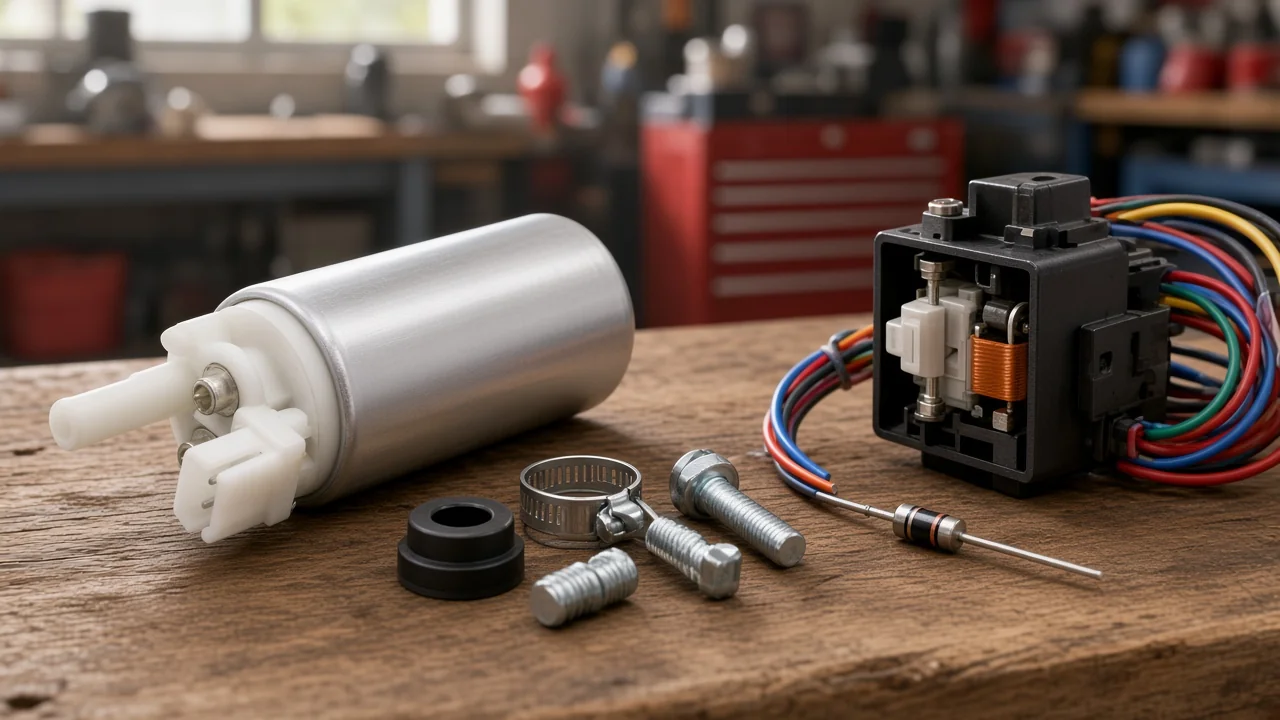
In engineering language the same part is a flyback diode, freewheeling diode, snubber diode, suppressor diode, or clamp diode. Those names describe any diode connected across an inductive path to eliminate the sudden voltage spike when supply current is interrupted. A fuel pump relay diode note on a print is usually that clamp across the coil, not a separate “pump-only” mystery part number.
Fuel-pump documents rarely print the textbook labels. They mark a small axial part, a molded diode pack, or a coil note as a “fuel pump diode,” so buyers treat the phrase like a universal SKU.
A diode conducts easily in one direction and blocks in the other, so it can steer or clamp energy without being a current-limiting fuse. Fuel-pump circuits include inductive pieces—relay coils especially, and sometimes an electric fuel pump motor—so turn-off events create kickback that needs a planned path.
Circuit Roles: Flyback, Isolation, and Diode Packs
“Fuel pump diode” on a print can mean different jobs; read the role on the diagram before you order a part or blame the pump.
| Role people mean | Where it usually sits | What it is doing | What it is not |
|---|---|---|---|
| Flyback / coil suppression (fuel pump relay diode) | Across the fuel pump relay coil (parallel, reverse-biased to the supply) | Clamps coil kickback so the switch, transistor, or ECU driver is not abused | Not a contact amp rating and not a fuse |
| Pump-lead snubber / flyback diode fuel pump path | Across pump power leads near the motor or connector | Gives inductive energy a local loop when the feed opens | Not proof every rotary pump “needs” an external diode |
| Isolation / anti-backfeed diode | In series with alternate feeds (for example start vs alternator hold paths) | Stops power from running the wrong way between sources | Not flyback clamping across a coil |
| OEM diode pack / diode module | Harness module that may share a relay-looking housing | Combines diode logic or safety steering for a platform | Not automatically an ISO cube relay |
Community threads show the naming collision clearly. Classic-car owners ask “what is the purpose of the diode on the fuel pump?” and replies sometimes reveal a capacitor for radio noise.
Others recommend a bipolar Transient Voltage Suppressor (TVS) across points instead of a plain rectifier. Marine service threads describe dual diodes around a fuel pump relay so start and alternator feeds cannot back-feed each other.
Builder forums discuss reverse-biased diodes across pump leads to reduce switch arcing.
How Flyback Suppression Protects the Circuit
When the coil or inductive path opens, stored magnetic energy tries to keep current flowing and creates a sharp reverse voltage spike; a reverse-biased fuel pump suppression diode across that inductor gives the current a safe recirculating path.
While the relay coil (or another inductive load) is energized, the suppression diode sits reverse-biased against the supply and stays out of the way. At turn-off the coil voltage reverses polarity relative to the open switch. The diode becomes forward-biased, closes a low-impedance loop with the coil, and lets the stored energy dissipate as heat in the winding resistance and the diode’s forward drop instead of as an arc into a semiconductor driver.
That protection is why control panels and ECU-driven fuel pump relays care about coil diodes. Unsuppressed kickback can arc mechanical contacts, stress driving transistors, and inject noise that resets nearby electronics. A general-purpose silicon rectifier in the common 1N400x class is the textbook example for many low-voltage DC coils—as a part class with margin above coil current and supply voltage, not as a Kangsong SKU.
There is a real trade-off. A plain silicon diode keeps coil current circulating longer, so relay contacts can drop out more slowly.
Designers who need faster release sometimes add a series resistor, a series Zener, or a TVS so the clamp voltage is higher and energy clears faster—at the cost of a higher transient at the switch. For a procurement reader the takeaway is simpler: the diode’s job is spike management on the control side, not “more amps for the pump.”
Important: A shorted or reversed isolation diode in a dual-feed fuel-pump relay circuit can keep the pump powered after key-off, or blow fuses when the diode no longer blocks reverse current (iboats — Fuel pump, relay and diode help). Confirm the role on the schematic before you replace random diodes or the pump itself.
Placement and Polarity Basics
Mount the suppression diode reverse-biased across the inductive device, keep it physically close, and orient the cathode/banded end toward the more positive supply side in the usual DC coil drawing.
| Placement check | Do this | Avoid this |
|---|---|---|
| Electrical position | Parallel with the relay coil (or the inductive leads you intend to clamp) | Series in the high-current pump feed as if it were a fuse |
| Polarity (common DC coil drawing) | Cathode / band toward +V; anode toward the switched/grounded coil end | Reversing the diode so it conducts whenever the coil is powered |
| Physical location | As close to the coil or pump leads as practical | Long flying leads that re-introduce loop inductance |
| Part class | Rectifier or TVS rated above supply voltage and coil current with margin | Random signal diodes undersized for the coil, or guessing without a diagram |
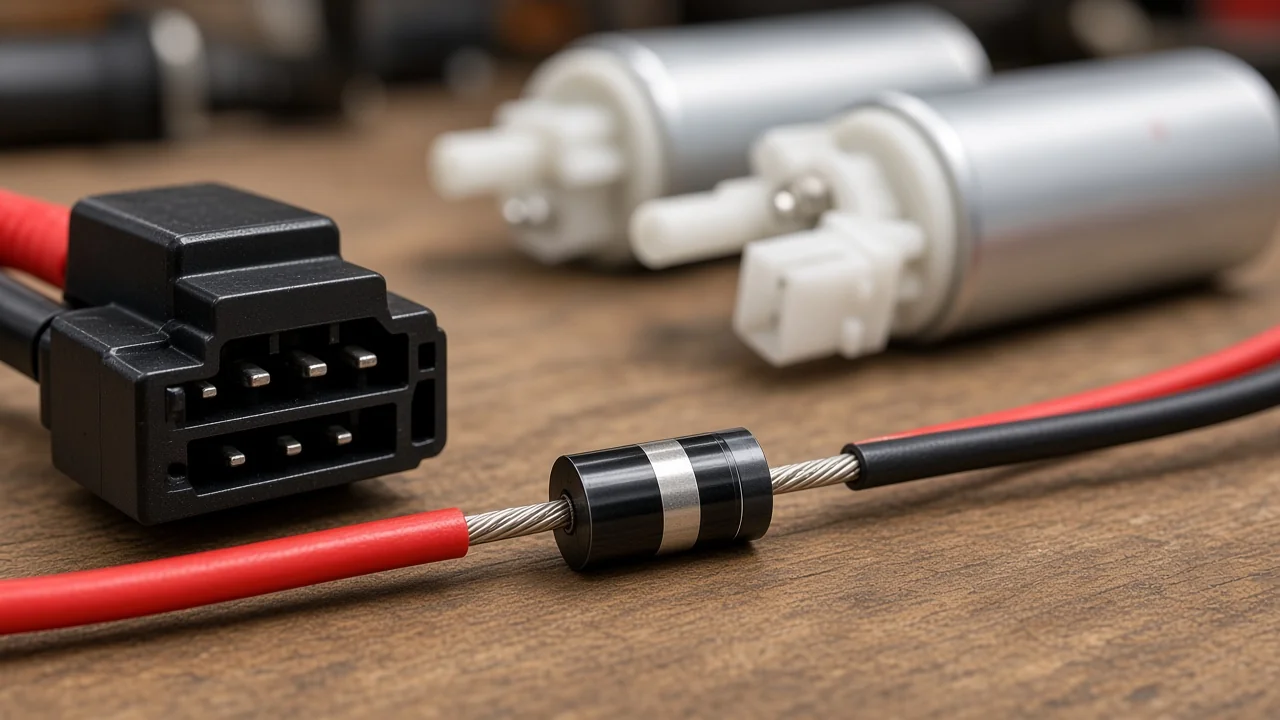
Polarity mistakes matter immediately: a reversed flyback diode across a powered coil behaves like a short and typically opens the fuse or damages the feed. Isolation diodes in dual-feed designs are oriented for steering, not for coil freewheeling. Copying a coil-snubber orientation onto an isolation diode (or the reverse) recreates the “pump won’t shut off” class of faults described in marine service threads.
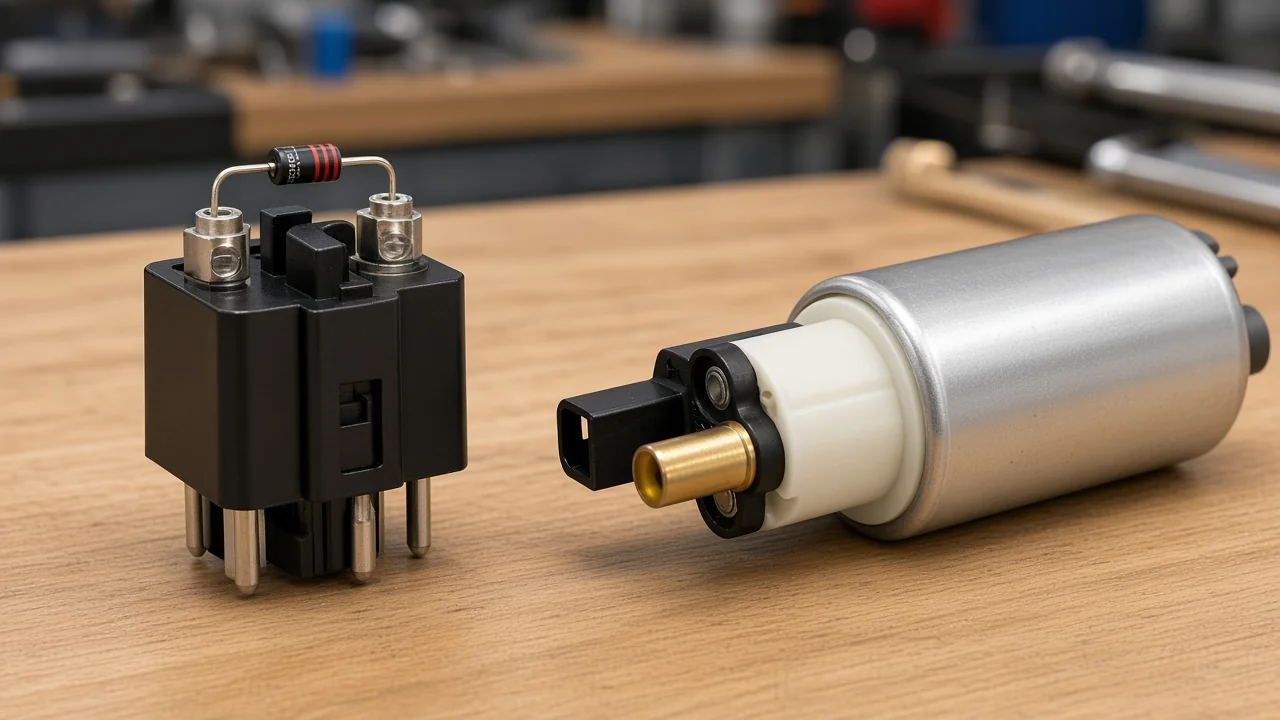
Failure Modes and Field Symptoms
Shorted diodes often create fuse trips or back-feed paths; open diodes quietly remove suppression; reversed isolation diodes can leave a fuel pump running after the key returns to off.
| Diode state | Typical electrical behavior | Field symptom pattern |
|---|---|---|
| Shorted | Conducts both ways / loses one-way block | Fuse or breaker opens; unexpected back-feed; pump or relay circuit stays live when it should not |
| Open | No clamp path | Suppression lost; switches or drivers see kickback again; noise or premature contact wear may return |
| Reversed (isolation role) | Steering direction wrong | Pump keeps running after key-off until the relay is pulled; battery drain complaints |
| Reversed (flyback across coil) | Diode tries to short the coil supply | Immediate fuse blow when the coil circuit is powered |

These are pattern language, not a Kangsong diagnostic tree for every platform. If the symptom is “no fuel pressure” with a dead pump feed, start with power, ground, relay contacts, and the fuse—not with a diode lecture. If the symptom is “pump won’t stop” on a dual-diode hold circuit, the isolation diode path belongs on the checklist before you condemn the pump motor.
What a Fuel Pump Diode Is Not
A fuel pump diode is not a fuse substitute, not a relay amp-sizing answer, and not a full twelve-volt wiring or prime-connector manual.
A fuse opens on overcurrent to protect the wire. A diode does not replace that job.
Answering “can I use a fuse instead of a diode?” with “yes” confuses two different protection problems. Relay contact amperage and ISO mini versus micro form factor belong on the what size relay for fuel pump guide.
Coil suppression is only a related control-side note there, while this page owns the diode definition.
Fuse continuity testing and blown-fuse symptom maps are separate service articles. Full twelve-volt pump wiring novels and prime-connector pinouts are likewise out of scope here so those intents stay readable on their own pages.
If you only need the definition: the diode clamps or steers. If you need the next hardware decision on relay size or fuse health, follow the sibling link rather than stretching this article into a catch-all electrical manual.
Choose a Kangsong Electric Fuel Pump Install Kit After the Circuit Concept
Kangsong does not publish a fuel-pump diode SKU; when the next purchase is the pump hardware itself, use a scoped electric fuel pump with installation kit rather than inventing a diode product line.
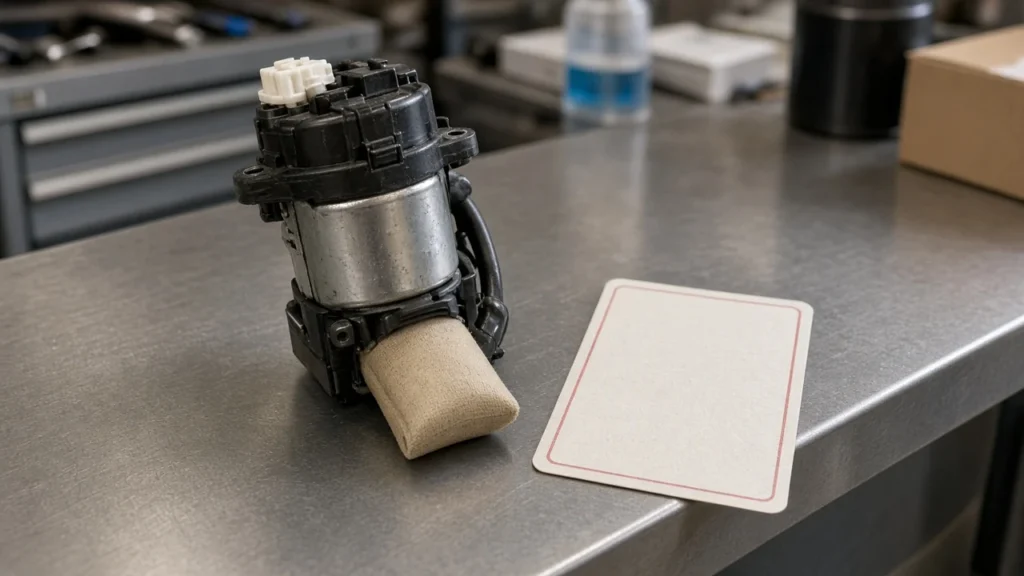
After the circuit role is clear, many service jobs still end at a tired electric pump, damaged connector, or missing install hardware—not at a mystery diode catalog.
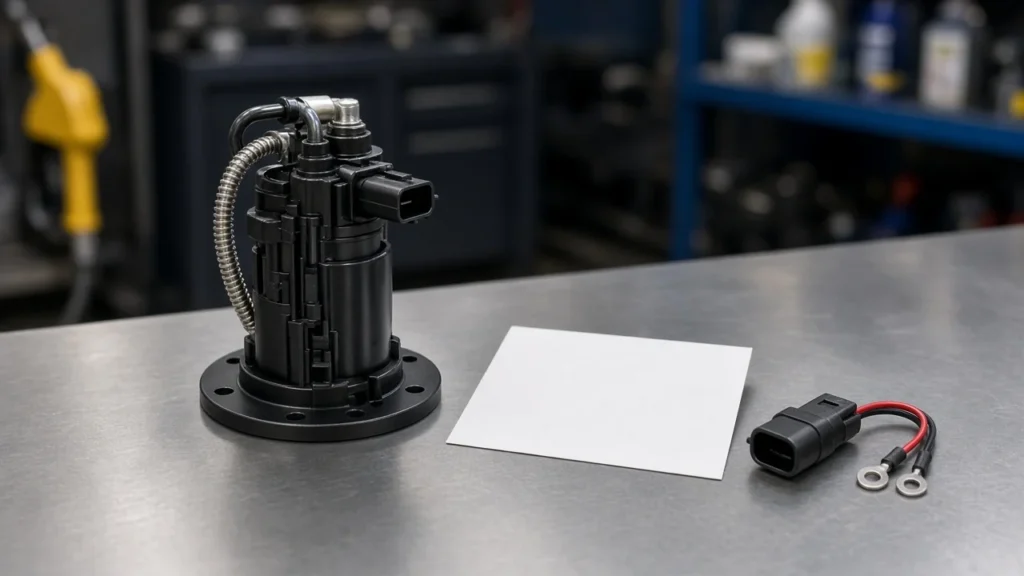
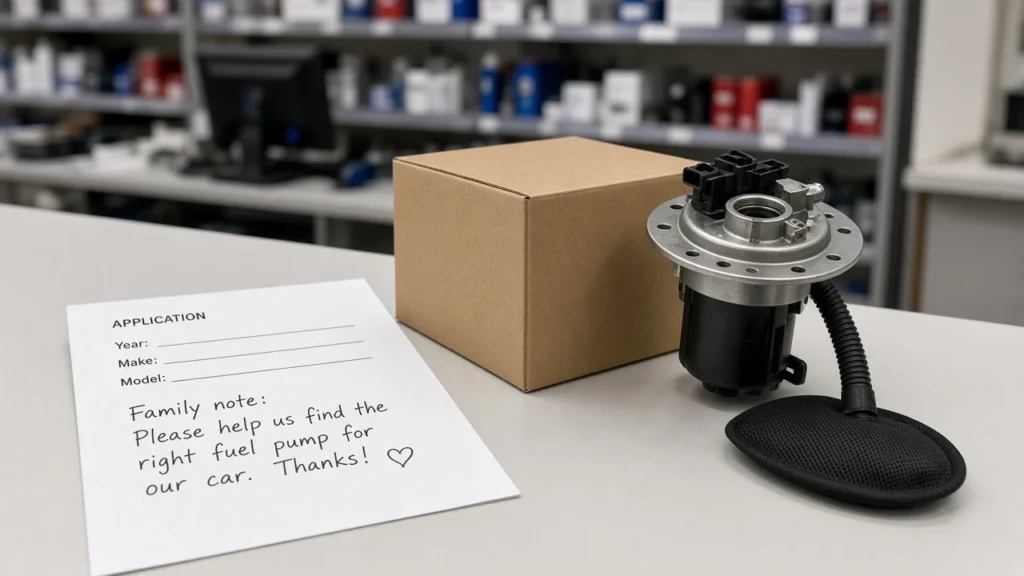
The published electric fuel pump with installation kit (product ID 2551) is an electric gasoline pump kit with accessories included and a 2-pin main connector.
PDP fitment language is scoped to 1987–1995 C/K 1500/2500/3500 pickup applications, with published flow/pressure figures on that product page. It does not claim to include a suppression diode, and it is not a universal diode retrofit kit.
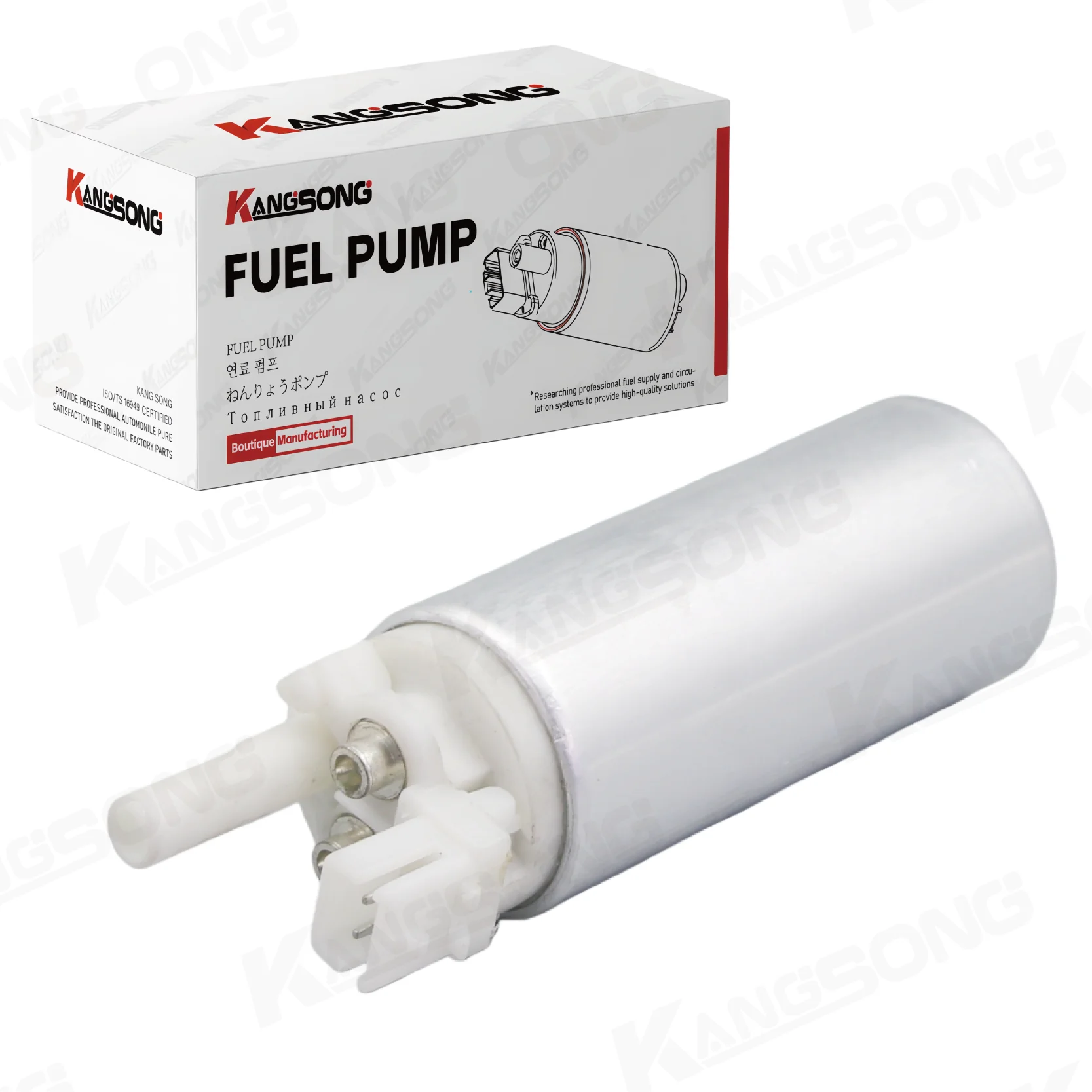
Browse the products catalog when another vehicle scope is required. Do not treat third-party brand names that appear in forum threads as Kangsong equivalents, replacements, or performance claims.
FAQ
What is a fuel pump diode in plain terms?
It is a one-way electrical part used in a fuel-pump circuit to clamp inductive kickback or, on some designs, to stop power from back-feeding between alternate feeds. It is not a fuse and not a relay amp rating.
Is the diode across the relay coil or the pump motor?
Both placements appear in the field. Coil flyback diodes sit across the fuel pump relay coil; some builders also place a reverse-biased diode across pump leads to protect a switch.
Isolation diodes sit in series with steering feeds. Read the diagram role before you copy a photo from another platform.
What happens if a fuel pump diode goes bad?
A shorted diode can blow fuses or create back-feed paths. An open diode removes suppression so kickback returns to the switch or driver. A reversed isolation diode can keep a pump running after key-off.
How can I tell if the diode is bad?
With power removed and the diode isolated as the schematic allows, a multimeter diode-mode check looks for conduction in one direction and block in the other. Readings that look shorted both ways or open both ways flag a failed part. Platform harness diodes buried under tape may need diagram-led access rather than a blind probe.
Can I use a fuse instead of a diode?
No. A fuse protects against overcurrent on the wire. A diode manages direction and inductive spikes.
You typically need the correct fuse and, where the design calls for it, the correct diode role—not one part pretending to be the other.
What would cause a diode to burn out?
Reverse installation across a live coil, sustained overload, heat, or a short that turns the diode into a fuse-blowing path are common mechanical stories. Isolation diodes that are installed backwards create steering faults that look like “run-on” rather than a melted package.
Does a flyback diode slow relay release?
Yes, a simple silicon flyback diode can delay contact drop-out because coil current keeps circulating. Faster-release networks use added resistance, Zener, or TVS clamps when timing matters.
Does Kangsong sell a fuel pump diode?
No published diode SKU turned up in the catalog search for this article. When the pump hardware is the next buy, use the scoped electric fuel pump with installation kit linked above, and keep diode selection on the electrical design—not on a fake product claim.