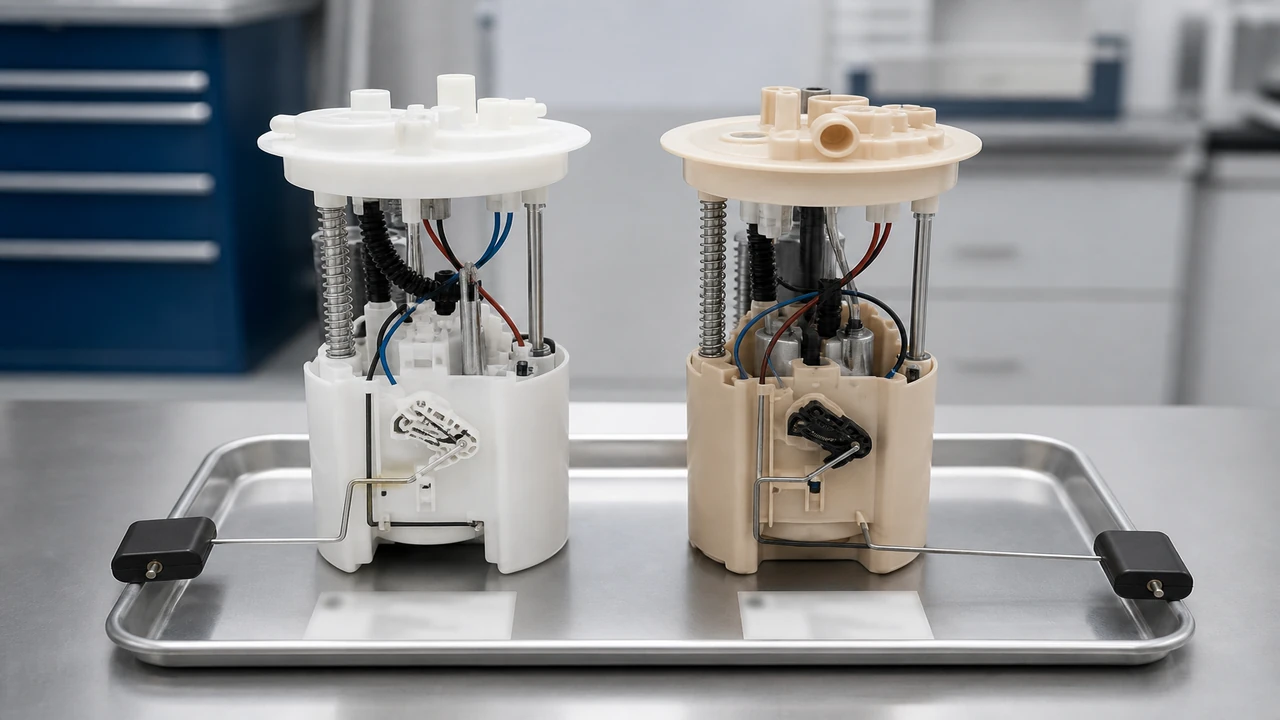
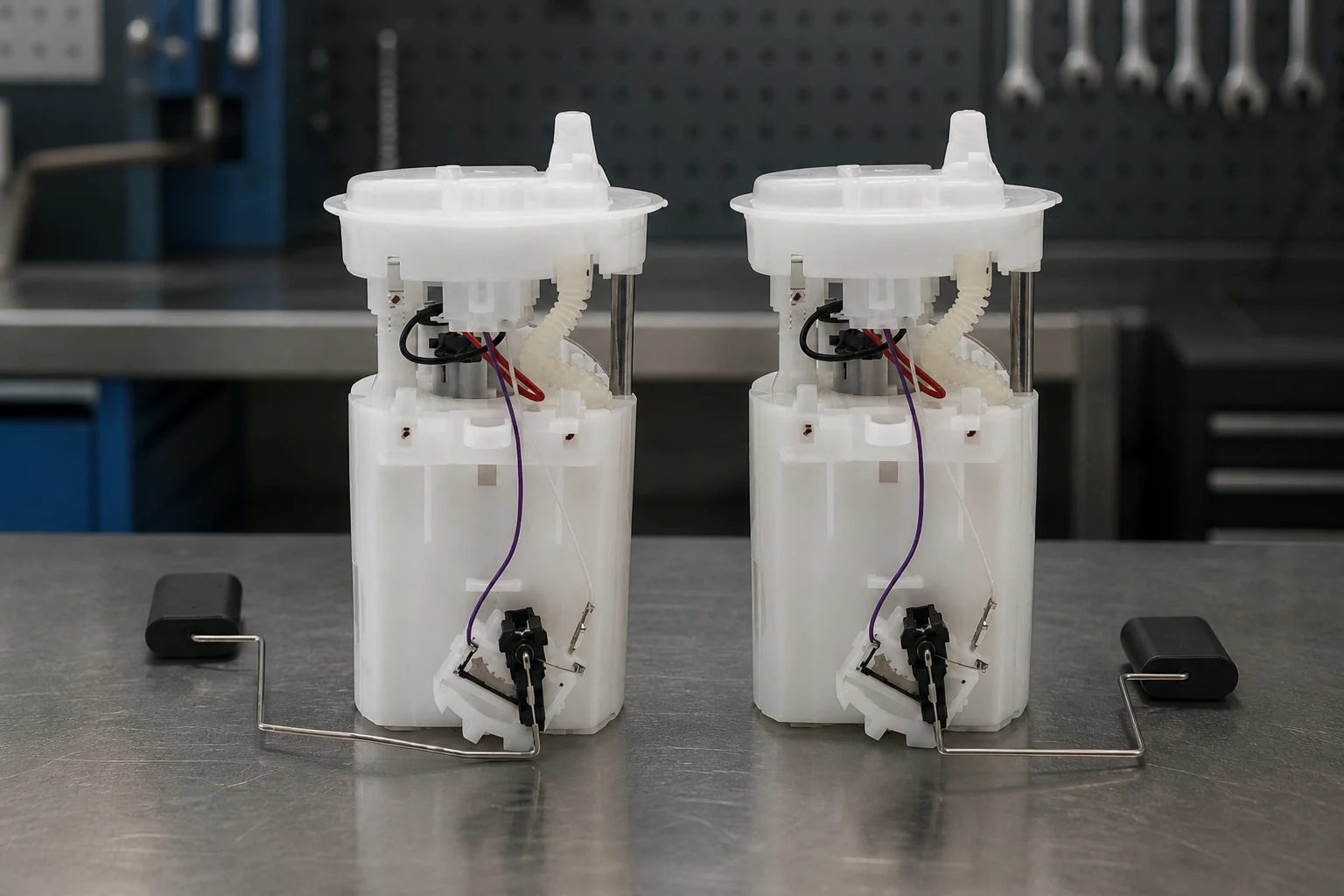
A fair Delphi fuel pump comparison against OEM-equivalent assemblies starts with identical scope (full module vs pump-only), matching specification fields, complete documents, and lot-level traceability—not with brand slogans. Wholesale buyers who normalize those four inputs can stock both lines without margin surprises or comeback spikes.
Part 1. Start With Scope, Not Brand Labels
Search traffic for delphi fuel pump often mixes three different SKUs: a branded module assembly, a Delphi-sourced electric pump cartridge, and an aftermarket OEM-equivalent module that only claims fitment parity. Price tables that ignore that split are not comparable.
Readers comparing Delphi modules to OEM-equivalent assemblies need a document checklist, not a loyalty argument.
Treat brand as one commercial attribute. Treat scope—sender included, hanger assembly, strainer, regulator, harness pigtail—as the first RFQ gate.
Part 2. Specification Fields That Must Match
Before ranking quotes, force both sides onto the same engineering fields. Missing voltage or connector notes is a return waiting to happen.
| Spec field | Why it must match | Reject when |
|---|---|---|
| Flow / pressure rating basis | Duty and platform pressure strategy | Rating present without measurement basis |
| Voltage and current draw | Vehicle electrical load | “12 V pump” with no draw band |
| Connector / harness pinout | Plug-and-play claims | Photo only, no pin description |
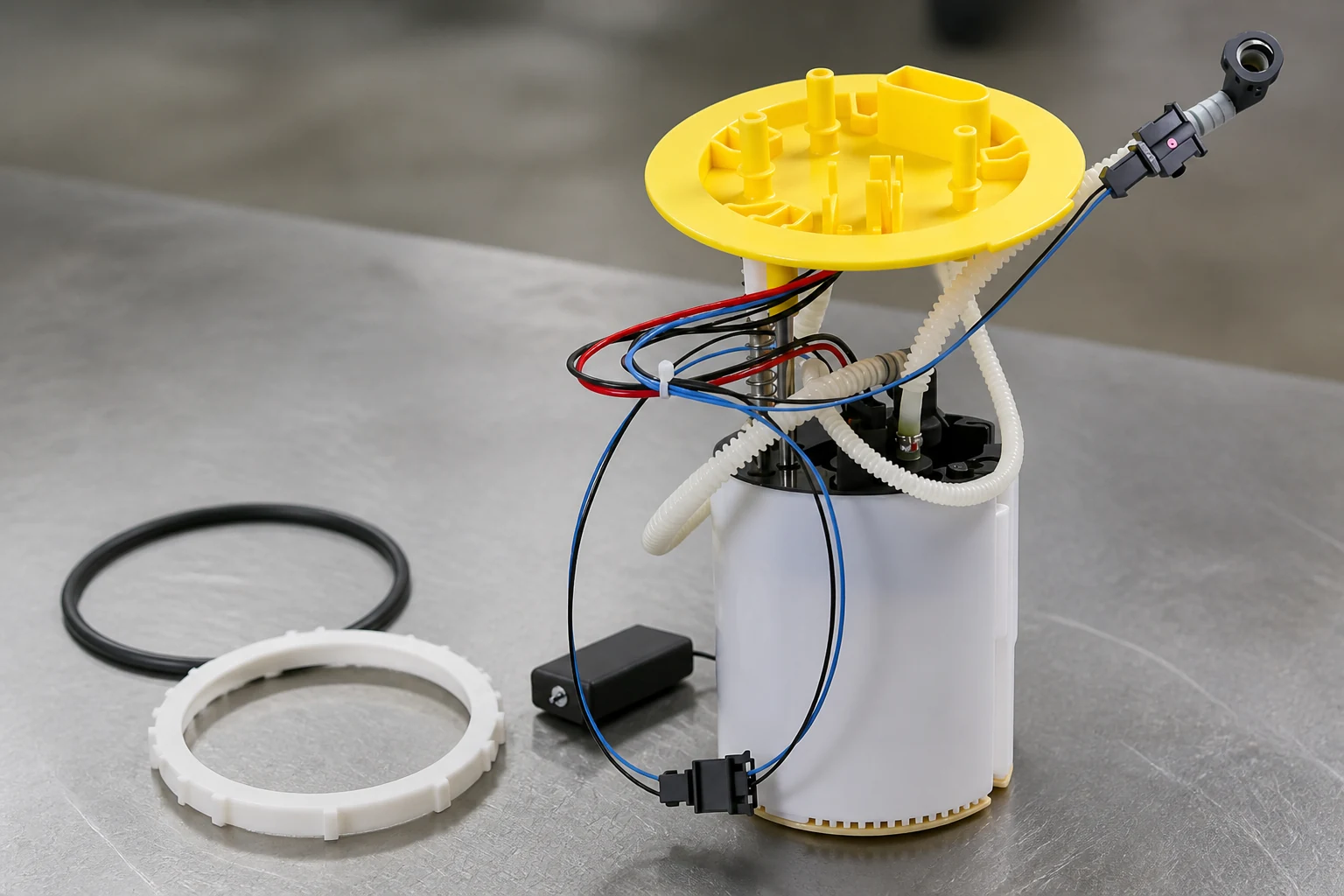
| Sender / level unit type | Module completeness | Pump-only sold as “module” |
| Filter sock / strainer mesh | Contaminant risk | Omitted on dirty-fuel programs |
Secondary searches for delphi fuel pump module assembly and delphi electric fuel pump should be tagged in the RFQ so suppliers answer the correct SKU family.
Part 3. Documentation Packages Side by Side
Score packages the same way you score hardware. A clean PDF with OE supersessions often beats a glossy photo set with no revision date.
| Document | Delphi-branded offer | OEM-equivalent offer |
|---|---|---|
| Fitment / OE cross-ref list | Expected from brand catalogs | Must be explicit and revision-dated |
| Dimensional notes | Usually available | Require drawing or critical dimensions |
| Installation torque / seal notes | Often in service literature | Ask if omitted |
| Warranty claim path | Brand channel rules | Factory or distributor channel rules |
Important: Do not treat a brand name as a substitute for a revision-dated OE cross-reference and connector description on wholesale module RFQs. (Source: Manufacturer catalog practice / distributor returns analysis.)
When documents diverge, pause commercial ranking and request a controlled revision—not a verbal assurance.
Part 4. Traceability and OE Cross-Reference Evidence
Importers serving fleet and jobber channels need lot identity when field failures appear months later. Forums and counter returns repeatedly cite “looks right, wires wrong” failures that lot codes and OE maps would have blocked.
| Traceability item | Buyer question | Pass signal |
|---|---|---|
| Lot / batch marking | Can we read it on the unit and carton? | Photo + marking rule in offer |
| OE supersession map | Which OE numbers does this replace? | Dated list, not a slogan |
| Incoming inspection fields | What did receiving check? | Checklist shared with PO |
| Claim evidence pack | What photos and VIN notes are required? | Written claim SOP |
Recall-sensitive programs still follow the verification workflow in the fuel pump recall stocking guide; this comparison only covers commercial document parity.
Part 5. When a Delphi-Branded Path Is the Clearer Buy
Delphi-branded modules remain a strong path when the program requires brand-specified stocking, dealer-adjacent expectations, or catalog familiarity that shortens counter training. That is a channel fit decision, not a verdict that aftermarket is inferior.
Choose the branded path when OE documentation and connector identity are already locked to that catalog family, and switching brands would break existing customer part numbers.
Choose an OEM-equivalent path when OE cross-references, pressure/flow basis, and lot marking are complete and the commercial program favors factory-direct assemblies.
Part 6. Kangsong OEM-Equivalent Routes After Comparison
After both quotes share scope, specs, documents, and traceability, route OEM-equivalent demand to Kangsong assembly programs and keep Delphi-branded demand on its existing channel—without mixing claims.
| Inquiry type | Route | RFQ focus |
|---|---|---|
| Documented OE cross-ref + module scope | Kangsong products | OE numbers, voltage, connector, sender |
| Mixed pump-only vs module quotes | Return for scope rewrite | Assembly inclusions list |
| Brand-mandated Delphi stocking | Keep branded channel | Do not force substitute |
- Kangsong fuel pump products — OEM-equivalent modules and assemblies when OE cross-ref and pressure/flow specs are documented.
- Contact Kangsong — RFQ with OE numbers, connector notes, and lot-traceability needs.
For labor and retail total context after you pick a tier, use the fuel pump replacement cost guide. Manufacturer background sits on About Kangsong.
Part 7. Fit Boundaries
This comparison does not publish Delphi performance curves, declare a universal winner, or provide vehicle-specific teardown steps. Final selection still requires supplier datasheets for the exact SKU and platform.
FAQ
What does Delphi fuel pump usually mean in wholesale RFQs?
It can mean a branded module, a branded electric pump cartridge, or a catalog family name used loosely at the counter—always force the RFQ to state module vs pump-only scope.
Is an OEM-equivalent assembly the same as a Delphi module?
Not automatically. Equivalence is proven by OE cross-reference, matching electrical and hydraulic fields, and a complete document pack—not by marketing language.
Which specs should appear on both quotes?
Flow/pressure basis, voltage/current, connector identity, sender inclusion, and strainer notes at minimum.
Why does module vs pump-only scope matter?
Pump-only pricing understates labor and return risk on platforms that need a full hanger/sender assembly.
What traceability fields reduce returns?
Lot/batch marking, dated OE maps, receiving checklists, and a written claim evidence pack.
Can distributors stock both Delphi and OEM-equivalent lines?
Yes. Separate channels by customer program rules and keep SKU identity clear so counters do not swap documents.
Does this page say Delphi is worse than aftermarket?
No. It compares documentation and scope so buyers can choose the fit for each program without brand bias.
How should buyers start a Kangsong RFQ after comparison?
Send OE numbers, platform notes, connector requirements, and whether the quote must be a full module; use Contact Kangsong.


