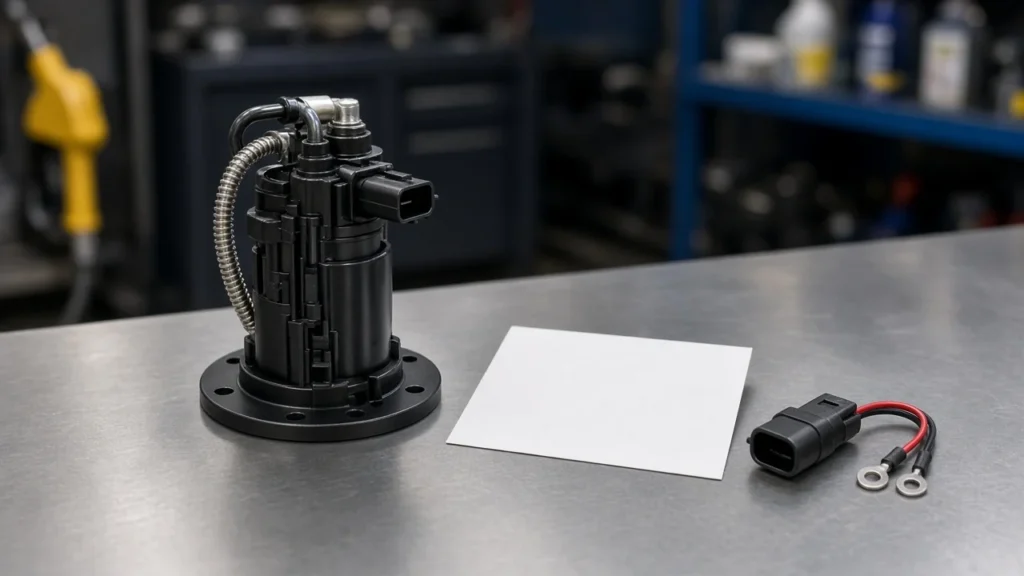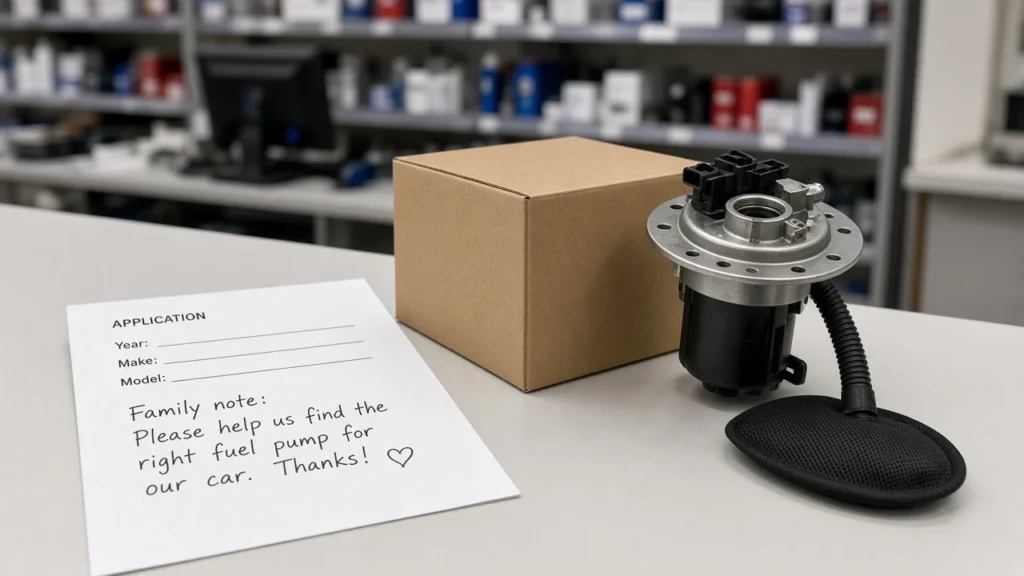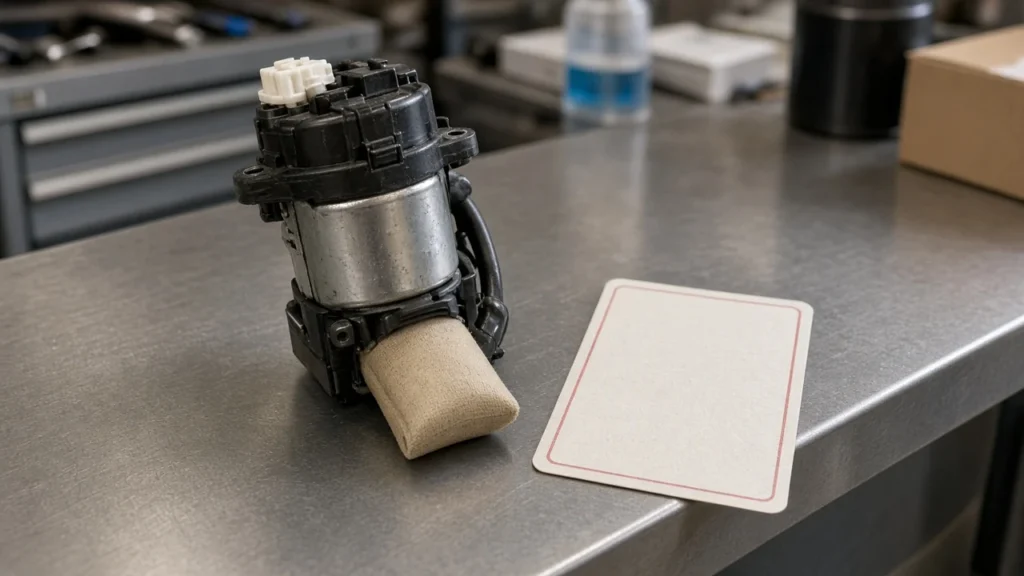

A what is a fuel pump assembly question usually means one thing on a parts counter: the complete in-tank fuel delivery module, not a bare pump motor. That module combines the electric pump with the flange cover, fuel-level sender and float, inlet strainer, seals, and usually a swirl-pot reservoir so pressurized fuel leaves the tank as one serviceable unit. This page defines the assembly, lists what it includes, explains how the in-tank layout keeps the pump fed and cooled, and shows when buyers should order an assembly versus a pump-only insert—before browsing fitment-scoped Kangsong listings.
A Fuel Pump Assembly Is the Complete In-Tank Delivery Module
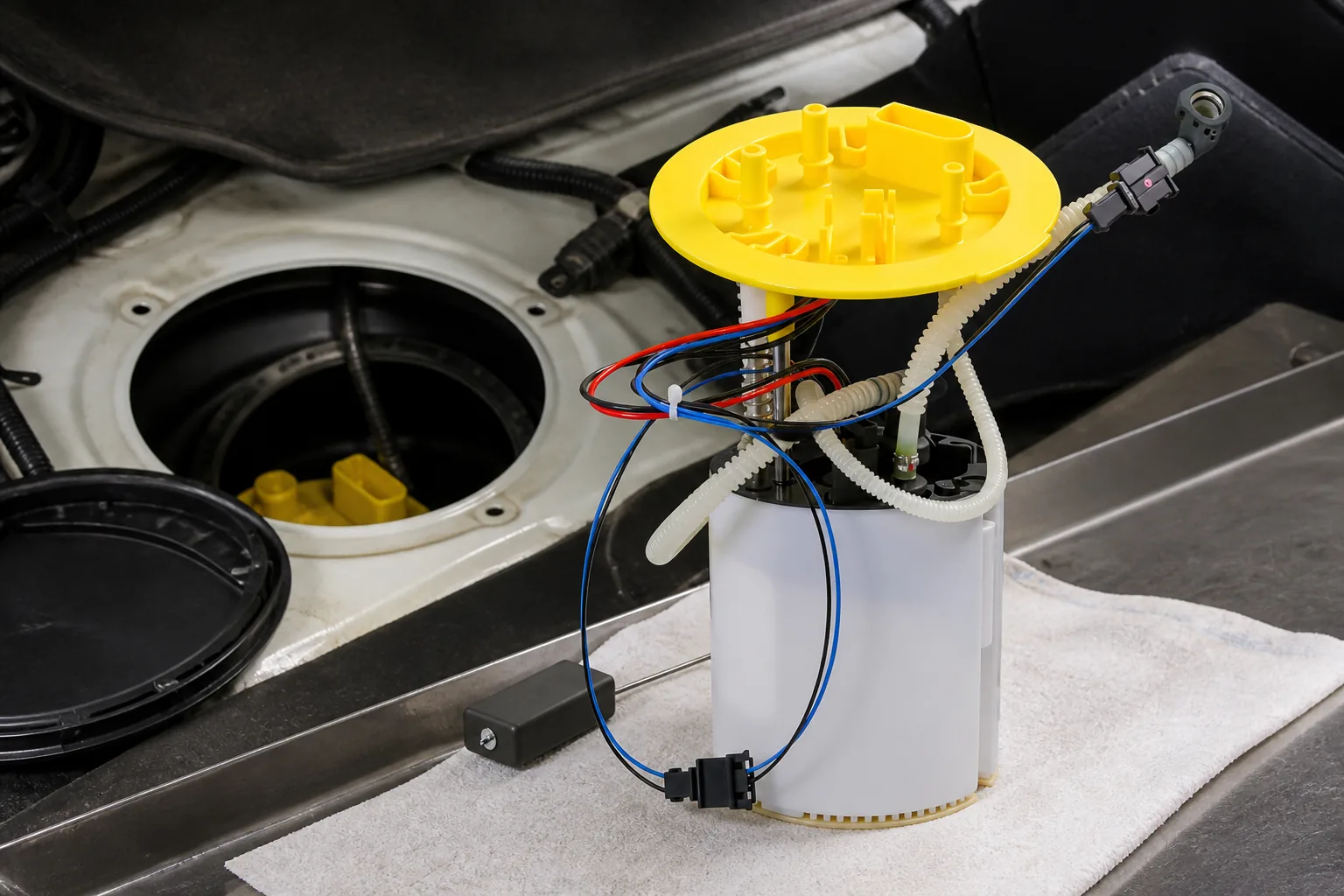
A fuel pump assembly is the complete in-tank module built around a flange cover and an electric pump in a reservoir—not a bare motor alone.
Supplier technipedia describes a fuel delivery module as the unit that lives in the fuel tank. It centers on a flange cover and a pump sitting in a reservoir (often called a swirl pot), then adds attachments such as the sender unit, filter, non-return valve, supply and return paths, and sometimes a suction jet pump or pressure regulator.
That is why catalogs also say fuel pump module, tank unit, or fuel delivery module. What is fuel pump assembly language and “module” language usually point to the same class of part: a sealed top flange plus the submerged hardware hanging into the tank.
The assembly sits inside the tank for more than packaging convenience. Fuel around the pump helps cool and lubricate the electric motor, and the submerged layout reduces fire risk compared with a dry, vapor-rich engine-bay mount for the same duty.
For architecture contrasts—internal tank modules versus external inline pumps—use the sister page on external fuel pump vs internal. This article stays on definition and composition.
What Does a Fuel Pump Assembly Include?
A typical assembly includes the pump core, flange, reservoir, strainer, float/sender, seals, and often check-valve or regulator attachments.
When readers ask what does a fuel pump assembly include, they want a parts map they can match to a photo or a packing list. Cutaway legends from supplier education name the same family of parts shops see on the bench: intake strainer, float, sender, reservoir, electrical connection, fuel ports, and suspension hardware that keeps the module seated.
| Component | What it does | Why buyers care |
|---|---|---|
| Electric pump core | Moves fuel under pressure toward the engine | The heart of delivery; fails when starved, dirty, or under-voltaged |
| Flange cover | Seals the tank opening; carries fuel and electrical ports | Leak path and orientation reference for the whole module |
| Reservoir / swirl pot | Keeps a local fuel volume around the pickup | Helps the pump stay fed in corners and at low tank level |
| Inlet strainer (sock) | Coarse pre-filter at the pump inlet | First debris barrier; clogs raise heat and dry-run risk |
| Fuel level sending unit + float | Converts fuel height into a gauge signal | Gauge faults often travel with the same housing as the pump |
| Seals / O-rings / lock hardware | Keep the flange vapor- and fuel-tight | Disturbed seals are a common post-service leak source |
| Check valve / non-return (when present) | Holds residual pressure after shutdown | Worn valves show up as long first cranks |
| Pressure regulator (when present) | Sets module or return-style pressure | On some returnless designs the regulator lives in the tank unit |
Not every application packages every attachment the same way. Some regulators sit on the rail; some tanks add suction jet pumps or dual-side transfer hardware.
The buyer still orders an “assembly” when the service unit is the flange-mounted module, not a loose motor. The inlet strainer is the first debris barrier; a packed sock can starve flow and push the pump toward dry-run heat.

How the In-Tank Module Keeps the Pump Fed and Cooled
The swirl-pot reservoir and surrounding fuel keep the pump pickup flooded and help cool the motor during normal driving.
Electric in-tank pumps rely on liquid fuel flowing through and around the motor. Independent repair education and supplier damage guides both treat fuel as coolant and lubricant. When the pickup pulls vapor or air instead of liquid, heat climbs quickly.
Modern modules usually place the pump inside a plastic cup or swirl pot. Community technicians describe that cup as staying full of fuel during normal driving so the motor stays wet even when the main tank level is lower. The cup tends to run dry only when the vehicle is nearly empty.
That design detail answers a common objection: “Why keep the pump in the tank at all?” Cooling, quieter operation, and a controlled pickup geometry are the engineering reasons—not an attempt to make the job harder for the bay.
From the field: Techs who doubt low-fuel myths still accept the cooling physics: once the pump sucks air, it overheats. Reservoir cups delay that moment; they do not repeal it when the tank is empty — source: community cooling discussion summarized from mechanics.stackexchange.com research extracts and AA1Car in-tank cooling notes.
Pressure targets are application-specific. Multiport systems often run tens of psi at the pump, while direct-injection architectures may use the in-tank unit as a supply pump ahead of a separate high-pressure pump on the engine. Those high-pressure diesel or GDI deep topics belong on their own pages—not here.
Fuel Pump Assembly vs Pump-Only Replacement
Choose a complete assembly when seals, strainer, and sender share the same age as the pump; pump-only only when the housing is verified good.
Independent module education frames the decision plainly. The strainer, check valve, regulator (when fitted), seals, and sending unit have lived in the same fuel, heat, and vibration as the motor. When one ages out, the others are often on a similar timeline.
Labor usually dominates the bill on in-tank jobs. Pulling the module twice to chase a leftover sender or seal fault is what makes the repair expensive.
| Choice | Best when | Watch-outs |
|---|---|---|
| Complete fuel pump assembly | High mileage or unknown tank history; sender or seals look tired; sock is packed | Higher parts cost; still must clean/inspect the tank |
| Pump-only insert | Housing, float travel, strainer, and seals verified good; failure was clearly the motor | Missed sock or sender faults return as “new pump” complaints |
| Housing reuse without inspection | Almost never for wholesale RMA discipline | Dirt left in the tank recreates the failure |

Flange Seals and Sender Orientation Buyers Should Not Ignore
Misaligned flange clocking can bind the float/sender and freeze or skew the fuel gauge.
Supplier use notes warn that modern tanks pack extra hardware inside the shell. If the module is installed on the wrong clocking, the fluid-level sensor can catch on those parts. The gauge then sits stuck even though fuel level is changing.
Many tanks and flange covers carry alignment marks for that reason. Buyers and counters should treat “orientation matters” as part of what an assembly is: the float arm geometry is designed for a specific installed angle.
This page does not walk depressurization, lock-ring tools, or prime cycles. Those steps live on how to install a fuel pump assembly. Electrical connector and harness details belong on the in-tank fuel pump wiring diagram sister—not here.
Important: Ordering the right assembly still fails the job if the float is bent by hand or the flange is clocked off the marks. Handle the sender gently; damped mechanisms can break when forced — source: https://www.ms-motorservice.com/int/en/technipedia/fault-diagnosis-electric-fuel-pumps
When Buyers Should Specify “Fuel Pump Assembly” Language
Use “assembly/module” when the order must include flange, sender, strainer, and seals as one tank unit.
Procurement wording prevents the wrong box from shipping. If the PO says only “fuel pump,” some channels ship a motor cartridge. If the bay needs the flange, float, sock, and seals, the PO should say fuel pump assembly or fuel pump module and list the vehicle or OE references the catalog requires.
That language also clarifies RFQ conversations with distributors. Ask whether the quoted unit includes the sending unit, strainer, and tank seal. Photos of a complete module—flange on top, reservoir and float below—are a faster check than a vague “pump” SKU title.
Document gauge readings and pressure checks before guessing the next SKU, the same discipline community technicians use when fuel-delivery faults look ambiguous. Treat gasoline fuel-system work with vapor and fire awareness when the module comes out of the tank.
Keep brand-equivalence claims out of the conversation. Site catalog scopes are vehicle- and OE-specific; they do not prove interchange with unrelated aftermarket lift systems or third-party brands.
Recommended Fuel Pump Assemblies and Modules to Browse
After terminology is clear, browse Kangsong fuel pump assemblies in the products catalog by vehicle/OE scope.
Start at the products-root catalog and filter for assembly or module titles that match the vehicle and OE references on the work order. A concrete example of a complete assembly listing is the Volkswagen-scoped unit at Fuel Pump Assembly / 1TD919051 / Volkswagen. Use the product title and OE fields as the fitment boundary—do not assume cross-platform adaptation without evidence.

When you are ready to install, move to the install-order sister rather than improvising from this definition page. When the question is architecture, use the external-vs-internal sister. When the question is harness layout, use the wiring-diagram sister.
FAQ
What is a fuel pump assembly?
It is the complete in-tank fuel delivery module: flange cover, electric pump in a reservoir, plus attachments such as sender, strainer, seals, and often check-valve or regulator hardware.
What does a fuel pump assembly include?
Typical contents are the pump core, flange, swirl-pot reservoir, inlet strainer, float and sending unit, seals, wiring and fuel ports, and—depending on the vehicle—check valve, suction jet pump, or pressure regulator parts.
Is a fuel pump assembly the same as just a fuel pump?
No. “Pump” can mean only the motor cartridge. An assembly/module is the full tank unit that also carries the flange, sender, strainer, and seals.
What does the float / sending unit do on the assembly?
The float arm and sender convert fuel height into the signal that drives the dash gauge. They usually share the same housing as the pump, so gauge faults often mean the module comes out anyway.
Why is the fuel pump assembly located inside the tank?
Fuel around the pump helps cool and lubricate the motor, quiets operation, and supports a controlled pickup geometry. Reservoir cups keep the pickup wet longer as tank level falls.
Do I always need to replace the complete fuel pump assembly?
Not always, but full assemblies are the better default when mileage is high or the sock, seals, and sender look aged. Pump-only makes sense only when those surrounding parts are verified good.
Can a misaligned flange cause a wrong fuel-gauge reading?
Yes. If the module is clocked incorrectly, the sender can bind on in-tank hardware and the gauge can stick or read wrong even when the pump still delivers fuel.